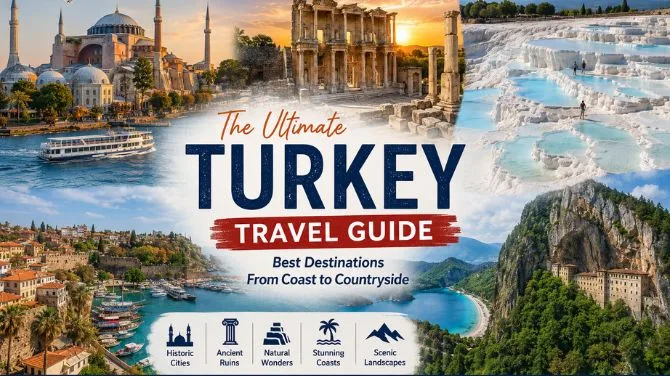
One day you're in a city that's been rebuilt by a dozen empires, the next you're on a beach that could pass for the Caribbean, and a day after that you're standing in front of ruins older than most religions. This guide leans into that variety — coast, countryside, and everything in between. And a quick heads-up before we get into it: sort your visa out early. If you're traveling from the Gulf, this Turkey visa for Bahrain residents page walks through exactly what's needed, so it's off your plate before you even start packing.
Istanbul — The City That Refuses to Pick a Side
Istanbul sits across two continents, and it wears that split well. The Hagia Sophia and Blue Mosque anchor the old city, but the real texture of the place is in the in-between moments — a tea seller balancing a tray through traffic, ferries crisscrossing the Bosphorus at rush hour, the smell of roasting chestnuts in winter. Give yourself at least three days here before heading anywhere else; it rewards slow mornings and long walks more than a checklist.
Ephesus — Walking Through the Roman Empire
Most ruins ask you to imagine what used to be there. Ephesus doesn't — the marble streets, the Library of Celsus façade, the massive amphitheater are all still standing, still walkable. It's one of the best-preserved ancient cities anywhere in the Mediterranean, and it's easy to lose an entire afternoon here without noticing the time pass.
Pamukkale — Turkey's Strangest Natural Landmark
Nothing about Pamukkale looks like it should be real. White mineral terraces cascade down a hillside, filled with warm thermal water that's been forming these pools for thousands of years. Right above it sits Hierapolis, an old Roman spa town, so you get geology and history in the same afternoon.
Antalya — The Coastal Break You Didn't Know You Needed
After a few days of ruins and mosques, Antalya is a nice reset. The old town of Kaleiçi is all narrow lanes and converted Ottoman houses, and the harbor is genuinely worth just sitting near for an hour with a coffee. It's also the jumping-off point for some of the best beaches on Turkey's southern coast.
By now you've covered a good stretch of ground — Istanbul, Ephesus, Pamukkale, Antalya — and if you're planning the trip in stages, it's worth locking down your paperwork before you get further along. The same Turkey visa for Bahrain residents guide covers eligibility and processing timelines, so you're not dealing with it mid-itinerary.
Fethiye and Ölüdeniz — The Turquoise Coast at Its Best
If Antalya is the coastal warm-up, Fethiye is the main event. The Blue Lagoon at Ölüdeniz is one of those views that photos genuinely undersell — turquoise water pinned between green hills, calm enough to swim in for hours. Paragliders drift overhead from the Babadağ mountain, and the town itself has a relaxed, unhurried pace that's a good contrast to Istanbul's energy.
Trabzon and the Black Sea Coast
This is the part of Turkey most first-time visitors skip, and honestly, that's their loss. The Black Sea coast is green, misty, and mountainous in a way that doesn't match most people's mental image of Turkey at all. Sumela Monastery, built into a cliff face outside Trabzon, is worth the drive alone, and the nearby Uzungöl lake area feels more like the Alps than the Mediterranean.
Final Thoughts
Turkey rewards travelers who don't try to see it all in one go. Pick a region — coastal, historical, or a mix — and let yourself move slowly through it. Whichever route you choose, don't leave the visa process as an afterthought. Reliable Online Visa Services can handle that part quietly in the background while you focus on the actual planning — the food, the routes, the places you'll want to linger a little longer than expected.