For example, an employee may submit a complaint or a compliance audit may reveal several issues. Additionally, turnover might increase without anyone noticing. This is when the management might start wondering,
How did this happen?
Well, the harsh reality is that ineffective HR Policy Development is largely an overlooked risk factor in organizations and this is even more so in highly regulated environments like Saudi Arabia.
The Problem
Weak, outdated, or unclear HR policies can cause confusion, inconsistency, and may also lead to legal exposures.
The Agitation
Check how
- different managers apply the rules inconsistently
- employees become disengaged
- you face growing compliance challenges
- employees continue to leave even though their exit motivates a management action
The Solution
One that is tactical and easy to follow an HR policy system that is in harmony with business objectives, local labor laws, and employee needs.
Here you will learn the hidden cost of HR mismanagement and most importantly how to set it right with the system that truly delivers.
What is HR Policy Development (And Why It Matters More Than You Think)
HR Policy Development at its essence refers to the creation of a set of organized rules that dictate how employees are handled in an institution.
However, this is where the majority of companies fail :
They merely see HR policies as written records. Actually, they are systems of decision-making.
Here are 3 ways a solid HR policy framework helps :
- It helps you stay on the right side of Saudi labor laws
- It makes that decisions get made the same way, no matter the department
- It contributes to building the vibe and trust in the organization
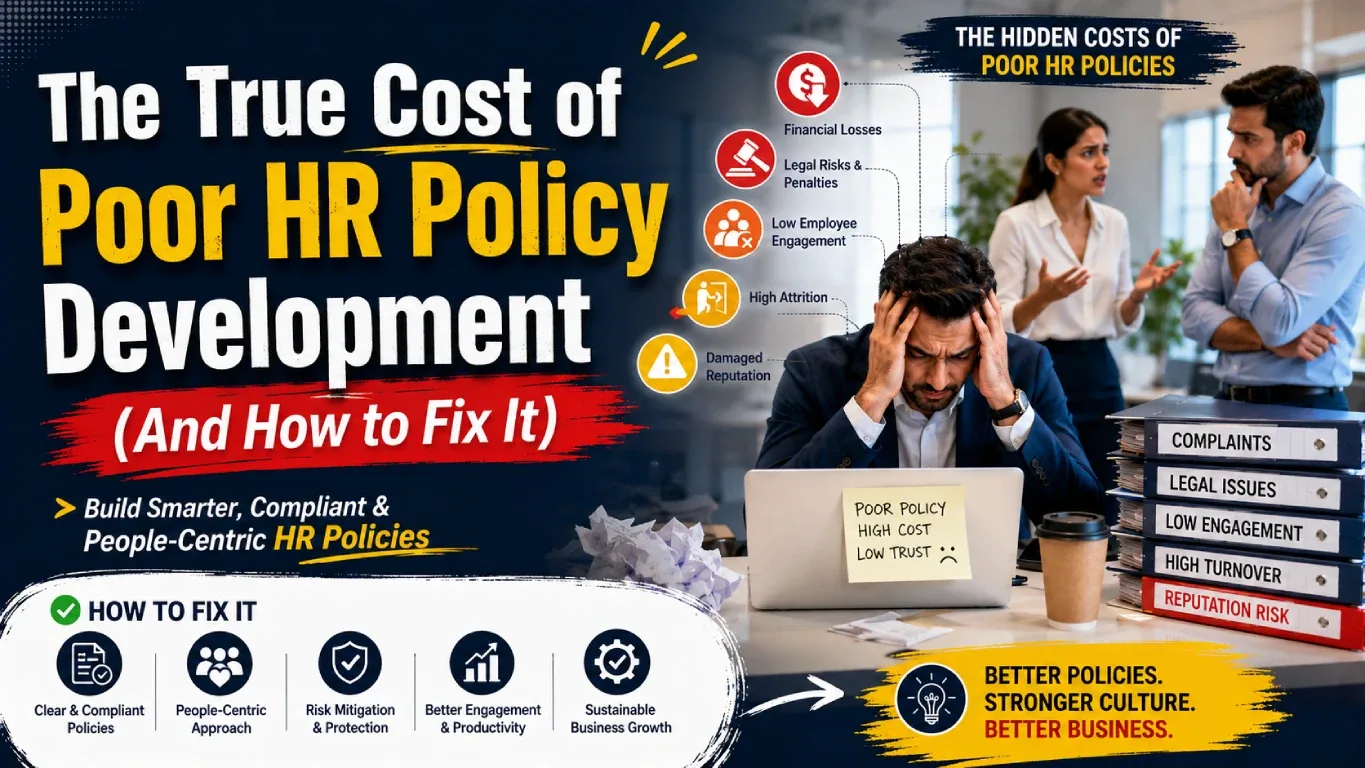
The Hidden Costs of Poor HR Policy Development
We should move past theory alone. Poor policies do not only cause inconvenience, but also lead to direct losses of money, time, and reputation.
1. Compliance Risks & Legal Penalties
Labor laws in Saudi Arabia are very strict, and their enforcement is becoming more and more rigorous.
Inadequately developed HR policies may result in the following :
- Non-compliance with the Saudi Labor Law
- Receiving fines and penalties
- Having legal conflicts with employees
For example :
If a company lacks a well-communicated termination policy, it may be exposed to claims of wrongful dismissal.
Cost Impact : Legal expenses + penalties + reputation damage
2. Inconsistent Decision Making
Unclear policies inevitably force employees to make up their rules.
Such a situation results in :
- Accusations of favoritism
- Disgruntled workforce
- Discord Among the staff
Reality Check : Two employees are caught red-handed but one is punished while the other is not.
Cost Impact : Loss of trust + toxic workplace culture
3. High Employee Turnover
Employees aren’t departing a business, they are leaving fuzzy systems and unfair treatments.
Bad HR policies typically cause :
- No clear idea of what the roles and expectations are
- The grievance handling system is so weak that it’s almost non-existent
- No structured performance management
Cost Impact :
Re-hiring a replaced employee might cost you from 50 to 200% of that person’s salary.
4. Operational Inefficiency
When policies are not clearly defined :
- Human resource departments spend an excessive amount of time on conflict resolution
- Decision-making by managers consumes time that could be spent on other activities
- Operations react to situations only as they happen, rather than being able to anticipate and prepare for them
Financial Consequences : Lack of efficiency leading to a drop in whole company productivity
5. Harm to Employer Brand
Reputation is a critical factor in the fiercely competitive job market of Saudi Arabia nowadays.
Some adverse outcomes of wrong policies include :
- Employees leaving disgruntled reviews
- Unable to attract highly skilled employees
- Fading employer brand
Cost Effect : Increase in recruiting expenses + decrease in employee capability.
Why HR Policy Development is Critical in Saudi Arabia
The labor market in Saudi Arabia is undergoing a major transformation as the country moves forward with its Vision 2030.
Some of the Main Challenges Business Are Facing
- Employment localization (meeting Saudization requirements)
- Continuous changes in labor law compliance
- Working with a multi-cultural team (expatriates and locals)
- Meeting ever-evolving employee demands
One size fits all HR policy is definitely not the solution here.
Your Policies Must Be
- Locally compliant (registered with Saudi Labor Law)
- Human- and culturally sensitive
- Able to support business growth
- Supporting business strategy
How to Fix Poor HR Policy Development (Step-by-Step Framework)
Let’s move from dissecting the problem to exploring the solution.
Step 1: Check Your HR Policies
The first thing to do is figure out where the weaknesses are.
Audit Checklist :
- Do policies match with Saudi labor laws?
- Have they been updated in the last year?
- Are they well communicated to the employees?
- Is there a uniform application of the policies by the managers?
Pro Tip :
Do this exercise as if you were assessing risks, not just updating papers.
Step 2 : Align Policies with Business Strategy
Make sure that your HR policies are aligned with your business strategy.
Example :
- Growing business will want more space to hire and will performance policies will be more flexible
- Industry that is concerned with compliance will have strict governance framework
Main thought :
HR Policy Development isn’t HR work, it’s a business strategy.
Step 3 : Build a Structured Policy Framework
Do not just have scattered documents; have a centralized system for them.
Essential Categories of HR Policies
- Hiring and employee orientation
- Salary and perks
- Absences and timekeeping
- Behavioral standards
- Appraisal and feedback
- Sanctioning and warning
- Separation and resignation
Step 4 : Make Sure Legal Compliance Is Met (Emphasis on KSA)
This cannot be compromised in any way.
The policies have to be in line with :
- Saudi Labor Law
- GOSI regulations
- Requirements of Saudization
Pro Tip : Hire HR consultants who have deep knowledge of Saudi regulatory environments.
Step 5 : Make Policies Simple & Usable
If employees can’t understand policies—they won’t follow them.
Best Practices:
- Use clear, simple language
- Avoid legal jargon
- Provide real-life examples
- Create a user-friendly employee handbook
Step 6 : Train Managers (The Most Overlooked Step)
Without appropriate implementation even the best policies are almost doomed.
Managers are expected to :
- grasp the meaning of policies
- use them in a consistent manner
- manage employee issues with fairness
Fact :
Most policy failures are a matter of failure to carry them out.
Step 7 : Track, Analyze & Refresh on a Regular Basis
Human resource policies can change over time.
Review Periodicity
- At least once a year
- When there are significant legislative modifications
- In case of corporate restructuring
Helpful Tips from HR Specialists (Saudi Market)
Avoid Just Copy-Pasting PoliciesIt is entirely possible that something that works in the UK or UAE will not work in Saudi Arabia.
Incorporate TechnologyHave a look at HR software allowing you to automate the workflow of policy implementation.
Give More Importance to Employee ExperiencePolicies must direct employees rather than put them under restriction.
Tie Policies to CultureYour policies are a reflection of how your company acts.
FAQ’s1. What is HR policy development?
It is the structured process of designing workplace rules and guidelines that ensure compliance, consistency, and operational efficiency.
2. Why is it critical in Saudi Arabia?
Due to strict labor laws, workforce diversity, and evolving regulations under Vision 2030.
3. How often should HR policies be updated?
At least once a year or whenever legal or organizational changes occur.
4. Can small businesses benefit from HR policies?
Absolutely. In fact, small businesses face higher risks without structured policies.
Final Thoughts Fix It Before It Costs You
Here’s the bottom line :
Poor HR Policy Development is not just an HR issue it’s a business risk.
It affects :
- Compliance
- Profitability
- Employee retention
- Brand reputation
The companies winning in Saudi Arabia today are not the ones with the most policies.They’re the ones with the right policies, implemented the right way.