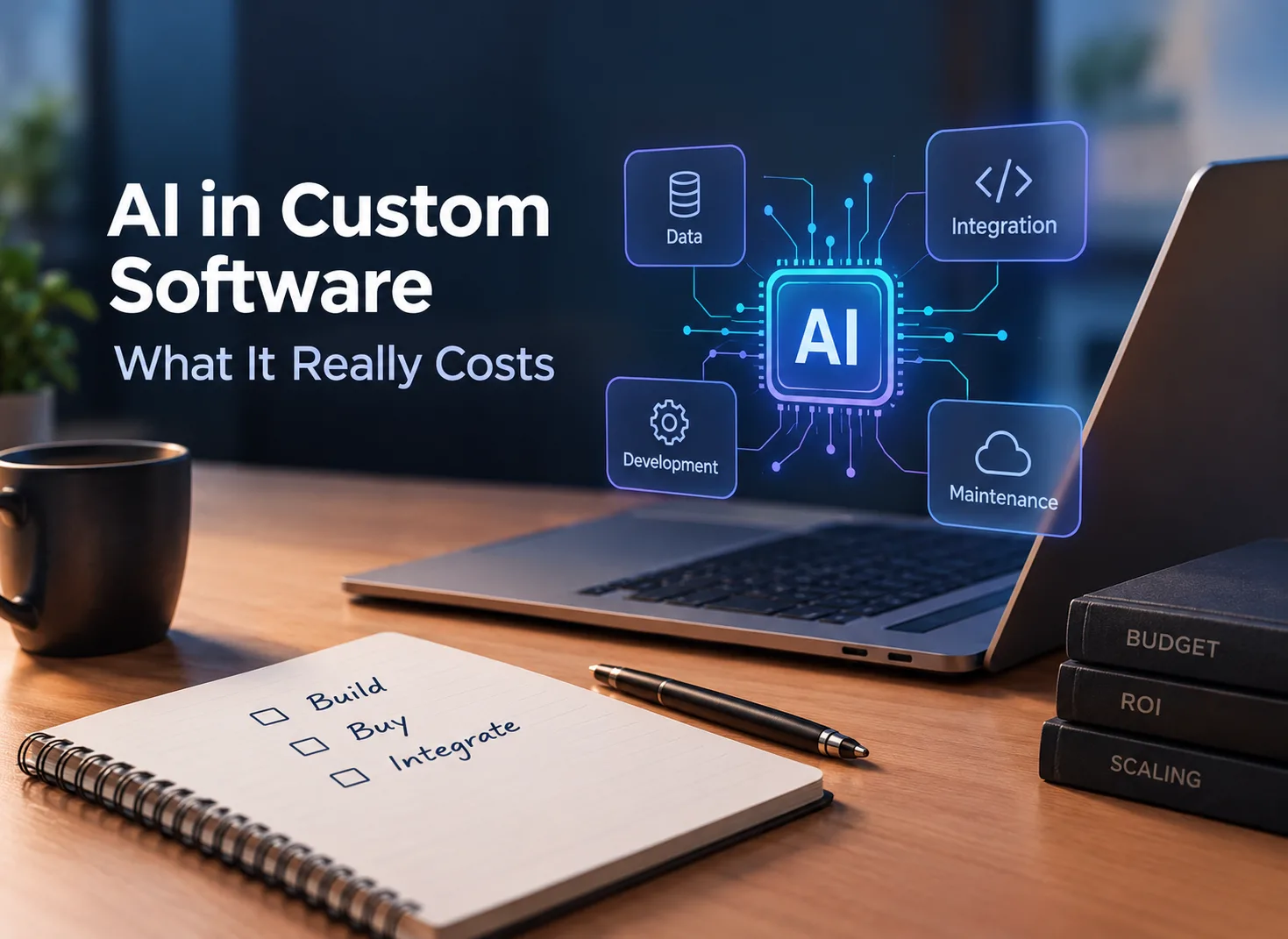
Ask three vendors what it costs to add AI to your software and you will get three wildly different numbers. One quotes a few weeks of work. Another quotes a few months. A third declines to quote until they see your data. All three can be honest, because the price of AI in custom software development depends less on the AI itself than on everything surrounding it.
This article is a buyer’s reality check. If you already understand what AI can do for a business, the next question is what it takes to get there without surprises. Here is how to think about build, buy, and integrate decisions, where budgets actually go, and how to tell whether the investment paid off.
AI Is a Feature Until It Becomes Infrastructure
Many projects begin with a modest idea: add a smart search bar, a recommendation row, or a support assistant. Treated as a feature, the work looks small. A model is chosen, an interface is built, and the team moves on.
But AI-powered custom software behaves differently from ordinary features. A normal feature does the same thing every time. An AI feature produces outputs that vary with the data it sees, which means it needs monitoring, evaluation, and occasional correction long after launch. Once it touches real customer decisions, it stops being a feature and becomes infrastructure that the business depends on.
If you want a broader view of how AI supports each stage of the build, from planning and coding to testing and maintenance, this guide on AI in custom software development covers the practical landscape. What follows focuses on a different question: how to budget and decide.
The Three Paths: Buy, Build, or Integrate
Almost every AI initiative falls into one of three approaches, and choosing the wrong one is the most expensive mistake available.
Buy a ready-made tool. Subscription products for transcription, basic chat, or analytics can be live in days. They are cheap to try and easy to abandon. The limits appear when your workflow is unusual, your data is sensitive, or you need the AI woven into your own product rather than sitting beside it.
Build from scratch. Training your own model makes sense in narrow cases, such as when you hold a large proprietary dataset that no general model has seen, or when a regulation demands full control. For most businesses it is slow, costly, and unnecessary.
Integrate existing models into custom software. This is the middle path and the most common sweet spot. You use a proven model as a building block, then add your own data, business rules, interface, and safeguards on top. The result fits your needs without reinventing the underlying technology.
A good test: if the AI is a commodity capability, buy. If it is your competitive edge, build around it. If it needs to live inside your existing systems, integrate. This is exactly where an experienced integration partner earns its fee, because connecting models to your CRM, database, and workflows is rarely trivial.
Where the Budget Actually Goes
Founders often assume most of the cost sits in the model. In practice, the model is frequently the cheapest line item. Here is a more realistic breakdown of where effort lands:
- Data preparation. Cleaning, labelling, and organizing records is routinely the largest and least visible cost. Messy data inflates every other phase.
- Integration engineering. Connecting the AI to authentication, existing databases, third-party tools, and internal workflows.
- Interface and experience design. Deciding how outputs are shown, how users correct mistakes, and how uncertainty is communicated.
- Testing and evaluation. Building test sets that reflect real situations, not just happy paths.
- Security and compliance. Access controls, audit logs, and privacy handling, especially where personal data is involved.
- Ongoing operation. Usage-based model fees, hosting, monitoring, and retraining.
That last item surprises people most. Many AI services charge by usage, so a feature that is cheap during testing can become a significant monthly cost once thousands of users rely on it. Ask any vendor to model your costs at ten times your expected volume before you commit.
The Pilot That Tells You the Truth
A well-designed pilot saves more money than any negotiating tactic. The trick is making it small enough to be cheap and real enough to be honest.
Choose one use case with a measurable outcome, such as reducing average support handling time or cutting manual data entry for one document type. Use real data, not a polished sample. Involve the people who will use it daily, because they will find the gaps first.
Before you start, write down the number that would make you continue and the number that would make you stop. Without that, pilots drift into endless “promising” territory. Teams that begin with a fast MVP of one narrow AI feature tend to learn what their data can and cannot do within weeks, which is far cheaper than discovering it after a full build.
Measuring Return Without Fooling Yourself
AI projects invite optimistic accounting. The tool saved time, but did anyone use that time for something valuable? The chatbot deflected tickets, but did customers actually get their answers?
Track outcomes rather than activity. Useful measures include:
- Time or cost per task before and after, measured the same way both times
- Error rate, including errors the AI introduced
- Adoption, meaning how many eligible users choose to use the feature
- Escalation rate, which shows how often a human has to step in
- Business impact, such as retention, conversion, or processing capacity
Be especially honest about adoption. A technically excellent feature that staff quietly avoid delivers nothing. Low adoption is usually a design or trust problem, not a model problem, and it is fixable once you notice it.
Drift: The Cost That Arrives Quietly
Traditional software that works today will usually work next year. AI features can degrade without any code changing. Customer behavior shifts, products change, language evolves, and a model trained on last year’s patterns slowly becomes less accurate. This is often called drift.
Plan for it from the start. Schedule regular reviews of accuracy against real outcomes. Keep a sample of recent cases that humans check. Define a threshold that triggers retraining or adjustment. Assign someone to own this, because a task owned by everyone is performed by no one.
Teams that skip this step often conclude, wrongly, that “AI does not work for us,” when in fact it worked well for six months and then nobody tended it.
Questions That Reveal a Good Development Partner
When you talk to potential partners, the quality of their questions matters more than the polish of their slides. Look for a team that asks about:
- The specific decision or task the AI will support
- The state, volume, and ownership of your data
- What should happen when the AI is unsure or wrong
- Who will use it and how you will train them
- How success will be measured after launch
Then ask your own: How will you test accuracy? What does ongoing monitoring look like? Who owns the code, the trained components, and the data? What are the usage costs at scale? A partner who answers plainly, including admitting what AI cannot do, is worth far more than one who promises guaranteed results.
A Simple Decision Checklist
Before you approve any AI initiative, check that you can answer yes to most of these:
- Can we state the problem in one measurable sentence?
- Have we reviewed our data for quality, volume, and permission to use it?
- Have we chosen between buying, building, and integrating, with reasons?
- Have we estimated costs at real-world volume?
- Is there a named owner for the feature after launch?
- Do we know what success and failure look like in numbers?
If several answers are no, that is not a reason to stop. It is a map of what to fix first, and fixing it before development is dramatically cheaper than fixing it after.
Final Thoughts
The businesses that get lasting value from AI are rarely the ones with the biggest budgets or the most advanced models. They are the ones that treat AI as a long-term capability rather than a one-time purchase, plan for the unglamorous work of data and maintenance, and measure results honestly.
If you are weighing a project of your own, Mind Roots offers AI software development services that cover the full journey, from scoping and data review to integration, deployment, and ongoing improvement.