Not every cooling requirement calls for the largest, most complex system available.
In commercial buildings, hotels, hospitals, and mid-size process facilities, the decision is rarely about maximum capacity. It is about finding a system that delivers consistent, efficient performance across varying load conditions, fits within the available space and infrastructure, and does not create operational complexity that the facility team cannot manage.
This is the environment where scroll chillers consistently prove their value.
What Makes Scroll Chillers Different
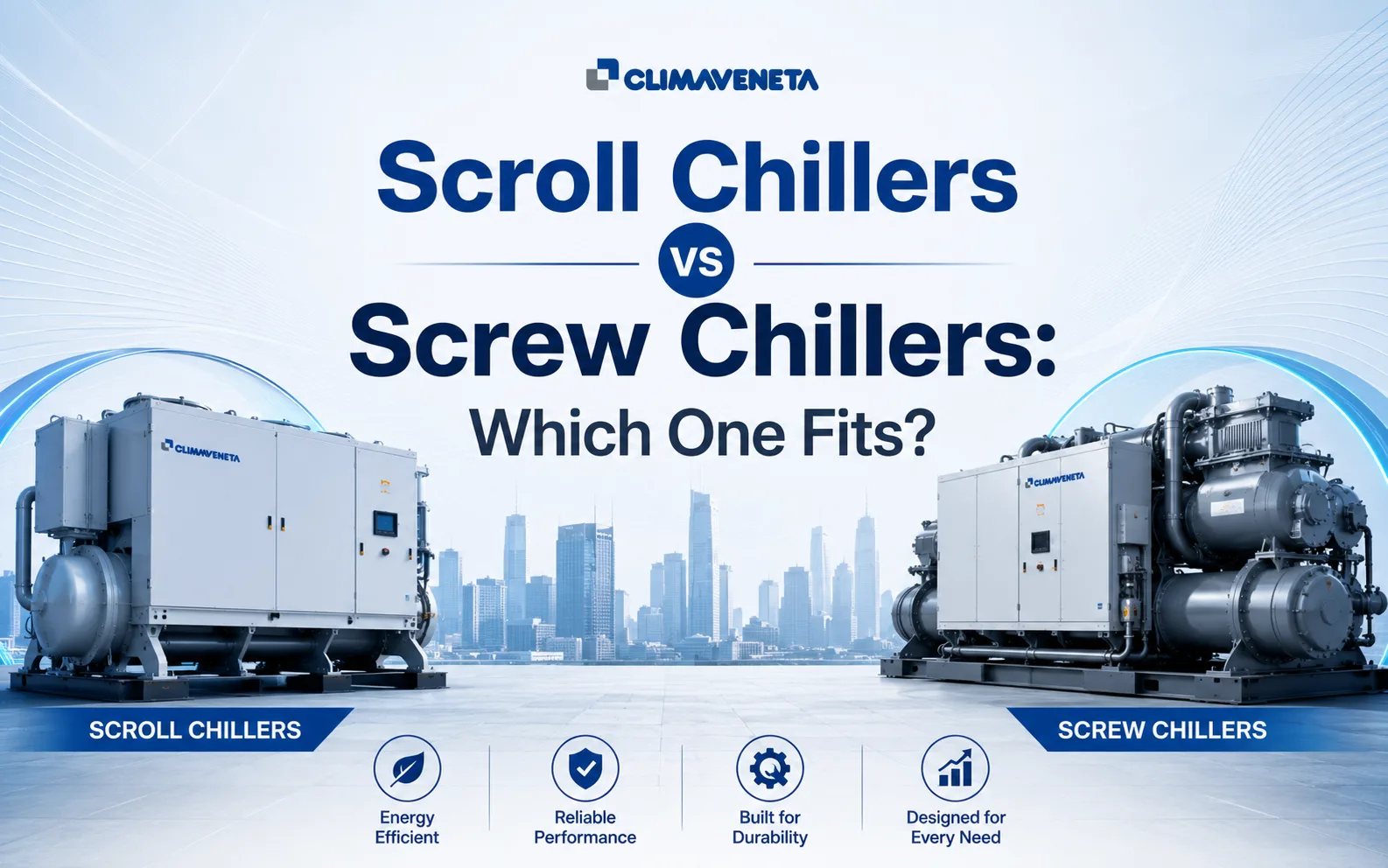
A scroll chiller uses scroll compressors — a technology where two interleaving spiral elements compress refrigerant through a continuous orbital motion. Unlike screw chillers, which use twin helical rotors and are typically engineered for higher capacity, continuous industrial loads, scroll compressors are optimised for efficiency across a wider range of operating conditions and load profiles.
The result is a system that performs well not just at full load, but across the partial load conditions that define how most commercial facilities actually operate throughout the year.
Where Scroll Chillers Deliver Their Strongest Value
Commercial Buildings and Offices
Office buildings, IT parks, and commercial complexes operate with cooling loads that fluctuate significantly across the day and across seasons. A system that can match output closely to demand, rather than running at fixed capacity, directly impacts energy consumption.
Scroll chillers handle variable load profiles efficiently, making them a practical and cost-effective choice for facilities where full load operation represents only a fraction of annual operating hours.
Hotels and Hospitality
Hotels have diverse, simultaneous cooling demands across guest rooms, common areas, restaurants, and back-of-house operations. Scroll chillers offer the flexibility and quiet operation that hospitality environments require, without the infrastructure complexity that larger screw chiller systems typically involve.
Low noise emission is a meaningful operational advantage in settings where guest experience is tied directly to ambient comfort.
Hospitals and Healthcare Facilities
Healthcare environments require reliable, consistent cooling without disruption. Scroll chillers, with their relatively simple mechanical design and low vibration profile, suit clinical and administrative spaces where operational continuity and acoustic comfort are both important.
Mid-Size Process Applications
For process cooling applications that fall within the small to mid-capacity range, scroll chillers offer precise temperature control and reliable performance without the overhead of larger industrial systems.
Scroll Chillers vs Screw Chillers: Understanding the Difference
The comparison between scroll chillers and screw chillers comes up regularly in system selection conversations, and the answer is rarely straightforward.
Screw chillers are designed for high capacity, continuous load applications. Their twin rotor compressor design performs well at large scale, sustained cooling demands typical of industrial processes, large data centers, or central plant configurations serving multiple buildings simultaneously.
Scroll chillers are optimised for small to mid-capacity applications where load variability is higher and where installation simplicity, acoustic performance, and part-load efficiency are priorities.
Choosing between the two is not about which compressor technology is superior. It is about matching the system to the actual operating profile of the facility.
A scroll chiller installed in an environment that exceeds its capacity range will underperform. A screw chiller installed in a mid-size commercial application adds cost and complexity that the application does not justify.
The right answer sits in the application, not in the specification alone.
The Refrigerant Question
Modern scroll chillers are increasingly available with low GWP refrigerant options, addressing the growing regulatory and sustainability pressure on conventional refrigerants.
Systems running on R454B, for example, offer a significantly reduced environmental impact compared to R410A, without compromising on performance. For facilities navigating refrigerant compliance requirements or sustainability targets, this availability makes scroll chillers a forward-looking choice as well as a practical one.
Installation and Integration
One of the practical advantages of scroll chillers in commercial applications is installation simplicity. With all main hydraulic and mechanical components integrated within the unit, modern scroll chiller ranges offer plug and play installation that reduces commissioning time and simplifies integration into existing HVAC plants.
This matters in retrofit situations, where minimising disruption to ongoing operations is as important as the performance of the system itself.
Conclusion
Scroll chillers occupy an important space in the commercial cooling landscape — not because they are the most powerful option available, but because they are the right option for a wide range of applications where efficiency, acoustic performance, installation simplicity, and load flexibility matter more than raw capacity.
Understanding where scroll chillers fit, and where screw chillers are the more appropriate choice, is what separates a well-designed cooling strategy from one that simply meets the specification on paper.
For facilities operating in the commercial, hospitality, healthcare, or mid-size process space, scroll chillers deserve serious consideration as part of any system selection process.
This is exactly the kind of application-specific engineering thinking that chiller manufacturers like Climaveneta India bring to scroll chiller solutions across commercial and industrial environments in India.