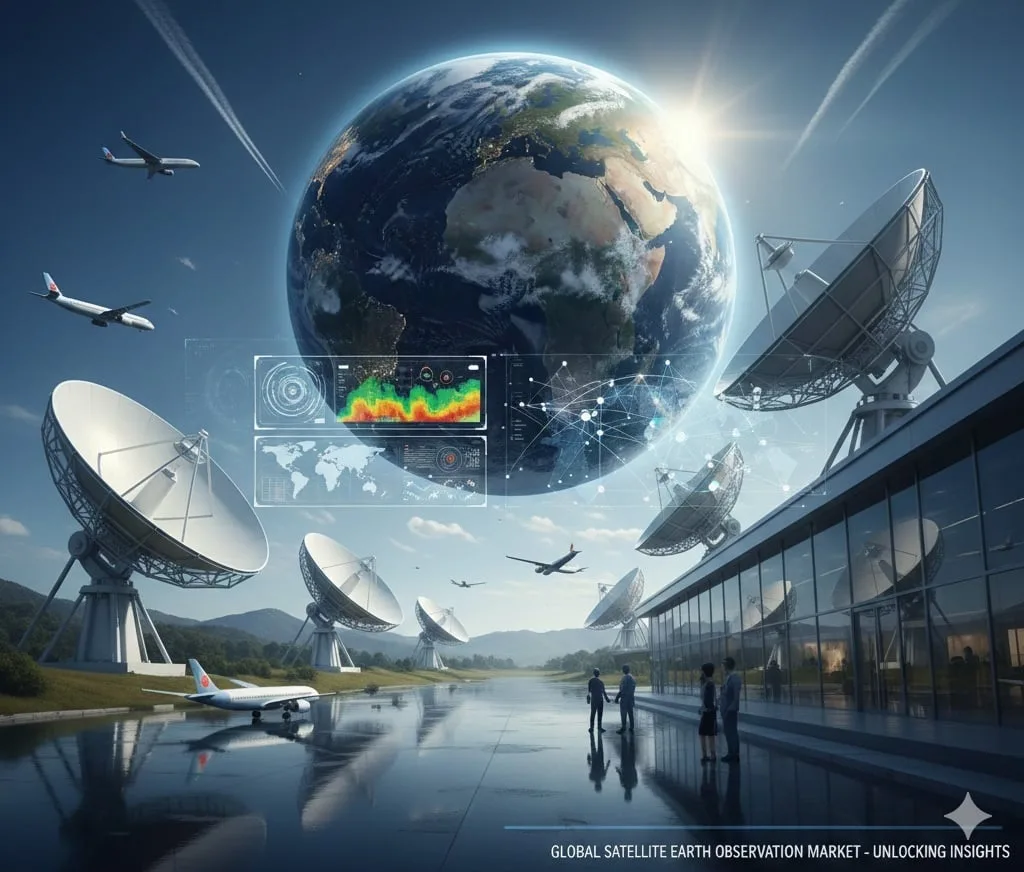
The satellite Earth observation market is entering a new phase of commercial and strategic importance. Governments, defense agencies, insurers, agricultural firms, and infrastructure operators increasingly rely on satellite-derived intelligence for real-time decision-making.
According to BIS Research, The satellite Earth observation market is projected to reach $15,903.0 Million by 2032 from $7,705.9 Million in 2021, growing at a CAGR of 6.92% during the forecast period 2022-2032.
Growth across the broader earth observation satellite industry is being driven by lower launch costs, rising climate-monitoring needs, and rapid advances in analytics. Commercial operators are also expanding access to high-frequency imagery and geospatial data services for enterprise users.
Key Drivers in the Satellite Earth Observation Market
Climate and environmental monitoring remain major demand drivers. Governments require persistent monitoring for wildfire detection, emissions tracking, flood mapping, and biodiversity management. Satellite-based systems can deliver wide-area coverage far more efficiently than terrestrial networks.
Defense modernization is another critical factor. Countries increasingly view satellite intelligence solutions as strategic infrastructure for border surveillance, maritime awareness, and tactical reconnaissance. Recent geopolitical tensions have accelerated investment in sovereign Earth observation capabilities globally.
Commercial adoption is expanding as well. Agriculture companies use remote sensing for crop health analysis and irrigation planning, while insurers rely on geospatial datasets for catastrophe assessment. Infrastructure operators are integrating satellite monitoring services into asset inspection workflows for pipelines, rail corridors, and energy facilities.
Artificial intelligence is further increasing the operational value of Earth observation technologies. AI-driven processing enables automated object detection, anomaly identification, and predictive analysis across enormous image datasets. Research institutions note that machine learning is becoming central to the transition from raw imagery to actionable intelligence.
Request An Updated Sample for Satellite Earth Observation Market - Focus on End User, Application, Services, Manufacturing, Technology, Altitude, and Country - Analysis and Forecast, 2022-2032
Key Trends in Satellite Earth Observation Market
Small satellite constellations are reshaping the economics of Earth observation. Operators can now deploy fleets of lower-cost satellites that provide higher revisit rates and near real-time imaging coverage. This trend is improving accessibility for commercial users while reducing dependency on large government-owned systems.
Another important trend is the convergence of optical and SAR imaging. Optical systems provide high-resolution visual imagery, while SAR delivers all-weather, day-and-night observation capabilities. Several emerging companies are combining both technologies into integrated platforms to improve reliability and responsiveness.
The future of the earth observation market will also be shaped by downstream analytics rather than hardware alone. Investors increasingly focus on companies that can convert imagery into operational insights for logistics, climate risk, defense, and financial services.
Challenges & Opportunities
Despite strong momentum, the market faces operational and regulatory challenges. Space debris is becoming a growing concern for low Earth orbit missions, increasing maneuvering costs and shortening satellite lifespans.
Data standardization also remains fragmented across commercial providers. Differences in resolution, processing methods, and licensing structures can limit interoperability for enterprise customers.
At the same time, opportunities remain substantial. Demand for persistent monitoring, AI-enabled analytics, and sovereign geospatial infrastructure is expected to rise steadily over the next decade. Emerging markets are also investing more aggressively in national space programs and private Earth observation ecosystems.
Conclusion
The satellite Earth observation market is evolving from a niche aerospace segment into a critical layer of global digital infrastructure. Advances in analytics, sensor fusion, and satellite deployment models are expanding both commercial and government applications.
As Earth observation capabilities become more integrated with AI and real-time decision systems, the sector is likely to attract sustained investment interest. Companies that combine scalable data acquisition with advanced analytics will be best positioned to capture long-term market value.
Trending FAQs in the Market
What is the satellite Earth observation market?
It refers to the global industry focused on collecting and analyzing Earth data using satellites for applications such as defense, agriculture, climate monitoring, and infrastructure management.
What is driving growth in the Earth observation market?
Key drivers include climate monitoring demand, defense modernization, AI-powered analytics, and increased adoption of commercial satellite services.
What are satellite intelligence solutions?
These are analytics platforms and imaging systems that transform satellite data into actionable insights for governments, enterprises, and security agencies.
Why is SAR technology important in Earth observation?
Synthetic Aperture Radar (SAR) enables imaging during cloud cover and nighttime conditions, making it essential for continuous monitoring applications.