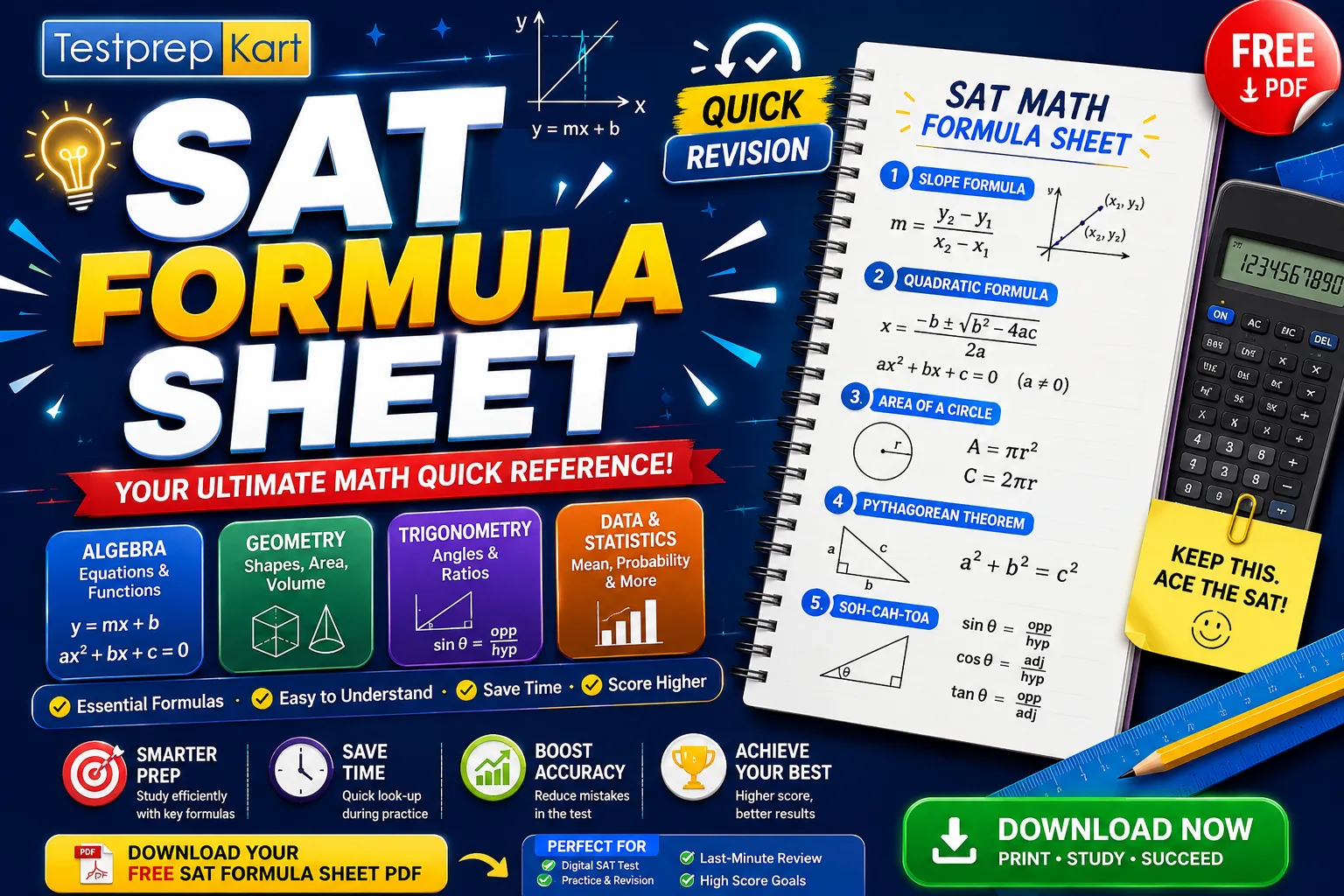
SAT Math preparation becomes much easier when students have the most important equations arranged in one place. Instead of searching through notebooks, textbooks, and old practice tests, students can use an SAT formula sheet to review key concepts before solving questions.
A formula sheet is not meant to replace regular practice. Its main purpose is to help students recall important rules quickly, recognize the right method for a question, and reduce avoidable calculation mistakes.
Why an SAT Formula Sheet Is Useful
Digital SAT Math covers concepts from algebra, advanced math, problem-solving, data analysis, geometry, and trigonometry. Students often understand these topics but lose time because they cannot immediately remember a formula or identify which equation applies.
A clear formula guide can help students review:
- Linear equations and slope
- Quadratic equations
- Exponent rules
- Percent change
- Geometry measurements
- Circle formulas
- Volume formulas
- Probability and averages
- Right triangles and trigonometry
Keeping these formulas together makes revision more organized, especially during the final weeks before the test.
Important Algebra Formulas
Algebra questions may appear through graphs, tables, equations, and real-world situations.
The slope formula is:
m=y2−y1x2−x1m=\frac{y_2-y_1}{x_2-x_1}m=x2−x1y2−y1
The slope-intercept form of a line is:
y=mx+by=mx+by=mx+b
In this equation, mmm represents the slope and bbb represents the y-intercept.
Students should also understand that parallel lines have the same slope, while perpendicular lines have slopes that are negative reciprocals.
For example, if one line has a slope of:
34\frac{3}{4}43
a perpendicular line has a slope of:
−43-\frac{4}{3}−34
Quadratic Equations and Advanced Math
Quadratic questions may require students to find roots, identify a vertex, factor an expression, or interpret a graph.
The quadratic formula is:
x=−b±b2−4ac2ax=\frac{-b\pm\sqrt{b^2-4ac}}{2a}x=2a−b±b2−4ac
The vertex form of a quadratic equation is:
y=a(x−h)2+ky=a(x-h)^2+ky=a(x−h)2+k
The vertex is represented by (h,k)(h,k)(h,k).
Students should also review the difference-of-squares identity:
a2−b2=(a−b)(a+b)a^2-b^2=(a-b)(a+b)a2−b2=(a−b)(a+b)
Recognizing this pattern can save time when factoring expressions.
Geometry Formulas for SAT Math
Geometry formulas are easier to remember when students organize them by shape.
The area of a triangle is:
A=12bhA=\frac{1}{2}bhA=21bh
The area of a circle is:
A=πr2A=\pi r^2A=πr2
The circumference of a circle is:
C=2πrC=2\pi rC=2πr
The volume of a rectangular prism is:
V=lwhV=lwhV=lwh
The volume of a cylinder is:
V=πr2hV=\pi r^2hV=πr2h
A frequent mistake is using the diameter instead of the radius in a circle formula. Students should carefully identify what measurement is provided before substituting values.
Right Triangles and Trigonometry
The Pythagorean theorem is one of the most frequently used geometric relationships:
a2+b2=c2a^2+b^2=c^2a2+b2=c2
The side ccc must be the hypotenuse.
Students should also review these trigonometric ratios:
sinθ=oppositehypotenuse\sin\theta=\frac{\text{opposite}}{\text{hypotenuse}}sinθ=hypotenuseopposite cosθ=adjacenthypotenuse\cos\theta=\frac{\text{adjacent}}{\text{hypotenuse}}cosθ=hypotenuseadjacent tanθ=oppositeadjacent\tan\theta=\frac{\text{opposite}}{\text{adjacent}}tanθ=adjacentopposite
The memory aid SOH-CAH-TOA can help students recall these relationships.
Percentages and Data Analysis
Percent questions may involve discounts, population changes, interest, growth, or survey data.
The percent-change formula is:
Percent change=new value−original valueoriginal value×100\text{Percent change} = \frac{\text{new value}-\text{original value}} {\text{original value}} \times100Percent change=original valuenew value−original value×100
The probability of an event is:
P(event)=favorable outcomestotal possible outcomesP(\text{event}) = \frac{\text{favorable outcomes}} {\text{total possible outcomes}}P(event)=total possible outcomesfavorable outcomes
The mean is calculated using:
Mean=sum of all valuesnumber of values\text{Mean} = \frac{\text{sum of all values}} {\text{number of values}}Mean=number of valuessum of all values
Students should understand what each value represents instead of applying a formula mechanically.
How to Use the Formula Sheet Effectively
Students should review one formula group at a time and immediately solve related questions. For example, after reviewing circle formulas, complete a few problems involving radius, diameter, area, circumference, and arc length.
It is also useful to mark formulas that are difficult to remember. A student’s personal revision list may be much shorter than a complete formula guide and can focus on recurring mistakes.
During early practice, students can keep the formula sheet nearby. As the test approaches, they should gradually solve more questions without referring to it.
Download the SAT Formula Sheet
Students looking for a quick and organized math revision resource can use this [SAT formula sheet] to review essential equations before practice tests and study sessions.
A useful downloadable sheet should include algebra, quadratics, geometry, trigonometry, percentages, statistics, and other commonly tested concepts in an easy-to-review format.
Regular formula review, combined with Digital SAT-style practice, can help students solve questions more efficiently and approach SAT Math with greater confidence.
Replace [SAT formula sheet] with your backlink URL. Use the exact-match anchor only once in the article and keep the remaining mentions unlinked for a more natural backlink profile.