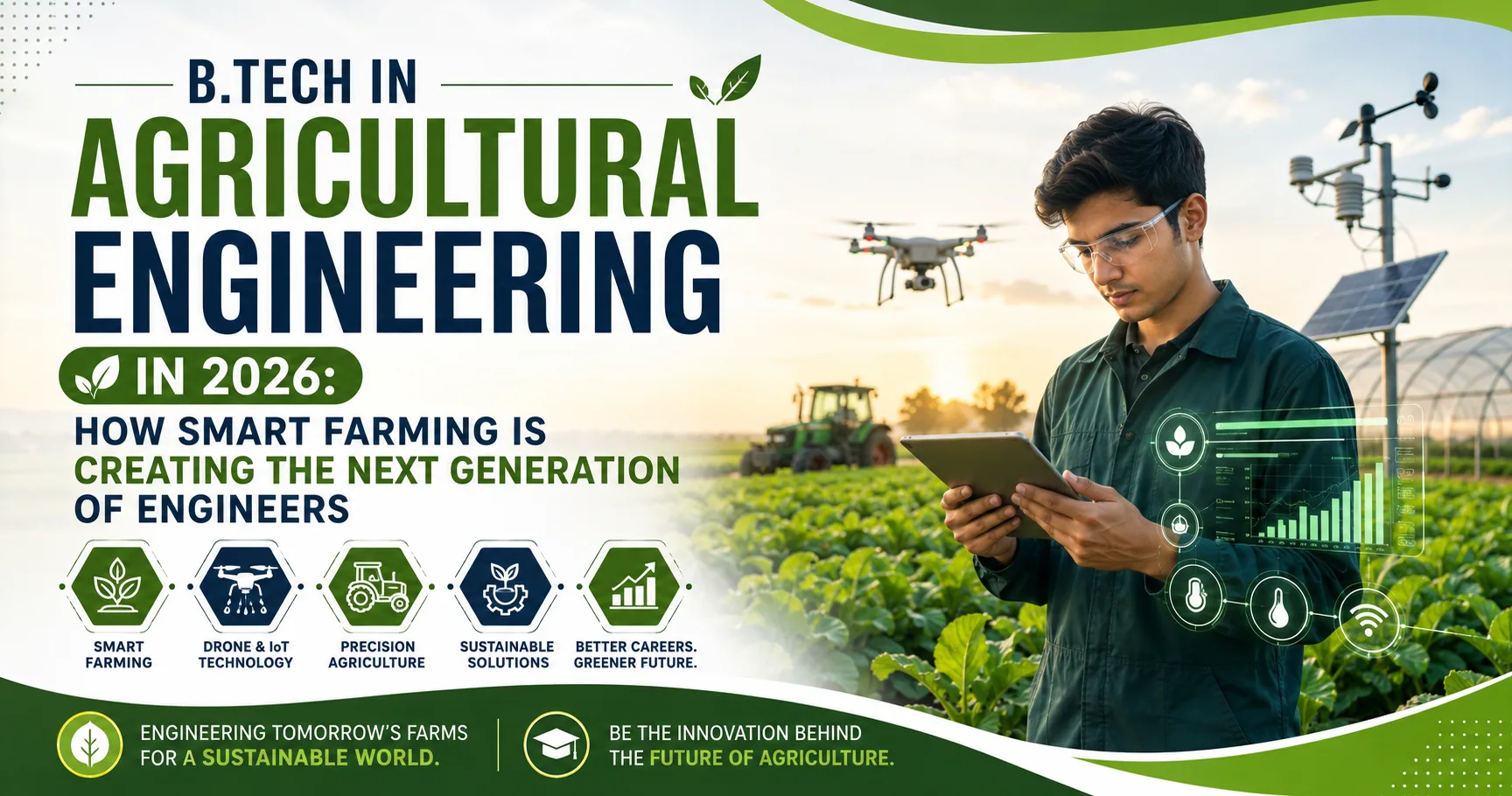
Agriculture is undergoing one of the biggest technological transformations in history. Artificial intelligence, drones, robotics, satellite mapping, precision irrigation, and data-driven farming are helping improve productivity while addressing challenges such as climate change, water scarcity, and food security. As these innovations become more common, the demand for professionals who understand both engineering and agriculture continues to grow. For students considering a B.Tech in Agricultural Engineering, this is an exciting time to enter a field that combines technology with sustainable development.
Today's agricultural engineers are no longer limited to designing farm equipment. They contribute to smart farming solutions, irrigation systems, renewable energy projects, food processing technologies, and precision agriculture. By combining engineering principles with agricultural science, they help create efficient farming practices that benefit both farmers and society.
Why Agricultural Engineering Is More Relevant Than Ever
The global agricultural sector faces several challenges, including a growing population, changing weather patterns, declining natural resources, and increasing food demand. Traditional farming methods alone cannot meet these challenges efficiently.
Modern agricultural engineering focuses on developing innovative solutions such as:
- Smart irrigation systems
- Precision farming technologies
- Farm automation
- Sustainable water management
- Renewable energy applications
- Agricultural machinery design
- Controlled environment agriculture
- Soil and water conservation
These advancements are transforming agriculture into a technology-driven industry, creating new career opportunities for engineering graduates.
How Smart Farming Is Changing Agriculture
Smart farming uses digital technologies to improve decision-making and resource management. Instead of relying solely on traditional methods, farmers can now monitor crops, soil health, weather conditions, and irrigation systems in real time.
Some of the technologies shaping modern agriculture include:
Artificial Intelligence
AI helps analyze crop health, predict diseases, optimize irrigation schedules, and improve yield forecasting. It enables farmers to make faster and more accurate decisions using real-time data.
Drones and Remote Sensing
Drones capture aerial images of agricultural fields, allowing farmers to monitor crop growth, detect pest infestations, and identify nutrient deficiencies without inspecting every acre manually.
Internet of Things (IoT)
Connected sensors placed across farms collect information about soil moisture, temperature, humidity, and crop conditions. This data supports efficient resource management while reducing waste.
Precision Agriculture
Precision farming focuses on applying the right amount of water, fertilizers, and pesticides exactly where needed. This improves productivity while minimizing environmental impact.
Skills Every Agricultural Engineering Student Should Develop
The agricultural industry now values graduates who possess both technical knowledge and practical problem-solving abilities.
Some essential skills include:
- Farm machinery and equipment design
- Irrigation engineering
- Soil and water conservation
- Geographic Information Systems (GIS)
- Agricultural automation
- Data analysis
- Sustainable farming practices
- Project management
- Research methodology
- Communication and teamwork
Developing these skills prepares students for diverse roles across agriculture, technology, manufacturing, and research sectors.
Why Practical Learning Matters
Engineering education becomes more meaningful when students apply classroom concepts to real-world situations. Practical exposure helps students understand agricultural systems, engineering design, and field challenges more effectively.
Students pursuing btech agricultural engineering should seek opportunities to participate in:
- Laboratory experiments
- Field demonstrations
- Industrial visits
- Research projects
- Internship programs
- Innovation competitions
- Smart farming initiatives
These experiences build confidence while improving technical and analytical skills.
Career Opportunities Beyond Traditional Farming
Agricultural engineering offers career opportunities across multiple industries. Graduates are increasingly employed in organizations working on food production, environmental sustainability, renewable energy, irrigation, infrastructure, and agricultural technology.
Popular career options include:
- Agricultural Engineer
- Irrigation Engineer
- Farm Machinery Design Engineer
- Precision Agriculture Specialist
- Food Processing Engineer
- Soil and Water Conservation Engineer
- Research Associate
- Quality Control Engineer
- Agri-Tech Consultant
- Project Engineer
- Renewable Energy Specialist
- Technical Sales Engineer
Graduates may also pursue higher education, research, entrepreneurship, or government services depending on their interests.
Sustainability Is Driving Future Innovation
Environmental sustainability has become a major priority across the agricultural sector. Engineers are designing systems that reduce water consumption, improve energy efficiency, minimize waste, and protect natural resources.
Future agricultural professionals will play an important role in developing climate-resilient farming methods, renewable energy solutions, and sustainable food production systems that support long-term environmental goals.
Choosing the Right Engineering Program
Selecting the right university is an important step toward building a successful career. Students should evaluate factors such as curriculum quality, experienced faculty, laboratory facilities, field training, research opportunities, industry collaborations, internship support, and placement assistance.
Those exploring b tech agri up should compare institutions based on practical learning opportunities, modern infrastructure, innovation culture, and industry exposure rather than relying solely on rankings or advertisements. A program that combines academic knowledge with hands-on experience can better prepare students for the evolving demands of the agricultural sector.
Emerging Technologies Every Student Should Watch
Agricultural engineering continues to evolve with rapid technological advancements. Some of the most promising areas include:
- Autonomous farming equipment
- Robotics for harvesting and planting
- Artificial intelligence in crop management
- Climate-smart agriculture
- Vertical farming
- Hydroponics and aeroponics
- Agricultural drones
- Smart irrigation systems
- Renewable energy for farms
- Digital farm management platforms
Students who stay informed about these innovations can build valuable expertise that aligns with future industry needs.
Why This Engineering Discipline Has Long-Term Potential
Food security, sustainable agriculture, and efficient resource management will remain global priorities for decades to come. As governments, research organizations, and private companies continue investing in agricultural technology, the need for skilled engineers is expected to grow.
Professionals who combine engineering expertise with agricultural knowledge are well-positioned to contribute to innovations that improve productivity, support environmental sustainability, and strengthen modern farming systems.
Final Thoughts
Agriculture is becoming increasingly technology-driven, creating exciting opportunities for students who want to solve real-world challenges through engineering. A B.Tech in Agricultural Engineering provides the technical foundation needed to work on smart farming, sustainable infrastructure, precision agriculture, and agricultural innovation.
As you explore different academic options, focus on institutions that emphasize practical learning, research, industry collaboration, and emerging technologies. Building expertise in these areas will prepare you to contribute to the future of agriculture while developing a rewarding and future-ready engineering career.