Introduction
There's a quiet anxiety a lot of finance and ERP professionals carry but rarely say out loud: the exact skills that make them valuable today could easily be outdated in a few years if they stop learning. Soft Online Training hears versions of this concern constantly from people already working inside Oracle Fusion Financials Course, wondering what comes next once the basics are covered. The honest answer isn't a neat list of two or three certifications it's a broader mix of technical depth, analytical thinking, and communication skills that most professionals don't build until they're deliberate about it.
Basic System Navigation Won't Carry a Career Far
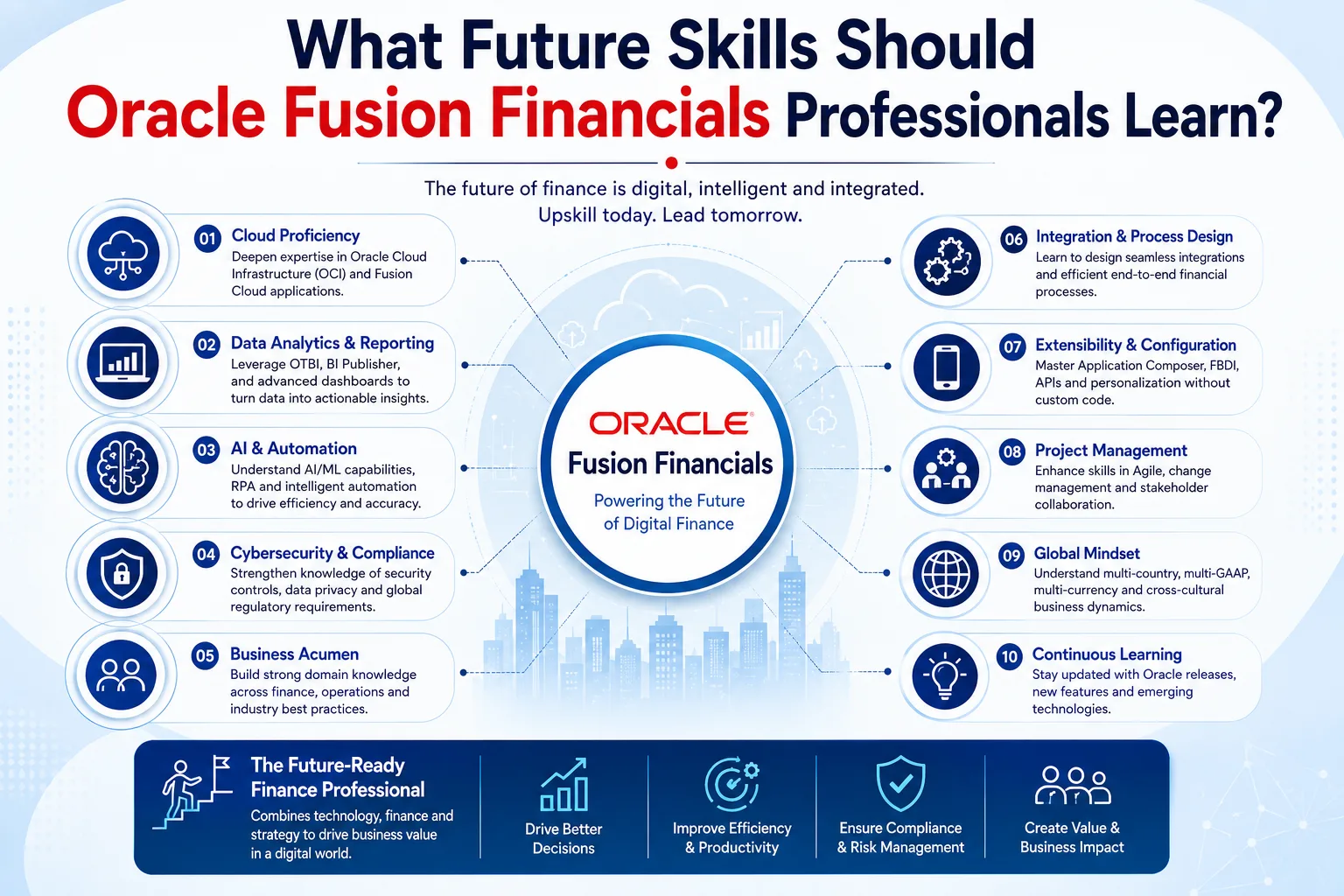
It's easy to reach a plateau where you know Fusion Financials well enough to get through your daily tasks running standard reports, processing routine transactions, clearing reconciliations without ever understanding what's actually happening underneath those screens. That level of familiarity is fine for an entry point, but it won't keep you competitive for long. The professionals who remain genuinely valuable are the ones who understand how the ledger structure ties into subledgers, how a single configuration decision cascades across multiple modules, and how multi-entity consolidation actually works behind the interface.
Building that kind of depth is precisely what a properly designed Oracle Fusion Financials Course should deliver. Instead of just showing which buttons to click, strong training explains the reasoning behind the system's design, which makes real troubleshooting and long-term optimization far more manageable later on.
Analytics Skills Are Quickly Becoming Non-Negotiable
The sheer volume of financial data Fusion Financials generates is only useful if someone knows how to interpret it. Professionals who can spot trends, build dashboards that actually inform decisions, and turn raw numbers into something leadership can act on are pulling ahead of colleagues who only know how to export a standard report.
This isn't a call for every finance professional to retrain as a data scientist. But comfort with the platform's embedded analytics, along with the instinct to ask the right questions of the data in front of you, is shifting from a "nice-to-have" into something closer to a baseline job requirement.
Automation and AI Features Deserve Real Attention
Oracle keeps expanding the automation and AI-driven capabilities inside Fusion Financials, from anomaly detection to predictive cash flow modeling and smarter transaction matching. Professionals who actually understand how these features are built, what data drives them, and how to adjust them for their organization's specific needs stand out sharply from colleagues who simply accept whatever the default settings happen to be.
This is one area where formal, structured learning genuinely earns its cost, since these features rarely reveal their full potential through casual, everyday use. A well-built Oracle Fusion Financials Online Training program that dedicates real time to automation configuration gives professionals the confidence to customize and troubleshoot these tools rather than treating them as fixed, unchangeable black boxes.
Integration Fluency Is Rapidly Becoming Essential
Almost no company runs Fusion Financials as a standalone island. It typically connects to procurement platforms, HR systems, tax engines, and various third-party tools, and professionals who understand exactly how those connections work and where they tend to break down become the people everyone turns to during audits, upgrades, and unexpected troubleshooting sessions.
That kind of integration awareness rarely develops just from routine daily use. It usually comes from deliberate, structured study that covers common integration patterns and their typical failure points, which is exactly the depth a solid Oracle Fusion Financials Course ought to include.
Tax and Regulatory Configuration Knowledge Pays Off
As tax rules continue shifting across different regions and jurisdictions, professionals capable of adjusting Fusion Financials' tax engine correctly, without breaking existing workflows, become especially valuable for multinational organizations. This is a narrower specialty, but it's consistently well compensated, precisely because so few people combine strong tax knowledge with the hands-on technical skill to configure it properly inside the system.
Communication Skills Matter More Than Most Technical Professionals Assume
Deep technical knowledge on its own has a ceiling. Professionals who can explain complicated system behavior in plain terms to non-technical stakeholders, manage implementation timelines effectively, and stay composed during high-stress moments like audits or migrations tend to move up faster than purely technical peers. Learning to translate between finance, IT, and leadership is a skill worth building on purpose, not something left to develop by accident over time.
Learning Has to Become an Ongoing Habit
Given how frequently Oracle rolls out platform updates, treating training as a one-time event is a mistake. The professionals who stay relevant approach learning as a continuous practice rather than a box checked off early in their careers. A flexible Oracle Fusion Financials Online Training program that can be revisited whenever new features launch makes this realistic for working professionals who don't have the luxury of stepping away from their jobs for extended periods.
Conclusion
The professionals who'll still be in demand years from now won't be the ones who learned Fusion Financials once and stopped there. They'll be the ones who kept building architecture, analytics, automation, integration, regulatory knowledge, and communication all stacked on top of a genuinely solid foundation. Whether that foundation begins with a structured Oracle Fusion Financials Course or an ongoing Oracle Fusion Financials Online Training program, the principle stays consistent: on a platform that never stops evolving, the people who keep learning alongside it are the ones who remain hard to replace.