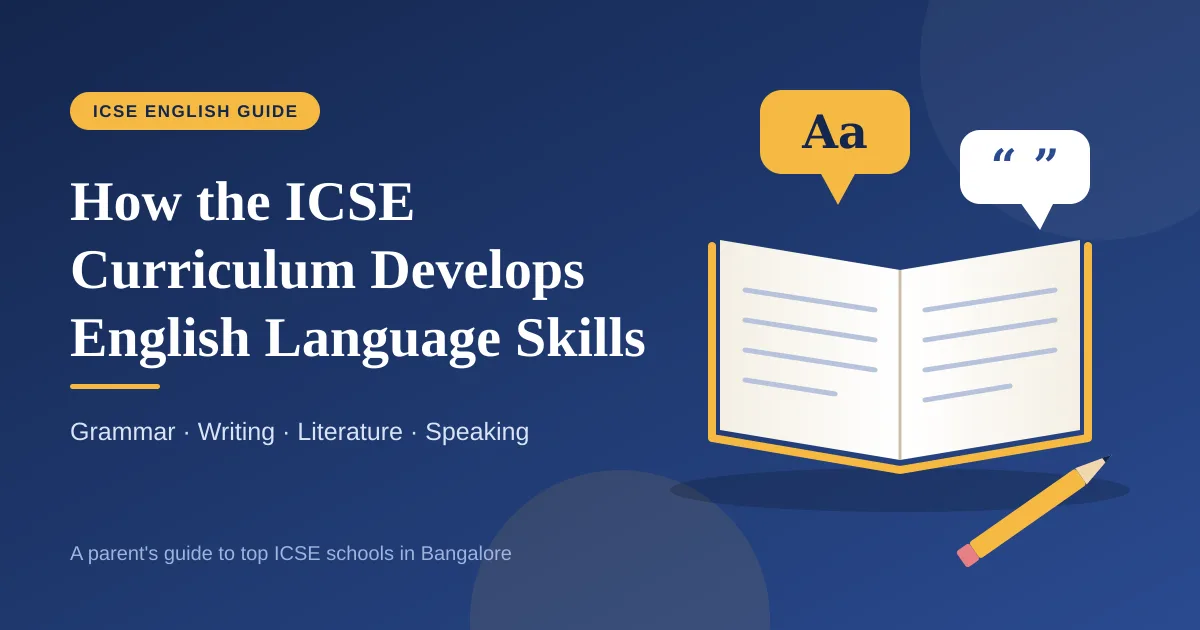
If you’ve ever listened to a child who studied under the ICSE board, you may have noticed how comfortably they speak and write in English. That’s not an accident. English sits at the heart of the ICSE system, and the way it’s taught builds real language ability instead of exam-only knowledge. It’s one reason many parents shortlisting the top ICSE schools in Bangalore pay close attention to how a school handles English.
English Is Treated as a Core Skill, Not Just a Subject
In many boards, English is one paper among several. In ICSE, it’s split into two separate papers: English Language and English Literature. Each gets its own attention, its own syllabus and its own marks. Students learn how to use the language, and they also learn how to appreciate it.
That split matters more than it sounds. A child who only studies grammar can write correct sentences but may struggle to express an idea with feeling. A child who only reads stories may enjoy them but slip on punctuation or sentence structure. ICSE asks for both, and over the years the two skills strengthen each other.
Grammar That Is Actually Used
Grammar in the ICSE curriculum isn’t taught as a list of dry rules to memorise. Students work with tenses, prepositions, verb forms, sentence transformation and comprehension in ways that mirror real writing. They rewrite sentences, fill gaps in passages and correct errors, so the rules get applied again and again.
By the time a student reaches the higher classes, grammar has become habit. They don’t stop to wonder whether “has” or “have” fits. It simply sounds right. Most teachers will tell you this comes from steady practice over many years, and the ICSE structure supports exactly that.
Writing That Goes Beyond the Basic Essay
Writing is where ICSE really stands out. Students are expected to produce compositions on a wide range of topics, from narrative and descriptive pieces to arguments and reflective writing. They also learn formal and informal letters, notices, emails and reports.
This variety teaches something valuable: the same person writes differently depending on who’s reading. A letter to a principal sounds different from a note to a friend, and ICSE students learn to feel that difference early. Many parents notice that their children become more thoughtful about word choice and tone, which helps them long after school ends.
Literature Opens the Door to Imagination
The literature paper is often the part students remember most fondly. Through poems, short stories and prose, children meet different voices, cultures and ways of thinking. They learn to read between the lines, to ask why a character acted a certain way and to explain their opinion with evidence from the text.
This builds vocabulary naturally. A student who reads a well-written story absorbs new words in context, so they don’t have to memorise them from a list. It also builds empathy and critical thinking, two skills that matter well beyond English class. When families compare the best schools in Bangalore, the quality of literature teaching is worth asking about, because a good teacher can turn a poem into a conversation that stays with a child for years.
Reading and Speaking Are Part of the Routine
ICSE encourages regular reading, both in class and at home. Students read aloud, discuss passages and sometimes present their thoughts to classmates. Many schools add debates, elocution, storytelling sessions and book clubs to this foundation.
Speaking confidently in English takes practice, and a classroom that values discussion gives children that practice daily. A shy student gradually learns to share an opinion in front of others. A confident one learns to listen and respond with care. Over time, spoken English becomes as natural as the written kind.
Why This Matters for the Future
Strong English opens many doors. It helps in competitive exams, university applications, interviews and the workplace. Students from an ICSE background often find it easier to handle entrance tests that test comprehension and expression, and they adapt quickly to higher education where English is the main medium.
Beyond careers, there’s a personal benefit too. A child who can express themselves clearly feels more sure of themselves. They can explain a problem, ask for help and share an idea without hesitation. That confidence shows up in every part of school life.
Choosing a School That Gets English Right
Not every school delivers the ICSE English curriculum with the same care, so it helps to look closely. Ask about the teachers’ experience, how often students write and receive feedback, and whether the library and reading programmes are active. Visit a classroom if you can and see how students respond when the teacher asks a question.
If you live in the south of the city, you may already be searching for the best ICSE schools in Banashankari. Look beyond rankings and brochures. Talk to current parents, attend an open day and notice how students speak to visitors. A school that nurtures good English usually shows it in the way its children talk.
For families building a list of the top 10 ICSE schools in Bangalore, the English programme is a smart place to start comparing. Two schools may have similar results on paper, but the daily classroom experience can feel very different.
Presidency School Banashankari: Where English Becomes a Everyday Skill
At Presidency School Banashankari, English is taught as a skill the children actually use every day, not just a paper to pass. Following the ICSE framework, the school gives equal weight to English Language and English Literature, so students learn to write clearly and also to enjoy what they read. Regular reading, discussions, debates and elocution activities help even the shyest child find their voice, while teachers give steady feedback on writing so improvement is visible term after term. For parents looking at the best ICSE schools in Banashankari, this balanced, practice-led approach to English is a strong reason to visit the campus and see it in action.
Final Thoughts
The ICSE curriculum develops English by combining grammar, writing, literature and speaking into one connected journey. Children don’t just learn about the language, they learn to live in it. When a school teaches this well, students leave with skills that stay useful for life.
If English matters to you, and it should, make it a key question during your school search. The right answer can shape how your child thinks, writes and speaks for years to come.
A quick note: no tool or writer can honestly guarantee that text will pass every AI detector, since detectors are inconsistent. For the best result, read it aloud and add a few of your own details, such as a real classroom example or a quote from a teacher. That personal touch makes the article more credible to readers as well.