
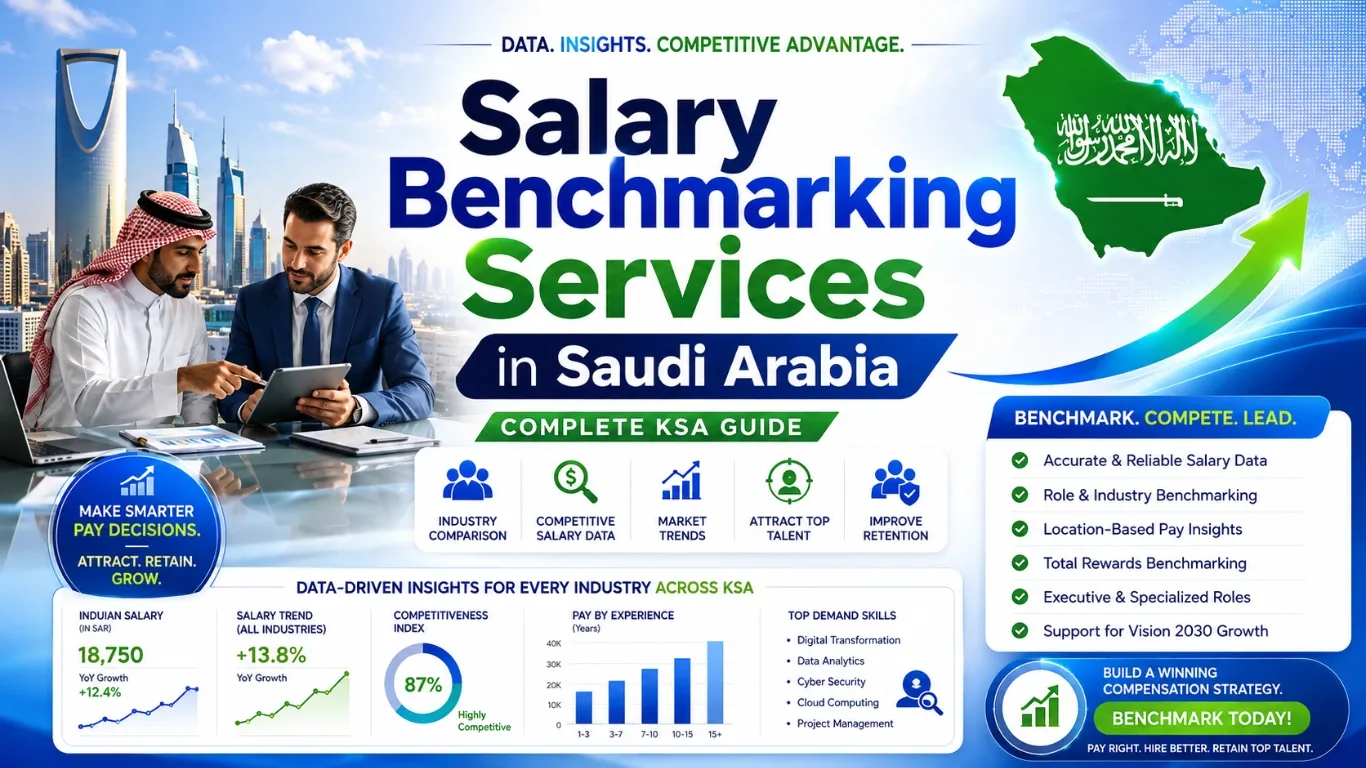
Here’s a scenario most HR leaders in Saudi Arabia know well. A strong candidate accepts your offer – then resigns three months later for a 20% pay increase from a competitor. Or your top performer quietly updates their LinkedIn profile after learning a peer at a rival firm earns significantly more.
Both situations have the same root cause : a compensation strategy that isn’t grounded in current market data.
Saudi Arabia’s job market is moving fast. Vision 2030 is reshaping entire industries. Saudization quotas are pushing up local talent demand. And a new generation of Saudi professionals expects compensation packages that reflect their market value – not just internal pay grades from five years ago.
This guide covers exactly how salary benchmarking in Saudi Arabia works, why the standard approach falls short in the KSA context, and what a structured benchmarking process looks like in practice.
What Is Salary Benchmarking Services In SAudi Arabia and Why Does It Matter in Saudi Arabia?
Salary benchmarking is the process of measuring your organisation’s pay levels against verified external market data for comparable roles. It tells you whether you’re paying above, at, or below market rate – and by how much.
In most markets, benchmarking is a useful annual exercise. In Saudi Arabia right now, it’s a strategic necessity.
The Kingdom is experiencing a labour market transformation unlike anything in its recent history. Entire sectors – tourism, entertainment, fintech, renewable energy – have emerged or expanded dramatically since 2016. New job categories are being created faster than existing pay structures can track them.
What is salary benchmarking in Saudi Arabia?
Salary Benchmarking in Saudi Arabia involves comparing an organisation’s salary packages to the industry and region’s market rates for the same positions. It entails gathering information on salary surveys, matching internal jobs with market opportunities, identifying pay gaps, and re-aligning pay systems with a competitive mix – taking into account Saudization mandates, sector requirements and Vision 2030 changes to market.
The direct business impact of getting it wrong
The impact of low pay is measurable when it is below the level of the market. Recruitment timelines lengthen. Acceptance rates decrease. High performers leave for better-paying roles – often at competitors you’re trying to out-hire.
When pay is set too high without market validation, the cost impact compounds across headcount. Over-paying relative to market can be just as damaging to business sustainability as under-paying is to talent retention.
Benchmarking gives you the data to get this balance right. It’s the foundation of any credible total rewards strategy – which covers not just base pay, but bonuses, benefits, long-term incentives, and non-financial rewards that together define what an employer actually offers.
How Vision 2030 Is Reshaping Compensation Expectations
If you’re using salary data from 2020 or even 2022, you’re not benchmarking – you’re guessing. Vision 2030 has fundamentally shifted what talent costs in Saudi Arabia across multiple dimensions.
New sectors driving new pay benchmarks
The giga-projects alone – NEOM, Red Sea Project, Diriyah Gate, Qiddiya – have created a sustained high demand for specialist roles that simply didn’t exist at scale in Saudi Arabia a decade ago. Project managers, sustainability officers, experience designers, digital infrastructure engineers: these roles command premium pay because supply of qualified talent is still catching up to demand.
Tourism and hospitality, previously a minor employer, is now a targeted pillar of the economy. The sector is competing for bilingual Saudi talent who can meet international service standards. That talent commands different pay than hospitality roles did when the sector was smaller.
The privatisation effect on pay expectations
As government-owned entities across healthcare, utilities, and transport shift toward private or semi-private models, compensation structures are changing. Public sector pay norms – typically more rigid and seniority-based – are giving way to performance-linked, market-competitive packages.
This affects both the organisations going through privatisation and the private companies competing with them for the same talent pool.
For any company operating in the KSA market today, benchmarking needs to account for this structural shift – not just compare like-for-like with last year’s data from the same sector.
The Step-by-Step Salary Benchmarking Process for KSA Companies
Most companies treat benchmarking as a one-time data pull. It shouldn’t be. Here’s what a proper, structured process looks like – one that actually produces compensation decisions you can defend.
Step 1: Define the Job Architecture
Before you can benchmark a role, you need to define it precisely. Job titles are not job descriptions. Two companies can have a “Senior HR Manager” role with completely different scopes, team sizes, budgets, and accountability levels.
Start with a formal job analysis for each role you want to benchmark. Document scope, reporting lines, required qualifications, and level of decision-making authority. This is what job evaluation methodology is designed to produce – a consistent, comparable definition of each role’s relative weight within your organisation.
Step 2: Select the Right Data Sources
Saudi-specific salary data comes from several sources, each with different strengths :
- Published salary surveys – regional surveys from Mercer, Hay Group (now Korn Ferry), Willis Towers Watson, and Price waterhouse Coopers cover GCC and KSA-specific data by industry and function
- Government data – the General Authority for Statistics (GASTAT) publishes national labour market data including average earnings by sector
- HR consultancy benchmarking databases – specialist firms with active KSA clients hold proprietary data that reflects real hiring and retention activity
- Job offer analysis – tracking accepted and rejected offers over 12 months provides real market signal from your own recruitment activity
No single source is sufficient on its own. Good benchmarking triangulates across at least two or three data sources to identify consistent market ranges.
Step 3: Match Internal Roles to Market Benchmarks
This is where most in-house benchmarking falls short. Matching a role to a survey benchmark requires genuine understanding of the role – not just title matching.
A “Finance Manager” at a 50-person private company and a “Finance Manager” at a listed conglomerate are different roles. Matching them to the same benchmark produces misleading data. Use job evaluation frameworks to match by function, scope, and level – not by title alone.
Step 4: Analyse Pay Position vs Market
Once roles are matched, calculate where your current pay sits relative to the market median and the market range (typically P25–P75, the middle 50% of market pay).
The comparison metric is the compa-ratio : your actual pay divided by the market median, expressed as a percentage. A compa-ratio of 100% means you’re paying at market median. Below 90% signals a retention risk. Above 115% may indicate over-spend relative to market.
A compa-ratio analysis from Rooted HR produces this comparison across your full role population, segmented by function, level, and nationality where relevant under Saudization frameworks.
Step 5: Define Your Compensation Philosophy
Where do you want to sit relative to market ? This is a strategic decision, not a default. Common positions include :
Market PositionTarget PercentileTypical Use Case in KSABelow marketP25–P40Cost-control environments; offset with strong non-cash benefitsAt marketP50Standard positioning for most established companiesAbove marketP65–P75High-growth sectors, talent-scarce roles, Saudization-targeted positionsPremium marketP90+Executive roles, giga-project specialists, critical hard-to-fill positionsStep 6: Build or Revise Your Pay Bands
After determining the market position, develop the pay bands (salary grades) around this position. Every band should have a minimum, midpoint and maximum with a mid-point usually corresponding to your target percentile for your market.
Considering the rapid pace of market movements, review these bands at least on an annual basis in the context of KSA. A mid-year review can be considered for certain positions in giga-projects or for quickly evolving industries such as fintech and renewables.
Looking for a salary benchmarking partner familiar with the Saudi Arabia market?
Rooted HR provides industry-specific compensation benchmarking data, spanning 150+ markets, and customized to the KSA industry and aligned to the realities of the KSA workforce, as captured in Vision 2030.
→ Request a Salary Benchmarking Consultation
Salary Benchmarking by Industry: What to Expect Across Key KSA Sectors
Saudi Arabia has a non-uniform labour market. Pay norms, Saudization pressures, and talent supply vary dramatically by sector. Here’s what benchmarking typically reveals across the Kingdom’s most active industries.
Technology and Digital
This is the fastest-moving compensation market in the Kingdom right now. The push to build a digital economy under Vision 2030 — combined with global competition for Saudi tech talent – has driven salaries for software engineers, data scientists, and cybersecurity specialists significantly above GCC averages in many specialisations.
Benchmarking tech roles against regional data is insufficient. Many Saudi tech companies now compete globally for remote-capable talent, which means pay structures need to reflect international market rates for critical roles.
Healthcare
Healthcare is under sustained compensation pressure from two directions : Saudization targets requiring local hiring, and ongoing global shortages in clinical specialisations. Saudi nationals in clinical roles command premium pay – particularly in nursing, pharmacy, and allied health – because the national supply of qualified professionals remains below demand.
Expatriate clinical compensation is complex, with housing, schooling, flights, and end-of-service benefits forming a substantial portion of total cost. Benchmarking total cost of employment – not just base salary – is essential for accurate comparison in this sector.
Energy and Utilities
Traditional oil and gas compensation in Saudi Arabia has always been competitive. The shift toward renewable energy is creating a new layer of demand for roles in solar, hydrogen, and grid infrastructure – where KSA-specific talent supply is very thin.
Aramco and ACWA Power set pay reference points that many energy sector employers find themselves benchmarking against, often without the same financial capacity to match. Understanding exactly where you sit on the energy compensation spectrum helps prioritise where to compete on pay versus where to differentiate on other dimensions.
Banking and Financial Services
Banking compensation in Saudi Arabia is heavily influenced by the large domestic banks – Al Rajhi, SNB, Riyad Bank – and the expanding presence of international institutions. Fintech is disrupting this further, with start-ups offering equity-linked packages that traditional banks struggle to replicate.
Benchmarking in this sector needs to account for the fintech effect : senior digital and product talent is increasingly choosing early-stage growth companies over established institutions, driven by package structures that go beyond base salary.
Construction and Infrastructure
The scale of giga-projects has created one of the most active construction labour markets in the world. Project directors, quantity surveyors, BIM managers, and specialist engineers are in sustained short supply relative to project pipeline.
Pay for these roles has moved significantly since 2022. Any benchmarking data older than 18 months in this sector should be treated as directional only – not as a current market reference.
Saudization and Its Direct Impact on Pay Structures
Saudization – the policy framework requiring companies to maintain minimum percentages of Saudi national employees – has a direct and often underestimated effect on compensation benchmarking in the Kingdom.
In some cases, the market rates for Saudi nationals are significantly higher for regulated industries with high Saudization quotas compared to similar expatriate talent.This isn’t a distortion – it’s a market reality driven by mandated demand and constrained supply. Benchmarking that doesn’t account for this produces misleading pay comparisons.
Saudi national vs. expatriate pay benchmarking
In practice, many KSA employers maintain separate pay reference points for Saudi national hires versus expatriate hires in the same role. This is particularly pronounced in sectors where Saudization pressure is highest and locally qualified talent is scarce relative to quota requirements.
A properly structured benchmarking process for Saudi Arabia needs to segment this data — not treat national and expatriate compensation as a single comparable market. Merging them produces a blended average that accurately reflects neither group’s actual market rate.
The strategic workforce planning work that precedes effective benchmarking in Saudi Arabia typically addresses this segmentation – ensuring that pay band design accounts for Saudization-driven market pressures by role and by function.
For a broader view of how the Saudi Ministry of Human Resources and Social Development frames workforce policy – including Saudization frameworks and labour market regulations – the Ministry of Human Resources and Social Development (HRSD) official portal is the authoritative source.
5 Salary Benchmarking Mistakes Saudi Companies Keep Making
Good data doesn’t automatically produce good benchmarking. The process matters as much as the source. These are the five mistakes that produce unreliable results — and the fixes that make benchmarking actually usable.
Mistake 1: Using Title-Based Matching Instead of Role-Based Matching
Job titles are not standardised across Saudi companies. “Business Development Manager” at one firm might be a field sales role. At another, it’s a strategy and partnership function. Matching on title alone introduces significant error into your benchmarking output.
Fix : Match roles to market benchmarks based on a documented job profile – scope, accountability, team size, budgetary authority – not on what the role is called internally.
Mistake 2: Benchmarking Base Salary in Isolation
In the KSA market, total compensation includes allowances (housing, transport, mobile), annual performance bonuses, end-of-service benefits, health insurance, schooling support, and in some sectors equity or profit-sharing. A comparison of base salaries alone yields a flawed and incomplete market comparison.
Fix: Benchmark total cash (base + allowances + guaranteed bonus) and total remuneration (total cash + benefits value) separately. This is the approach Rooted HR’s compensation benchmarking service applies across all KSA engagements.
Mistake 3: Relying on a Single Survey Source
No single salary survey covers every sector, every function, and every level with equal accuracy. Mercer may be strong for multinational pay data. The local norms of pay for SMEs and family businesses may be better represented in local surveys. If you use 1 source as the authority, you’re adding bias.
Fix: Triangulate from two or three sources. If they agree with each other then the information is accurate. If they differ greatly, research the issue first and then choose the one that you feel is best.
Mistake 4: Benchmarking Every Role as Equally Important
Not all roles are equally critical and risk of talent scarcity. If the same benchmarking approach and same market position is applied to each role within the organisation then this wastes compensation budget.
Fix: Divide roles based on strategic importance and lack of talent in the market.Invest above market for truly hard-to-replace roles. Maintain market or below-market positioning for roles where talent supply is ample. The strategic workforce planning framework that Rooted HR uses with clients in Saudi Arabia explicitly addresses this prioritisation.
Mistake 5: Treating Benchmarking as Annual Rather Than Ongoing
In a stable labour market, annual benchmarking is sufficient. Saudi Arabia’s labour market right now is not stable. Giga-project announcements, new sector regulations, Saudization target changes, and Vision 2030 programme expansions all shift compensation norms within months, not years.
Fix: Conduct a full benchmarking review annually. Run lighter quarterly pulse checks on the highest-risk roles — those where you’ve lost talent or struggled to fill positions in the previous 12 months.
For companies operating across the GCC – not just Saudi Arabia – the SHRM Compensation Survey Toolkit provides a useful international framework that Rooted HR’s SHRM-recognised consultants apply and adapt to regional market realities.
Paying people fairly starts with knowing what the market actually pays.
Rooted HR delivers salary benchmarking in Saudi Arabia backed by 150+ market data sources, sector-specific KSA insights, and consultants recognised by SHRM and ATD.
→ Book a Compensation Benchmarking Consultation
Or reach our team directly : +44 7984 860230
People Also Ask Salary Benchmarking in Saudi Arabia
What is salary benchmarking in Saudi Arabia?
Salary benchmarking in Saudi Arabia is the process of comparing your organisation’s pay levels with current market rates for equivalent roles across the Kingdom. It uses salary survey data, job evaluation, and compensation analysis to determine whether your pay structure is competitive, fair, and aligned with industry norms — accounting for Saudization requirements and sector-specific market pressures driven by Vision 2030.
What is the purpose of salary benchmarking for companies in KSA?
The purpose is to ensure that an organisation’s compensation is competitive enough to attract and retain talent while remaining financially sustainable. In Saudi Arabia specifically, benchmarking also helps companies navigate Saudization targets, manage compensation equity between national and expatriate employees, and stay aligned with the rapidly shifting pay norms across Vision 2030 sectors.
How do you conduct salary benchmarking in Saudi Arabia?
The process involves six core steps: defining and documenting each role through a formal job analysis; selecting relevant KSA salary surveys and data sources; matching internal roles to market benchmarks by function and level (not just title); calculating compa-ratios to identify where current pay sits versus market; deciding on your compensation philosophy and target market position; and building or revising pay bands accordingly. This should be repeated annually – with more frequent pulse checks on high-risk roles.
How does Saudization affect salary benchmarking in Saudi Arabia?
Saudization – the government’s policy requiring minimum percentages of Saudi national employees — directly pushes up compensation for Saudi national hires in many sectors where local talent supply is limited relative to Saudization quotas. This means effective benchmarking in Saudi Arabia must segment data between Saudi national and expatriate compensation rather than treating them as a single comparable market. Blending the two produces misleading averages for both groups.
Salary survey vs salary benchmarking — what is the difference?
A salary survey is a data source: a report showing pay ranges for specific roles across companies, industries, and regions. Salary benchmarking is the process of using that data – plus job evaluation, gap analysis, and compensation philosophy decisions — to set and validate your organisation’s actual pay structure. A survey provides raw market intelligence; benchmarking converts that intelligence into a usable compensation strategy.
What is the best way to set competitive salaries in Saudi Arabia?
The most reliable approach combines external salary survey data (from at least two sources covering the KSA market), proper role-level matching using a job evaluation framework, and a clear decision about your target market position. Layer in Saudization-specific considerations for Saudi national hires, factor in the total compensation package rather than just base salary, and review annually — or more frequently for sectors actively reshaping under Vision 2030.
Which industries in Saudi Arabia have the highest salary benchmarking complexity?
Technology and digital roles present the highest complexity due to global competition for talent and rapid pay inflation. Healthcare follows, where Saudization pressure and clinical talent scarcity combine to create multiple pay tiers. Construction and giga-project roles also present significant benchmarking challenges due to the speed at which project demand has outpaced historical pay data, making data older than 18 months of limited reliability for many specialist roles.
FAQ: Salary Benchmarking in Saudi Arabia
How often should Saudi companies update their salary benchmarks?
At minimum, annually — before the start of the compensation review cycle. Given the pace of market change in Saudi Arabia under Vision 2030, companies in high-growth sectors (tech, renewable energy, tourism, construction) should run quarterly pulse checks on the most critical or hardest-to-fill roles. Using data older than 18 months for strategic pay decisions in the current KSA market carries significant risk.
What salary surveys cover the Saudi Arabia market accurately?
The most widely used surveys with KSA-specific coverage include Mercer’s Total Remuneration Survey (TRS), Korn Ferry’s Hay Group Pay Climate Report for the GCC, Willis Towers Watson’s Salary Budget Planning Report, and PwC’s Saratoga benchmarking database. Local HR consultancies with active KSA client bases also hold proprietary market data that may reflect real hiring activity more accurately than published surveys for specific industries or functions.
Does total compensation benchmarking include end-of-service benefits in Saudi Arabia?
It should. End-of-service gratuity (EOSB) is a statutory benefit under Saudi Labour Law – calculated at 50% of monthly salary for each of the first five years of service, rising to full monthly salary per year thereafter. This is a real compensation cost and represents a significant portion of total employment cost, especially for longer-tenured employees. Excluding it from total remuneration benchmarking understates what employers are actually committing to pay.
How does salary benchmarking support employee retention in Saudi Arabia?
Retention risk is one of the most direct outputs of a well-conducted benchmarking exercise. When benchmarking reveals that a segment of your workforce is paid below the P40 of market, that group faces a statistically higher risk of attrition – particularly in a market where competitor employers are actively recruiting. Benchmarking converts this from a vague concern into a quantified, prioritised list of compensation corrections to make before people start leaving. Pairing this with employee satisfaction survey data sharpens the retention action plan considerably.
What is a compa-ratio and how is it used in Saudi Arabia salary benchmarking?
A compa-ratio (comparative ratio) measures an individual employee’s actual salary as a percentage of the market median for their role. A compa-ratio of 100% means the employee is paid exactly at market median. Below 90% signals potential underpayment and retention risk.
Above 115% may indicate overpayment relative to market. In Saudi Arabia, compa-ratios are typically calculated separately for Saudi national and expatriate employees in the same role, given the different market dynamics affecting each group.
Can Rooted HR conduct salary benchmarking for companies based outside the UK operating in Saudi Arabia?
Yes. Rooted HR serves organisations across Saudi Arabia, Oman, Qatar, Bahrain, Iraq, and the United Kingdom. The firm’s compensation benchmarking and total rewards services are designed for multinational and GCC-based organisations operating in the Kingdom – including companies navigating Saudization requirements, Vision 2030 workforce transformation, and cross-border total compensation comparisons. See the full range of services at Rooted HR Total Rewards consulting.
What is the difference between job evaluation and salary benchmarking?
Job evaluation is an internal process – it assesses the relative worth of roles within your organisation based on scope, accountability, complexity, and required skills. It produces a job hierarchy or grading structure.
Salary benchmarking is external – it compares pay for those internally-graded roles against the external market.
The two processes work together : job evaluation provides the framework for consistent market matching; benchmarking provides the market data to set pay within that framework. Without job evaluation, benchmarking comparisons are inconsistent. Without benchmarking, job evaluation produces no external reference point for pay decisions.
Related Resources
- Total Rewards Comprehensive Total Rewards Consulting & Compensation Benchmarking for KSA and GCC Explore Service
- Retention Employee Satisfaction and Engagement Survey in Saudi Arabia: A 5-Step Action Plan Read Article
- Workforce Planning Strategic Workforce Planning: Align People Strategy with Business Goals in KSA Explore Service
- GCC HR Human Resource Consultancy in Oman: Business Success Through Strategic People Management Read Article