From choosing your first underwater experience to understanding PADI certification, these practical tips can help you plan a safer, more enjoyable diving holiday in the Andaman Islands.
A scuba diving holiday involves more than choosing a beautiful beach and reserving an underwater adventure. The type of dive, your swimming ability, the training involved, and even your return flight schedule can influence the experience.
Havelock Island, officially called Swaraj Dweep, is among the most popular places for scuba diving in the Andaman and Nicobar Islands. Its surrounding waters offer opportunities for first-time participants as well as people interested in becoming certified recreational divers.
However, not every diving program is designed for the same traveler.
Before booking, understanding a few important differences can help you choose an experience that matches your expectations.
1. Decide What You Want From Your First Dive
The first question is simple: Do you want to experience the underwater world once, or do you want to learn how to dive independently with a qualified buddy?
These are two different goals.
An introductory scuba diving session is designed for people who want to discover what breathing underwater feels like without completing a full certification program.
Participants receive basic safety instructions, learn how to use essential equipment, and explore the water under professional supervision.
A certification course requires a greater commitment. It introduces diving theory, underwater skills, equipment management, and important safety procedures.
Travelers exploring Scuba diving in Havelock can compare introductory experiences and training options according to their interests and available holiday time.
A short recreational experience may be enough for someone who wants a memorable activity. Someone planning future diving holidays may find certification more valuable.
2. Understand Why Dive Site Selection Matters
Not all underwater environments are equally suitable for beginners.
Different dive locations have different depths, currents, entry conditions, and underwater features. Some sites are better suited to introductory experiences, while others require additional training or experience.
Havelock Island has several recognized diving locations.
Nemo Reef
Nemo Reef is a well-known beginner-friendly diving location near Havelock. Its relatively accessible underwater environment makes it a common choice for introductory diving.
Divers may observe reef fish and coral habitats, depending on visibility and current conditions.
The Wall
The Wall is known for its underwater slope and deeper reef environment.
The appropriate dive profile depends on the diver's qualification, experience, and prevailing conditions.
Dixon's Pinnacle
Dixon's Pinnacle is a more advanced diving location known for its underwater formations and marine biodiversity.
It is generally associated with experienced divers rather than first-time introductory participants.
The important lesson is that choosing a dive site should never be based solely on photographs or online popularity.
A qualified instructor or dive professional should evaluate the participant's abilities and current environmental conditions before selecting a location.
3. Check Whether You Need Swimming Skills
One of the biggest misconceptions about scuba diving is that every participant must already be an experienced swimmer.
The actual requirement depends on the program.
Certain introductory diving experiences may accommodate non-swimmers under close professional supervision, provided they meet the operator's safety and medical requirements.
Certification programs are different.
For example, the PADI Open Water Diver course includes a swimming assessment. Students are typically required to swim 200 meters without aids or 300 meters using a mask, fins, and snorkel. They must also demonstrate the ability to float or tread water for 10 minutes.
These requirements matter because certification prepares participants for greater responsibility underwater.
Before booking, explain your swimming experience honestly to the training center. A responsible operator can help you identify an appropriate program.
4. Consider PADI Certification If You Want to Dive Regularly
A first underwater experience can introduce someone to an entirely new interest.
For travelers who want to continue diving beyond their Andaman holiday, the PADI Open Water Diver program provides a structured starting point.
The course develops essential recreational diving knowledge and practical skills.
Students learn about equipment preparation, buoyancy, underwater communication, dive planning, and basic safety procedures.
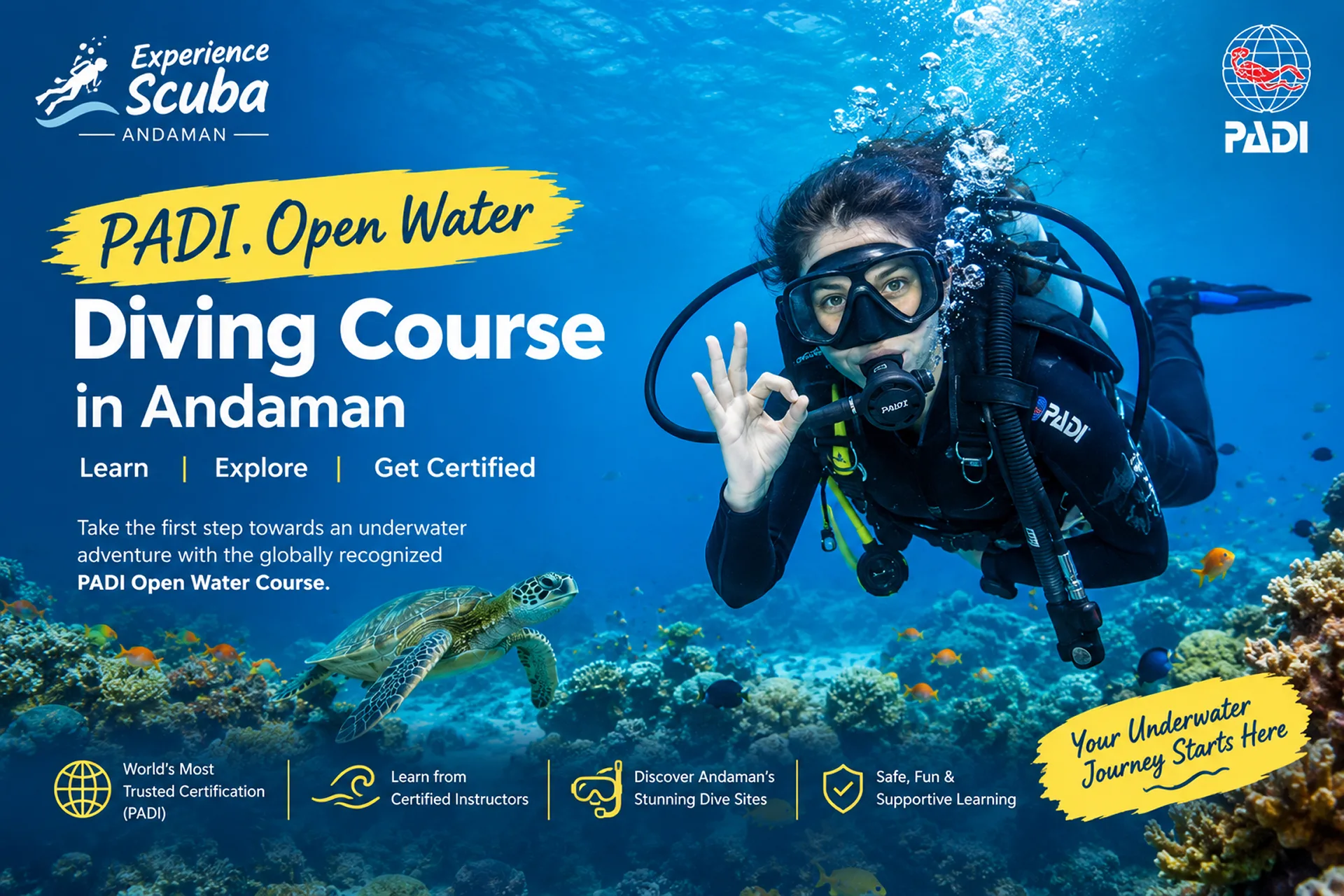
The PADI Open Water Diving Course in Andaman offered by Experience Scuba is structured around four days of training on Havelock Island.
Its published course schedule includes:
- Independent theoretical learning through PADI eLearning.
- Five confined-water training sessions.
- Four supervised open-water training dives.
- Skill evaluation and certification processing.
After meeting the course requirements, successful students receive a recognized PADI Open Water Diver certification.
For adults, this certification generally permits recreational diving with a qualified buddy to a maximum training depth of 18 meters, subject to appropriate conditions.
A PADI Open Water Course in Havelock is therefore more than an organized underwater excursion. It provides the foundation for future recreational diving experiences.
However, certification should not be rushed. Comfort, understanding, and skill development are more important than completing a program as quickly as possible.
5. Choose Your Travel Dates Carefully
Although the Andaman Islands attract visitors throughout much of the year, ocean conditions are not equally predictable in every season.
October through May is a popular travel period, with many visitors choosing the drier months for their island holidays.
Still, weather conditions can change even during the main tourist season.
Wind, waves, rainfall, currents, and underwater visibility all influence diving activities.
A calm beach does not necessarily indicate ideal conditions at every dive location.
For a better experience:
- Keep some flexibility in your itinerary.
- Avoid assuming every dive location will be accessible.
- Check weather-related arrangements with the operator.
- Follow professional advice if a dive is postponed or canceled.
Safety decisions should always take priority over a fixed sightseeing schedule.
6. Leave Enough Time Between Diving and Flying
One of the most overlooked aspects of a scuba diving holiday is the timing of the return journey.
Flying too soon after scuba diving can increase the risk of decompression sickness because atmospheric pressure decreases during flight.
According to the Divers Alert Network's flying-after-diving guidance, the suggested minimum surface interval is 12 hours after a single no-decompression dive and 18 hours after multiple dives or diving over several days.
These are minimum recommendations, not guarantees of safety. Longer intervals provide an additional precaution.
Travelers completing a multi-day PADI certification program should pay particular attention to their departure schedule.
Where possible, consider keeping the final day of your holiday free from scuba diving.
This allows time for rest, sightseeing, and more conservative travel planning.
Always follow the guidance of your dive professional, especially if your dive profile or health circumstances require additional precautions.
7. Ask What Your Scuba Diving Package Includes
A surprisingly low advertised price does not always tell you what the overall experience will involve.
Before confirming a reservation, ask for a complete explanation of the package.
Important questions include:
Is diving equipment included?
Confirm whether the operator provides the mask, fins, wetsuit, regulator, and other necessary equipment.
Will a qualified professional supervise the dive?
Ask about instructor or dive professional qualifications and supervision arrangements.
Are underwater photographs included?
Some operators provide photographs or short videos, while others charge separately.
How much time will the activity take?
The complete experience may include briefing, equipment preparation, transport, and underwater time.
What happens if the weather changes?
Understand the cancellation, postponement, and refund policies before paying.
Does the certification course include learning materials and certification fees?
If you're considering a PADI certification course in Andaman, confirm which training resources, equipment, and certification-related expenses are covered.
Clear answers make comparing different operators much easier.
Introductory Diving vs. PADI Certification: Which Should You Choose?
There is no single correct option for every traveler.
An introductory experience is suitable for someone who wants to discover the underwater world during a short holiday.
A PADI certification course is more appropriate for someone who wants to develop diving skills and continue exploring underwater environments during future trips.
Time is another important consideration.
A recreational introductory experience generally requires much less time than a multi-day certification course.
Certification also involves theoretical learning, water-skills assessment, and practical evaluations.
The better choice is the one that matches your travel plans, personal comfort, swimming ability, and long-term interests.
Responsible Scuba Diving Makes a Difference
Scuba diving provides access to marine ecosystems that can be damaged by careless human activity.
Coral formations, reef habitats, and marine animals should always be treated with respect.
Avoid touching coral, feeding fish, disturbing wildlife, or collecting objects from the seabed.
Certified divers should maintain appropriate buoyancy and follow established environmental diving practices.
For introductory participants, carefully following the instructor's guidance helps protect both the diver and the underwater environment.
The purpose of a dive should be to appreciate marine life, not interfere with it.
Frequently Asked Questions
Is Havelock Island suitable for first-time scuba divers?
Yes. Havelock has beginner-friendly diving locations and supervised introductory diving experiences. Participation depends on the program, health requirements, and prevailing conditions.
How many days should I keep for a PADI Open Water Diver Course?
A standard course commonly takes three to four days. Experience Scuba currently lists its PADI Open Water Diver program as a four-day course.
Can I get PADI certification without knowing how to swim?
The full PADI Open Water Diver certification requires swimming and floating skills. People who cannot swim may instead explore eligible supervised introductory programs.
Is PADI certification valid outside India?
Yes. The PADI Open Water Diver certification is widely recognized by recreational diving operators internationally.
Is scuba diving available throughout the year in Andaman?
Diving opportunities depend on weather, ocean conditions, operator availability, and safety assessments. Individual activities may be rescheduled when conditions are unsuitable.
Final Thoughts
Planning a scuba holiday becomes easier when you know what to ask before making a reservation.
Start by choosing the type of experience you want. Understand your swimming requirements, consider the time available, and learn about the diving locations suitable for your experience level.
If you're planning to dive regularly in the future, structured training may be worth the additional time.
Whether you choose a supervised introductory session or a complete certification program, scuba diving in Andaman offers an opportunity to experience marine environments from a different perspective.
A little preparation can make that opportunity safer, more comfortable, and more meaningful.