As organizations focus on reducing carbon emissions and improving sustainability performance, the demand for professionals with product carbon footprint knowledge is increasing. ISO 14067 lead auditor training helps professionals develop the skills to evaluate, verify, and report product carbon footprints effectively. ISO 14067 provides guidelines for quantifying greenhouse gas emissions throughout a product’s life cycle, enabling auditors to perform reliable assessments and support sustainability initiatives.
Understanding Product Carbon Footprint (PCF)
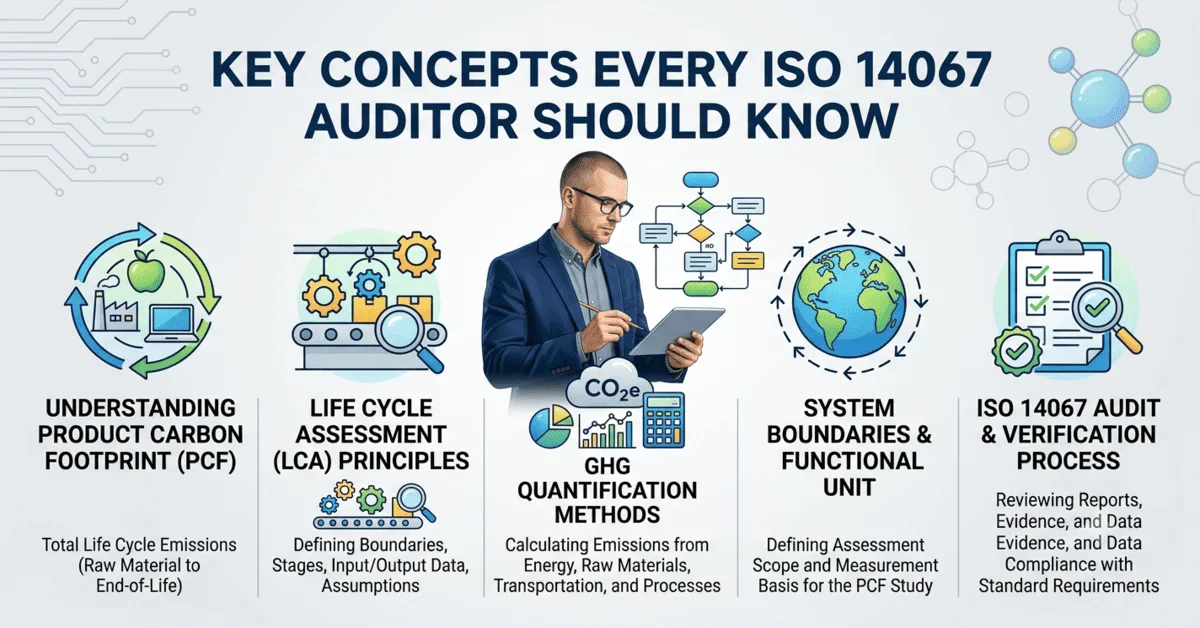
One of the most important concepts every ISO 14067 auditor should understand is Product Carbon Footprint (PCF). PCF represents the total greenhouse gas emissions generated by a product throughout its life cycle, including raw material extraction, production, transportation, use, and end-of-life stages.
Through ISO 14067 lead auditor training, professionals learn how to evaluate product systems, review data collection methods, and assess carbon emission calculation approaches. A strong understanding of PCF helps auditors identify errors in carbon footprint studies and ensure accurate, transparent, and reliable results. The principles of ISO 14067 carbon footprint auditing help professionals understand how product emissions are assessed, verified, and reported effectively.
Role of Life Cycle Assessment (LCA) in ISO 14067
Life Cycle Assessment (LCA) is a fundamental concept in ISO 14067. It helps organizations analyze environmental impacts associated with different stages of a product’s life cycle.
An ISO 14067 auditor should understand key LCA principles, including:
- Defining product boundaries
- Selecting life cycle stages
- Identifying input and output data
- Reviewing assumptions and calculation methods
Understanding LCA methodology allows auditors to evaluate whether product carbon footprint studies follow a consistent and reliable approach.
Understanding GHG Quantification Methods
Accurate greenhouse gas (GHG) quantification is essential for reliable carbon footprint reporting. ISO 14067 auditors must understand how organizations calculate emissions from energy consumption, raw materials, transportation, and manufacturing processes.
Auditors should review whether organizations:
- Use suitable emission factors
- Maintain accurate data records
- Apply correct calculation methods
- Document assumptions clearly
Proper GHG quantification ensures that carbon footprint results are meaningful and support sustainability decisions.
Importance of Functional Unit and System Boundaries
Functional unit and system boundaries are important elements in ISO 14067 assessments. The functional unit defines the measurement basis for calculating product carbon footprint, while system boundaries determine which life cycle stages are included.
Auditors must verify that organizations clearly define these elements and apply consistent rules during carbon footprint calculations. Incorrect boundaries or unclear functional units can lead to unreliable PCF results.
ISO 14067 Audit Process and Verification Approach
The ISO 14067 audit process involves reviewing documents, evaluating calculation methods, checking evidence, and verifying whether carbon footprint studies meet standard requirements.
During an audit, an ISO 14067 auditor typically reviews:
- Product carbon footprint reports
- Data collection methods
- Calculation records
- Emission sources
- Verification evidence
- Compliance with ISO 14067 principles
Professionals who want to improve their auditing skills and understand practical assessment methods can explore ISO 14067 lead auditor training program, which covers carbon footprint auditing, GHG quantification, and verification practices.
Why ISO 14067 Knowledge Matters for Auditors
A skilled ISO 14067 auditor helps organizations improve carbon transparency, strengthen sustainability initiatives, and make better environmental decisions. As businesses focus more on climate action and carbon reduction, professionals with product carbon footprint auditing skills are becoming valuable across industries.
Completing ISO 14067 lead auditor training helps professionals understand ISO 14067 requirements, audit techniques, and carbon footprint verification approaches. This knowledge enables auditors to evaluate PCF studies, identify improvement opportunities, and support reliable environmental reporting.
Conclusion
Understanding ISO 14067 concepts, including LCA, GHG quantification, system boundaries, and verification methods, helps professionals perform effective product carbon footprint assessments. As organizations focus on sustainability goals, ISO 14067 lead auditor training provides a strong foundation for developing auditing skills and supporting reliable carbon footprint reporting.