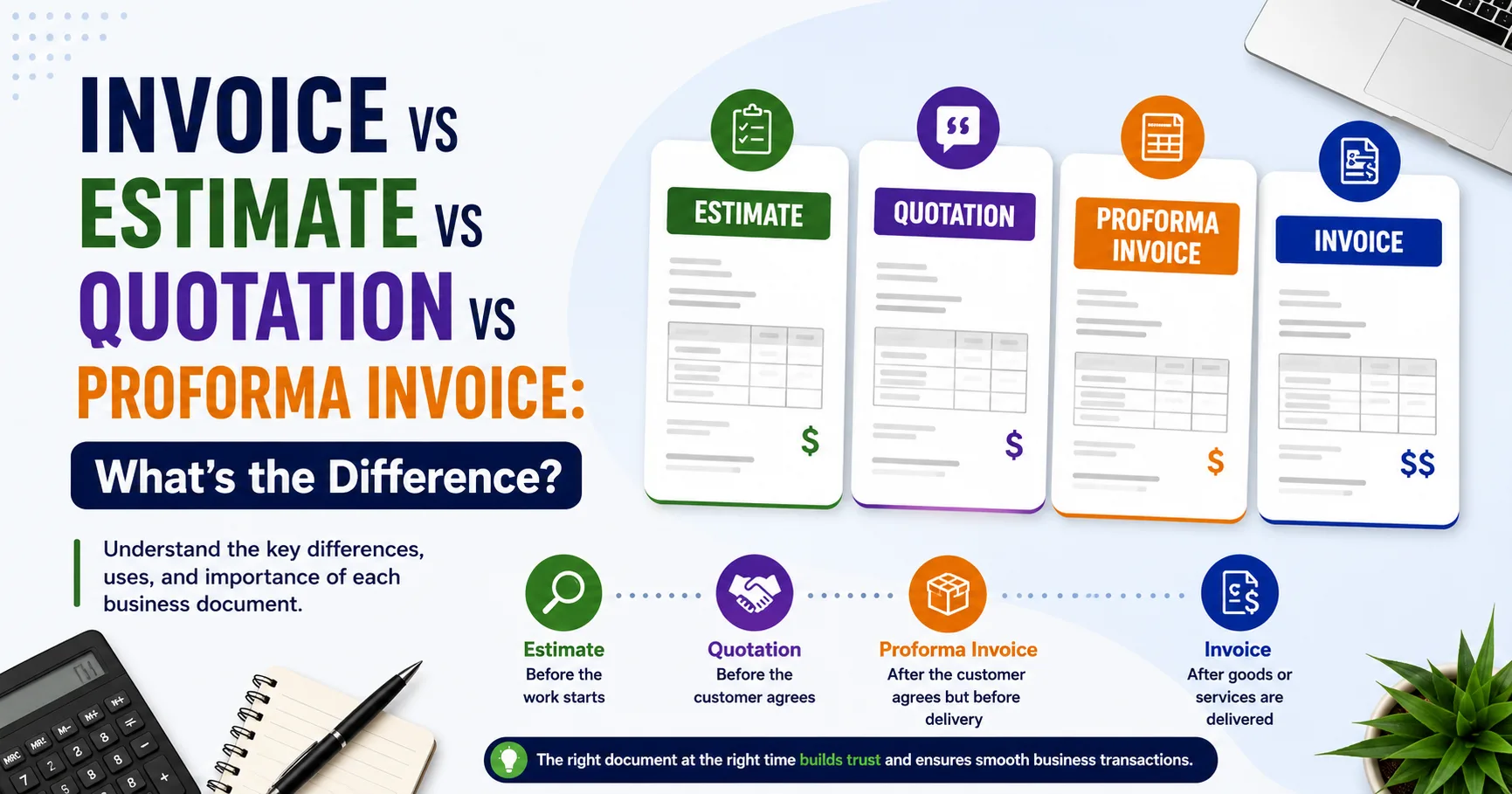
If you've ever created business documents for your customers, you've probably come across terms like estimate, quotation, proforma invoice, and invoice.
At first, they all seem similar. After all, they all include products, prices, and customer details. But they actually serve different purposes at different stages of a sale.
Using the wrong document can confuse your customers, delay payments, or even make your business look less professional.
In this guide, we'll explain the difference between an invoice, estimate, quotation, and proforma invoice in simple words, along with examples of when you should use each one.
Quick Comparison
DocumentWhen it's usedPrice fixed?Payment Required?EstimateBefore the work startsNoNoQuotationBefore the customer agreesUsually yesNoProforma InvoiceAfter the customer agrees but before the deliveryYesUsually before the deliveryInvoiceAfter goods or services are deliveredFinalYes
What Is an Estimate?
An estimate is a rough idea of how much a job or project might cost.
It's commonly used when the final price isn't known yet because the work may change along the way.
Think of it as saying:
"Based on what we know today, this is what the project will probably cost."
For example, if a plumber visits your house but isn't sure how much repair work will be needed, they'll usually give you an estimate instead of a fixed price.
Use an estimate when:
- The scope of work may change
- Material costs aren't final
- Labor hours are uncertain
- You're discussing a project with a new customer
Example
A contractor estimates that renovating a kitchen will cost around $8,000 to $9,500, depending on the materials chosen.
Since the exact work isn't finalized, this isn't a final price.
What Is a Quotation?
A quotation (or quote) is a document that offers a fixed price for specific products or services.
Unlike an estimate, a quotation is usually prepared after understanding the customer's exact requirements.
It tells the customer:
"This is the price we'll charge for the work you've requested."
Most quotations also include a validity period, such as 15 or 30 days.
Use a quotation when:
- Product quantity is fixed
- Service requirements are clear
- You want to offer a firm price
- The customer is ready to make a buying decision
Example
A printing company receives a request for 500 brochures.
After reviewing the requirements, it sends a quotation for $450, valid for 30 days.
If the customer accepts, the business proceeds with the order.
What Is a Proforma Invoice?
A proforma invoice is sent after the customer agrees to buy but before the actual goods or services are delivered.
It looks very similar to a regular invoice, but it is not a demand for payment and isn't an official tax invoice in most countries.
Instead, it confirms the expected transaction and tells the customer exactly what they'll receive and how much they'll pay.
Businesses often use proforma invoices for:
- International trade
- Customs clearance
- Advance payments
- Import and export transactions
Use a proforma invoice when:
- The order is confirmed
- Goods haven't been shipped yet
- The buyer needs payment details
- Customs or banks require transaction information
Example
A furniture manufacturer receives an international order.
Before shipping the products, the company sends a proforma invoice so the buyer can arrange payment and import documents.
What Is an Invoice?
An invoice is the final document sent after goods are delivered or services are completed.
It officially requests payment from the customer.
Unlike estimates, quotations, and proforma invoices, an invoice becomes part of your accounting records.
It usually includes:
- Invoice number
- Customer details
- Products or services
- Taxes
- Payment terms
- Due date
- Total amount
Use an invoice when:
- Work has been completed
- Goods have been delivered
- Payment is due
- You need to record the sale
Example
A web designer completes a client's website and sends an invoice for $1,500 with payment due within 15 days.
Estimate vs Quotation
Many people use these terms interchangeably, but they aren't the same.
An estimate is flexible.
A quotation is usually fixed.
If you're still discussing a project and costs may change, use an estimate.
If everything is finalized and you're ready to offer a price, send a quotation.
Quotation vs Proforma Invoice
These two documents are also easy to confuse.
A quotation is a sales offer before the customer accepts.
A proforma invoice is sent after the customer agrees to purchase but before delivery or billing.
Simply put:
Quotation → Customer decides to buy
Proforma Invoice → Customer has already agreed
Proforma Invoice vs Invoice
This is one of the most common questions among business owners.
The biggest difference is timing.
A proforma invoice is sent before the sale is completed.
A regular invoice is sent after the sale is completed.
A proforma invoice doesn't record revenue.
An invoice does.
Which One Should You Use?
Here's an easy way to remember it.
Use an Estimate if:
- The cost may change.
- You're discussing a project.
- You only want to give an approximate price.
Use a Quotation if:
- The customer wants a fixed price.
- Products or services are clearly defined.
- You're ready to make an offer.
Use a Proforma Invoice if:
- The customer has accepted the offer.
- You need advance payment.
- Goods haven't been delivered yet.
Use an Invoice if:
- The work is finished.
- Products have been delivered.
- It's time to collect payment.
The Typical Sales Process
Most businesses follow a simple workflow:
- Customer asks for pricing.
- Business sends an Estimate (if the cost isn't fixed).
- Business sends a Quotation with the final price.
- Customer accepts the quotation.
- Business issues a Proforma Invoice (if advance payment or shipping documents are required).
- Goods are delivered or services are completed.
- Business sends the final Invoice.
- Customer makes the payment.
Following this process keeps everything organized and makes your business look more professional.
Final Thoughts
Understanding the difference between an estimate, quotation, proforma invoice, and invoice helps you communicate clearly with customers and manage your business more efficiently.
A simple way to remember them is:
- Estimate = Approximate price
- Quotation = Fixed offer
- Proforma Invoice = Pre-sale confirmation
- Invoice = Final payment request
Using the right document at the right stage not only reduces confusion but also builds trust and creates a more professional experience for your customers.
If your business regularly prepares estimates, quotations, proforma invoices, and invoices, using invoicing software can save time by letting you create, manage, and convert these documents in just a few clicks.