Market Overview & Summary
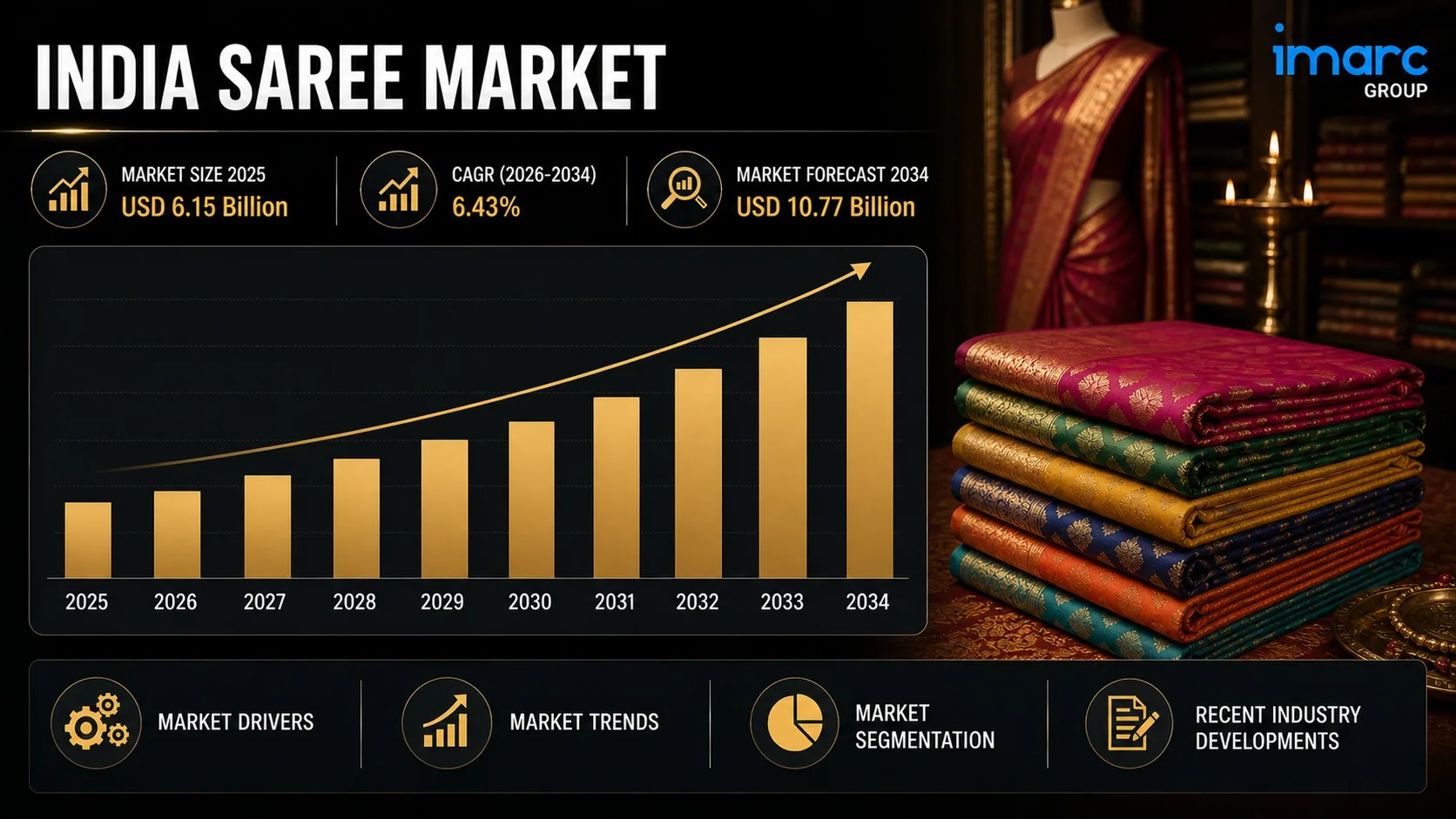
The India saree market size reached USD 6.15 Billion in 2025 and is projected to reach USD 10.77 Billion by 2034, growing at a compound annual growth rate (CAGR) of 6.43% from 2026-2034. The industry is experiencing robust growth propelled by the surge in female labor force participation and strategic government interventions supporting local artisans. Evolving consumer preferences have shifted traditional attire into daily professional wear and modern occasion-wear, further supported by the proliferation of e-commerce channels. Expanding digital retail infrastructure and the implementation of Geographical Indication (GI) tags continue to widen product authenticity and availability, sustaining strong market momentum for diverse regional weaves.
Market Size & Forecast:
- Market Size (2025): USD 6.15 Billion
- Projected Market Size (2034): USD 10.77 Billion
- CAGR (2026 - 2034): 6.43%
- Leading Regional Market: North India (36% Share)
Key Market Trends:
- Surge in Professional Ethnic Wear Adoption: As female workforce participation rises significantly, sarees have transitioned from purely ceremonial garments to staple professional ethnic wear. Corporate offices and government institutions exhibit a high preference for comfortable, breathable cotton weaves, ensuring a non-cyclical, year-round demand that stabilizes the overall volume growth of the mass-market segment and encourages diverse wardrobe collections.
- Implementation of Geographical Indication (GI) Tags: The active enforcement of GI tags for regional handlooms, such as Banarasi and Kanjeevaram, is fundamentally transforming the premium market. This legal protection prevents counterfeiting, assures buyers of product authenticity, and empowers traditional artisans to command premium pricing based on genuine heritage, significantly boosting the profitability of the overall textile value chain.
- Integration of Augmented Reality and Virtual Draping: To overcome the limitations of online shopping, major retailers are deploying advanced AR technologies and virtual draping tools. These innovative digital solutions allow consumers to visualize fit, drape, and exact color accuracy in real time, significantly boosting consumer confidence and reducing product return rates across specialized, high-value e-commerce platforms nationwide.
- Shift Toward Sustainable and Organic Fabrics: Modern consumers are increasingly prioritizing eco-friendly and sustainable fashion choices, driving high demand for organic cotton, bamboo silk, and natural dyes. Progressive brands are responding by utilizing blockchain-based traceability systems to precisely document the sustainable journey from the weaver’s loom to the customer, aligning with growing global environmental and ethical preferences.
- Rise of Contemporary Fusion Designs: The industry is witnessing a structural shift with the rapid introduction of pre-stitched sarees and modern fusion silhouettes. These innovations provide the traditional elegance of a drape combined with the convenience of western wear, making the garment highly accessible to younger, time-constrained demographics and growing diaspora populations globally.
➤ Request Sample Report (TOC & Charts): https://www.imarcgroup.com/india-saree-market/requestsample
Strategic Market Dynamics:
Growth Drivers:
- Rising Female Labor Force Participation: The sharp increase in women participating in the formal workforce directly accelerates the demand for versatile, comfortable daily-wear sarees. This powerful demographic shift structurally expands the non-discretionary apparel category across corporate and institutional sectors, ensuring consistent year-round product consumption.
- Aggressive Government Handloom Subsidies: Strategic federal budget allocations and robust "Vocal for Local" campaigns provide critical financial support for artisanal cluster development. This state backing empowers traditional weavers and modernizes the production supply chain to meet rapidly scaling domestic and international market demand.
- Expanding Disposable Incomes in Tier-2 and Tier-3 Cities: Rising purchasing power beyond metropolitan hubs is creating a robust new consumer class. This growing financial capacity drives higher demand for branded, quality-assured sarees that successfully blend traditional aesthetics with modern retail value and elevated shopping experiences.
- Proliferation of Social Commerce and Direct-to-Consumer Models: The explosive growth of social media storytelling and niche D2C platforms allows direct sourcing from artisans. This digital model eliminates middlemen margins and makes authentic heritage weaves globally accessible, driving high-margin sales and supporting rural economic empowerment.
Market Restraints:
- Intense Competition from Alternative Ethnic Wear: The market faces substantial substitution threats from highly convenient, ready-to-wear alternatives such as kurtis, anarkalis, and palazzo sets. These alternatives offer immediate ease of use, particularly appealing to younger, fast-paced urban demographics seeking quick wardrobe solutions.
- Complex Maintenance and Storage Constraints: Traditional silk and handwoven sarees require specialized dry cleaning, careful handling, and dedicated storage space. These stringent maintenance requirements deter frequent usage and actively discourage bulk purchasing by modern, time-constrained consumers lacking extensive wardrobe infrastructure.
- Supply Chain Inefficiencies and Slow Production Cycles: Authentic handloom production is highly labor-intensive, with intricate designs taking months to complete. This incredibly slow, traditional craft often struggles to meet the rapid, high-volume fulfillment expectations demanded by modern e-commerce retail networks and fast-fashion consumers.
➤ Explore the Full Report with Charts, Table of Contents, and List of Figures: https://www.imarcgroup.com/india-saree-market
Competitive Landscape & Key Company Insights:
The India saree market features a highly fragmented competitive structure, comprising established handloom cooperatives, legacy regional textile mills, and emerging premium designer labels operating across various price tiers. Companies compete aggressively on fabric quality, design innovation, pricing strategies, and the authenticity of regional weaves. Market leaders prioritize expanding their omnichannel presence, integrating AI for personalized recommendations, and securing direct partnerships with artisan clusters to guarantee material authenticity. Continuous investments in digital storytelling and sustainable sourcing remain critical for maintaining a competitive edge and capturing the high-margin professional and bridal demographics.
Deep-Dive Segment Insights:
Type of Saree Insights:
- Cotton Sarees
- Silk Sarees
- Synthetic Sarees
- Linen Sarees
- Chiffon Sarees
- Georgette Sarees
- Designer Sarees
- Handloom Sarees
- Others
Cotton sarees dominate the market with a 23% share in 2025, driven by their superior breathability, versatility, and affordability, making them ideal for daily wear across India's diverse climates and socioeconomic groups.
Price Range Insights:
- Economy Sarees
- Mid-Range Sarees
- Premium/Luxury Sarees
The economy segment leads with a 55% market share in 2025, reflecting strong price sensitivity among consumers seeking value-oriented, durable synthetic and machine-woven cotton options for regular use.
Distribution Channel Insights:
- Online
- Offline
The offline channel holds the largest market share at 65% in 2025, as consumers continue to prioritize the tactile evaluation of fabric weights, draping characteristics, and exact color accuracy before making significant wardrobe investments.
Region Insights:
- North India
- South India
- East India
- West India
North India commands market leadership with a 36% share in 2025, sustained by dense population centers, strong cultural affinity for elaborate traditional attire, and the presence of major textile manufacturing and retail corridors.
Recent News and Developments:
- Strategic Government Handloom Allocations: In August 2025, the government announced an increased budget allocation for handloom schemes, raising the total funding to INR 367.67 crore for 2024-25. This targeted financial intervention is designed to directly support weaver welfare and accelerate regional textile cluster development across the country.
- Launch of Contemporary Fusion Collections: In February 2025, designer Ridhi Mehra introduced the 'Ever After' saree capsule collection. This product line features modern silhouettes by incorporating corset belts and jackets, strategically merging traditional handloom elements with contemporary styling to cater to modern consumers seeking versatile ethnic wear.
- Digital Transformation and Authenticity Campaigns: In January 2025, corporate retailer Taneira launched verified transparency campaigns to specifically showcase their Silk Mark-certified handwoven lines, reinforcing consumer trust in the premium textile market. Additionally, the emergence of digital-first platforms like 'Chhunchi, The Needles Craft' is enabling consumers to discover region-specific weaves through curated online storytelling, seamlessly connecting traditional artisans with a digitally engaged audience.
Customization Note: If you require any specific information not covered within this report's scope, we will provide it as part of the customization.
➤ Request a Customized Report: https://www.imarcgroup.com/request?type=report&id=35333&flag=E
Frequently Asked Questions (FAQs):
Q1. How big is the India saree market?
Ans. The India saree market size was valued at USD 6.15 Billion in 2025.
Q2. What is the projected growth rate of the India saree market?
Ans. The market is projected to exhibit a CAGR of 6.43% from 2026-2034, reaching a value of USD 10.77 Billion by 2034.
Q3. Which type of saree holds the largest market share?
Ans. Cotton sarees dominated the market with a 23% share in 2025, driven by their versatility and superior breathability for daily wear.
Q4. Which price range segment commands the highest consumer demand?
Ans. Economy sarees lead the market with a 55% share in 2025, reflecting value-oriented purchasing behavior for regular usage.
Q5. Which region leads the India saree market?
Ans. North India exhibits a clear dominance with a 36% market share in 2025, propelled by dense population centers and major retail corridors.
Strategic Insight & Verdict:
Through our analysis, we observe that the India saree market is successfully transitioning from a localized, fragmented craft economy into a highly structured, scalable retail asset class. The robust market expansion is predominantly driven by increasing female workforce participation, strategic government support for heritage weavers, and the rapid deployment of direct-to-consumer digital platforms. While alternative ethnic wear poses a persistent substitution threat, the strategic integration of sustainable fabrics, GI tag certifications, and contemporary pre-stitched fusion designs is effectively capturing modern consumer demographics. Companies that focus on establishing vertically integrated supply chains with authentic artisan networks, while enhancing omnichannel shopping experiences, are well-positioned to command significant market share over the forecast period.