Industrial maintenance requires more than switching off a machine before starting repair work. Equipment may contain electrical energy, compressed air, hydraulic pressure, mechanical tension, or other hazardous energy that can cause serious injuries if released unexpectedly. Lockout Tagout (LOTO) is a systematic method of controlling these hazards by isolating energy sources, securing isolation points, and warning employees not to operate equipment during maintenance.
A lockout tagout kit provides the essential devices required to implement this process. However, selecting the right kit and understanding how to use its components correctly are equally important. Whether you work in manufacturing, automotive production, pharmaceuticals, oil and gas, power generation, or another industrial sector, an effective energy-control procedure helps protect employees and supports safer maintenance operations.
E-Square Alliance, through Safetylock.net, offers a comprehensive range of lockout tagout devices, kits, and related services for industrial energy isolation. This guide explains how to use a LOTO kit, select suitable devices, avoid common mistakes, and maintain an effective workplace energy-control program.
What Is a Lockout Tagout Kit?
A lockout tagout kit is a collection of specialized safety devices used to prevent the unexpected operation or energization of machinery during servicing and maintenance. Depending on the application, a kit may contain safety padlocks, lockout hasps, circuit breaker lockouts, valve lockouts, cable lockouts, safety tags, and other accessories.
Each device serves a specific purpose. A safety padlock secures a compatible lockout device, a hasp allows multiple authorized employees to apply their personal locks, and a circuit breaker lockout helps prevent operation of a compatible breaker. Valve lockouts secure suitable valves, while warning tags communicate that equipment must remain out of operation.
Different facilities require different combinations of devices. An electrical maintenance team may need a dedicated electrical LOTO kit, whereas a mechanical maintenance team may require valve and cable lockouts. Facilities handling several types of equipment may benefit from a comprehensive or customized kit.
It is important to remember that a kit is only one component of a complete energy-control program. Workers must follow the equipment-specific procedure, isolate all relevant energy sources, control stored energy, and verify safe conditions before maintenance begins.
Why Is a Lockout Tagout Kit Important?
Unexpected machine startup can cause electrical shock, burns, crushing injuries, cuts, and entanglement. Even when equipment appears to be switched off, hazardous energy may remain in electrical components, pressurized systems, elevated loads, springs, or rotating machinery.
A lockout tagout kit helps authorized employees secure energy-isolating devices and maintain control over the equipment while work is underway. It also helps establish consistent procedures across maintenance teams and departments.
In the United States, OSHA's general industry standard, 29 CFR 1910.147, addresses the control of hazardous energy during covered servicing and maintenance activities. It includes requirements for energy-control procedures, training, lockout and tagout devices, stored energy, and verification. Employers must determine which requirements apply to their operations and establish appropriate procedures.
A suitable LOTO kit supports this process, but purchasing safety devices alone does not establish compliance. Correct implementation, employee training, equipment compatibility, and regular program reviews are also essential.
What Does a Lockout Tagout Kit Include?
The components of a lockout tagout kit depend on the machinery, energy sources, and maintenance requirements of the facility. Common components include:
- Lockout safety padlocks: Secure compatible isolation devices and help maintain individual control over protection.
- Lockout hasps: Allow multiple authorized employees to attach their personal locks to a shared isolation point.
- Circuit breaker lockouts: Secure compatible electrical breakers against operation.
- Valve lockout devices: Prevent operation of compatible valves used in process and utility systems.
- Cable lockouts: Secure compatible isolation points, including certain multiple-point arrangements.
- Lockout safety tags: Communicate warnings and relevant identification information.
- Lockout bags and pouches: Keep portable devices organized and accessible during maintenance.
- Group lockout boxes: Support coordinated isolation arrangements involving several authorized employees.
E-Square Alliance offers several kit categories through Safetylock.net, including basic LOTO kits, electrical LOTO kits, mechanical and valve LOTO kits, electrical and valve combination kits, and protective zip-pouch kits.
Before choosing a kit, identify the actual isolation points in your facility. Check the product specifications and confirm that each device is suitable for the equipment and the intended energy-control procedure.
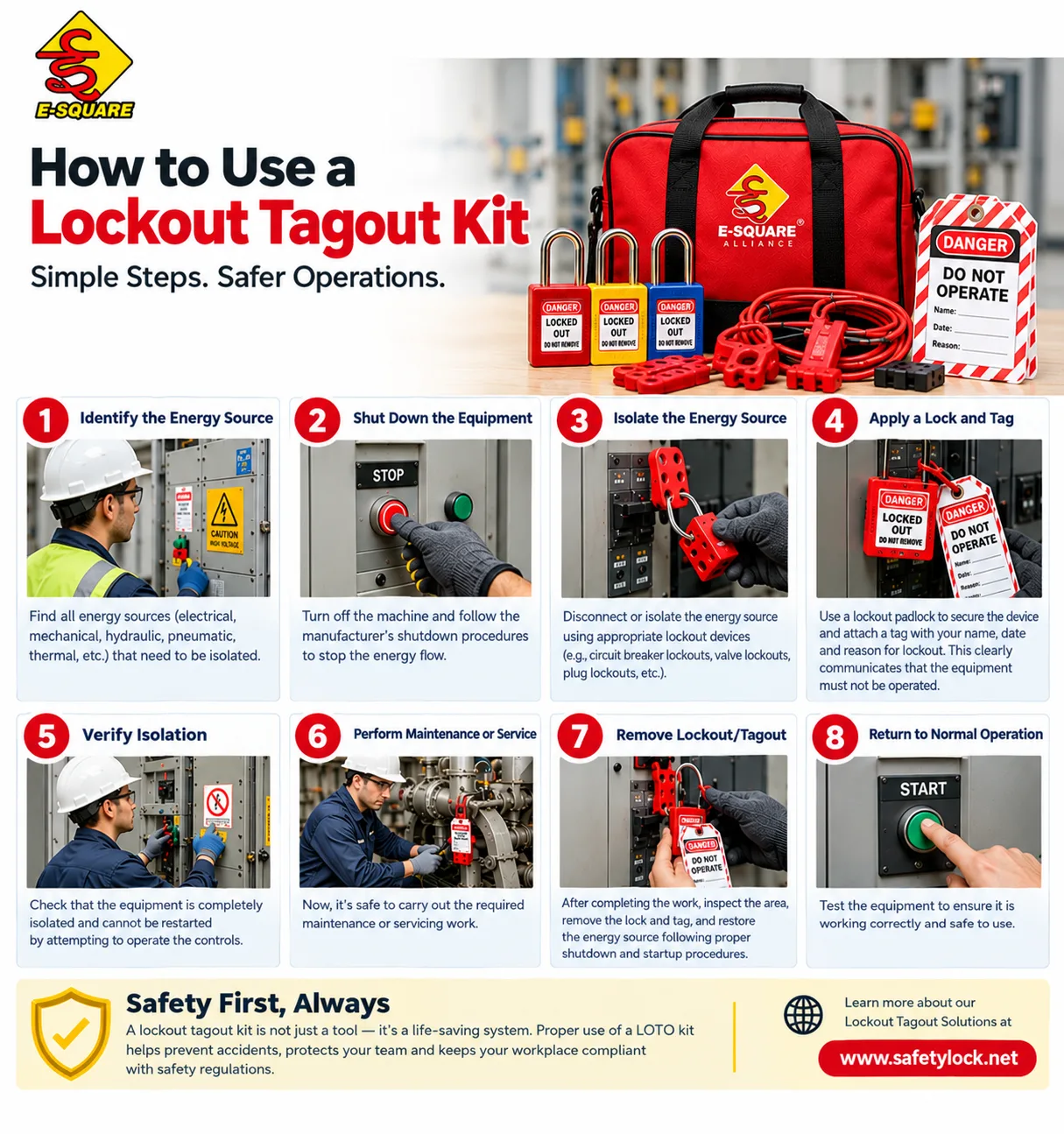
How to Use a Lockout Tagout Kit Step by Step
Using a lockout tagout kit involves a controlled sequence, from preparing the equipment for shutdown to verifying that hazardous energy has been isolated. The following steps provide a general overview and must be adapted to the equipment-specific procedure and applicable regulations.
Step 1: Identify Hazardous Energy Sources
Before beginning maintenance, review the equipment's energy-control procedure and identify all relevant energy sources. These may include electricity, compressed air, hydraulic pressure, steam, chemicals, gravity, and mechanical tension.
Determine the location of each energy-isolating device and the lockout components required. Inspect the selected devices for damage and confirm that they are compatible with the isolation points.
If the energy sources are unclear or the correct isolation points cannot be identified, stop and consult qualified personnel. Never guess which switch, valve, or disconnect controls the hazard.
Step 2: Notify Affected Employees
Inform equipment operators, maintenance personnel, supervisors, and other affected employees that the machine will be taken out of service.
Explain which equipment will be isolated and why maintenance is required. Follow the facility's notification procedure and ensure employees understand that the equipment must not be operated while the lockout tagout process is in effect.
Communication is particularly important when equipment is shared between departments or when maintenance affects an entire production line. Notification, however, does not replace physical energy isolation.
Step 3: Shut Down the Equipment
Follow the machine's established shutdown procedure. This may involve stopping the production cycle, using designated operating controls, or following a prescribed shutdown sequence.
Do not assume that pressing an emergency stop button or switching off the control panel provides adequate isolation. Ordinary control devices may stop a machine without disconnecting the hazardous energy supply.
After shutdown, proceed to the energy-isolating devices identified in the approved procedure.
Step 4: Isolate All Energy Sources
Operate each required energy-isolating device according to the equipment-specific procedure. Depending on the machinery, this may involve electrical disconnects, suitable circuit breakers, or manually operated valves.
Pay attention to auxiliary supplies and interconnected equipment. A machine may have multiple electrical feeds, a shared compressed-air supply, or a hydraulic system that remains pressurized after the main motor stops.
Every relevant energy source must be addressed. If a machine has multiple isolation points, securing only one may leave workers exposed to other hazards.
Step 5: Apply Lockout Devices and Safety Tags
Once the energy-isolating devices are in their required safe positions, apply compatible lockout devices according to the approved procedure.
For example, use a suitable circuit breaker lockout to secure a compatible breaker or an appropriate valve lockout to prevent operation of a compatible valve. Attach the required personal safety padlock and warning tag.
When several authorized employees are working on the same equipment, use an appropriate group lockout arrangement so each employee maintains the required personal protection. Never remove another employee's lock or bypass a lockout device outside the authorized procedure.
Step 6: Control Stored Energy
Isolating the primary energy supply does not necessarily eliminate every hazard. Capacitors may retain electrical charge, hydraulic accumulators may remain pressurized, and elevated loads or springs may contain mechanical energy.
Follow the approved procedure to release, discharge, restrain, block, or otherwise control stored energy. The correct method depends on the equipment and may require qualified personnel or specialized tools.
Consider whether hazardous energy could build up again during maintenance. Maintain the required safeguards throughout the task and never assume that a disconnected power supply makes every component safe.
Step 7: Verify Safe Conditions Before Work Begins
Before servicing starts, verify that all relevant energy sources have been isolated and controlled. Depending on the equipment, this may involve electrical testing with suitable instruments, confirming that pressure has been relieved, or checking that mechanical movement is prevented.
Electrical testing must be performed by qualified personnel using appropriate instruments and safety precautions. Where the approved procedure requires a try-start test, ensure personnel are clear of danger, follow the specified sequence, and return controls to the required safe position.
If unexpected voltage, pressure, or movement is detected, stop work and reassess the isolation. Maintenance must not begin until the required verification confirms that the equipment is safe to service.
Step 8: Complete the Work and Restore Equipment Safely
After maintenance is complete, inspect the equipment and surrounding area to confirm that tools and temporary materials have been removed and that components are ready for operation.
Ensure employees are clear of the hazardous area and follow the approved procedure for removing lockout devices. Each employee should remove their own personal lock unless an applicable, formally authorized exception procedure permits otherwise.
Notify affected employees before restoring equipment to service. Follow the established startup procedure and confirm that the machinery operates as intended.
How to Choose the Right Lockout Tagout Kit
Selecting a suitable kit begins with understanding your equipment and maintenance requirements. A kit intended for electrical isolation may not include the valve or mechanical lockout devices needed elsewhere in your facility.
Use the following table as a starting point.
Kits typeTypical applicationComponents to considerBasic LOTO kitSelected routine isolation tasksPersonal padlocks, tags, and compatible basic devicesElectrical LOTO kitElectrical panels and compatible breakersCircuit breaker lockouts, padlocks, tags, and accessoriesMechanical or valve LOTO kitSuitable mechanical and process isolation pointsValve lockouts, cable lockouts, padlocks, and tagsElectrical and valve combo kitFacilities with electrical and valve isolation requirementsA combination of compatible electrical and valve devicesProtective zip-pouch kitPortable maintenance activitiesOrganized devices in a protective pouchGroup lockout kitTasks involving several authorized employeesHasps, group lockout boxes, and personal locksConsider device compatibility, the number of authorized employees, environmental conditions, storage, and the frequency of maintenance. A facility with multiple machine types may need several specialized kits rather than one general-purpose kit.
For larger projects, a site survey can help identify isolation points, assess existing procedures, and determine which devices are required. E-Square Alliance also provides LOTO-related services, including site surveys, training, machine-specific procedures, and gap analysis, to help businesses evaluate and improve their energy-control programs.
Common Lockout Tagout Mistakes to Avoid
Even a well-equipped maintenance team can make mistakes if procedures are unclear or employees rush through the process.
One common error is assuming that switching off the machine is enough. Another is overlooking secondary energy sources, such as hydraulic pressure, compressed air, or stored mechanical energy. These hazards must be addressed according to the approved procedure.
Using incompatible or damaged devices is another avoidable problem. Inspect components before use and replace defective products. Never modify a device to force it onto an isolation point for which it was not designed.
Poor communication can also create risks during group maintenance and shift changes. Every authorized employee must understand how their protection is maintained throughout the task.
To improve your LOTO process, maintain clear equipment-specific procedures, provide appropriate employee training, inspect devices regularly, and never skip the verification step to save time.
Why Choose E-Square Alliance for Lockout Tagout Solutions?
E-Square Alliance specializes in lockout tagout products and energy-isolation solutions through Safetylock.net. Its product range includes safety padlocks, lockout hasps, electrical lockout devices, valve lockouts, cable lockouts, tags, stations, cabinets, and multiple types of LOTO kits.
The company also offers customized solutions and services for businesses with specific equipment and workplace safety requirements. These include LOTO site surveys, employee training, machine-specific procedures, and gap analysis.
For industrial buyers, having access to both products and technical support can simplify procurement and help align device selection with actual isolation requirements. The right solution depends on your equipment, hazards, and energy-control procedures rather than simply the number of devices in a kit.
Conclusion
Knowing how to use a lockout tagout kit is essential for controlling hazardous energy during industrial maintenance. The process involves identifying energy sources, notifying affected employees, shutting down machinery, isolating every relevant source, applying compatible lockout devices, controlling stored energy, and verifying safe conditions before work begins.
After maintenance, authorized employees must follow the established procedure to inspect the equipment, remove their own locks as required, notify affected personnel, and restore operations safely.
Choosing the correct kit is equally important. Electrical, mechanical, valve, and group maintenance tasks may require different devices, so assess your facility's needs before purchasing. With appropriate equipment, clear procedures, employee training, and regular inspections, businesses can establish a more consistent and effective energy-control program.