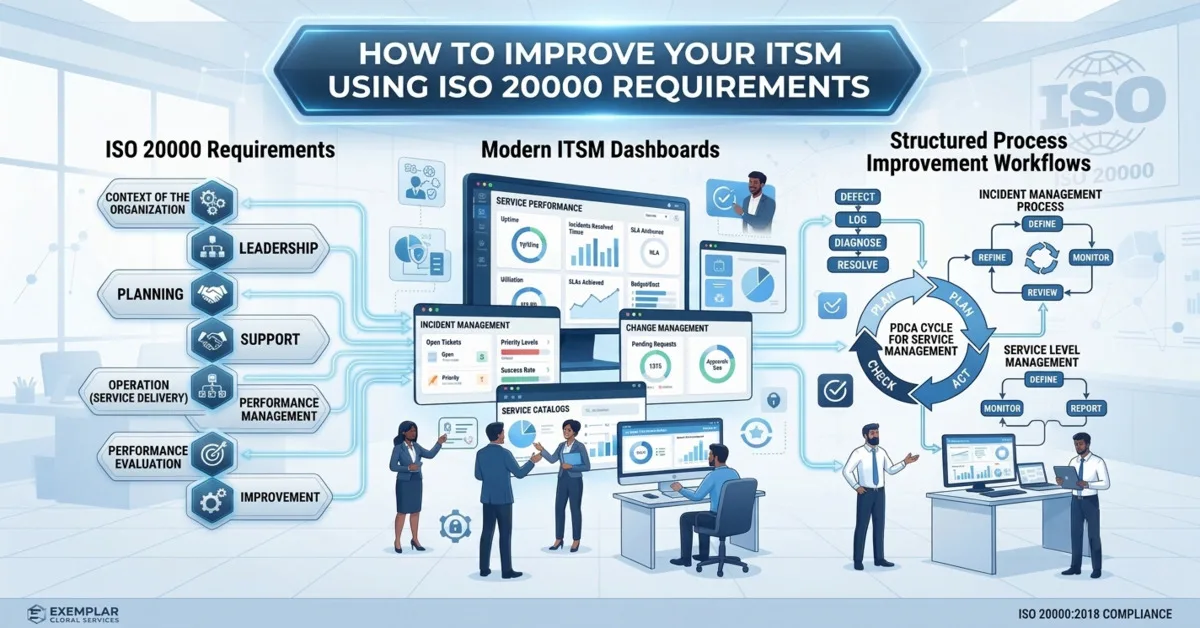
Information technology services are essential for business continuity, employee productivity, and customer satisfaction. However, inconsistent service delivery, recurring incidents, poorly managed changes, and unclear responsibilities can reduce IT performance. Implementing ISO 20000 requirements helps organizations establish a structured IT service management system (ITSMS) that improves service quality, strengthens operational control, and supports continual improvement.
1. Evaluate Existing IT Service Management Processes
The first step toward ITSM process improvement is understanding how IT services currently operate. Review existing workflows, incident records, service requests, customer feedback, service-level agreements, and performance reports. Identify recurring problems, delays, resource gaps, and areas where responsibilities are unclear.
A gap analysis helps compare current practices with applicable ISO 20000 requirements. This assessment provides a practical foundation for planning improvements, prioritizing risks, and setting measurable objectives for service management.
2. Standardize Incident and Problem Management
Frequent IT incidents can interrupt business operations and reduce user confidence. Organizations should establish consistent procedures for reporting, categorizing, prioritizing, investigating, and resolving incidents. Problem management should focus on identifying underlying causes and preventing recurring disruptions.
Clear escalation rules, assigned responsibilities, and accurate incident records help support faster resolution and better decision-making. Tracking recurring incidents also reveals opportunities to improve IT service reliability and reduce avoidable downtime.
Clearly defined roles also help teams understand accountability when handling service incidents and recurring problems. Read this guide on defining ITSMS responsibilities to learn more about assigning responsibilities within an IT service management system.
3. Strengthen Change and Service Level Management
Uncontrolled IT changes can cause service interruptions, security weaknesses, and unexpected costs. A structured change management process helps organizations assess risks, evaluate proposed changes, obtain appropriate authorization, and review outcomes.
Service level management is equally important. Organizations should define relevant service expectations, monitor agreed performance targets, and communicate service results to stakeholders. These practices help align IT services with business needs and improve accountability across IT teams.
4. Improve IT Service Performance Monitoring
Effective IT service performance monitoring enables organizations to evaluate whether their services meet established objectives. Useful indicators may include incident resolution time, service availability, recurring incidents, request completion time, and customer satisfaction.
Regularly reviewing these measurements helps management identify weaknesses and decide where corrective action is needed. Performance data should lead to practical improvements rather than simply generating reports. This approach supports evidence-based decisions and measurable IT service quality improvement.
5. Maintain Effective ISO 20000 Documentation
Consistent documentation helps employees understand their responsibilities and follow approved processes. ISO 20000 documentation can include service management policies, procedures, process records, performance reports, risk assessments, and evidence of reviews and corrective actions, as applicable to the organization's system.
Preparing documents from scratch can require considerable time and coordination. Using structured ISO 20000 documents can help organizations organize their service management documentation and adapt it to their operational requirements.
Before implementation, review the document contents and customize them to reflect actual services, organizational responsibilities, existing workflows, and applicable requirements. Documentation should support daily operations rather than remain unused paperwork.
6. Build Continual Improvement into ITSM
ISO 20000 implementation should be treated as an ongoing management activity, not a one-time certification project. Continual improvement in IT services involves regularly reviewing service performance, analyzing customer feedback, conducting internal audits, and identifying opportunities to make IT processes more effective.
Organizations should assign responsibility for improvement actions, establish realistic deadlines, and verify whether implemented changes produce the expected results. Monitoring performance trends and addressing recurring issues helps maintain ISO 20000 compliance while keeping service management practices aligned with changing business priorities.
Conclusion
Improving ITSM using ISO 20000 requirements helps organizations standardize processes, manage service risks, monitor performance, and deliver more reliable IT services. A structured approach to implementation, supported by appropriate documentation and continual improvement, can strengthen operational consistency and customer satisfaction. Organizations seeking a practical starting point can explore ISO 20000 documentation resources and customize them to support their IT service management objectives.