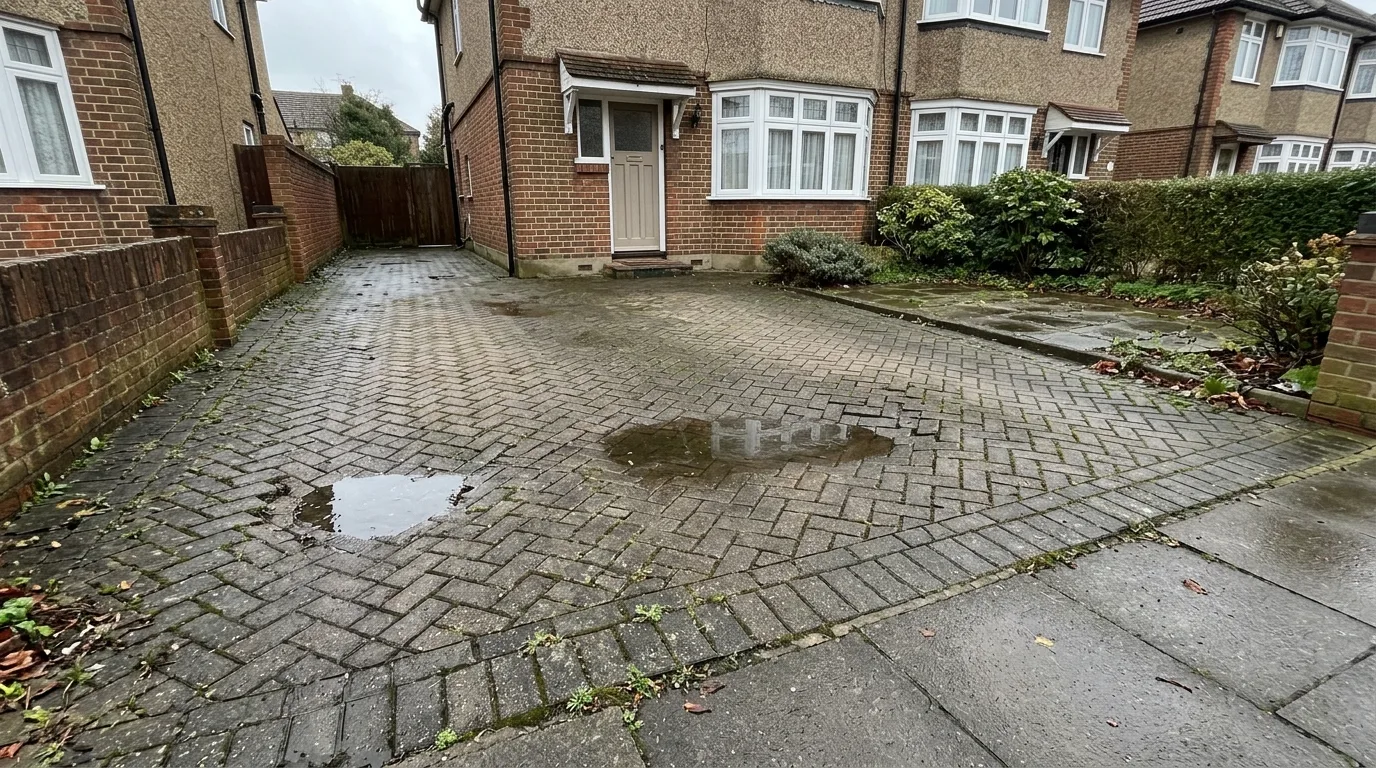
A block paving driveway should look sharp for decades. So it’s frustrating when you notice a dip near the garage, a puddle that never drains or a few blocks that rock when you step on them.
The good news is that most sunken driveways can be repaired, and often without relaying the whole surface. This guide explains why block paving in Enfield settles, how a proper repair works, and when it makes sense to call a paving company in Enfield.

Why Block Paving Sinks or Becomes Uneven
Block paving is a flexible surface made of several layers. The blocks sit on a bedding layer of sharp sand, which rests on a compacted stone sub-base, which sits on the natural ground. Each layer supports the one above it, so if one fails, the blocks on top move too. That’s why a sunken driveway is rarely a problem with the blocks themselves.
1. A weak or thin sub-base
This is the most common cause. If the stone base wasn’t dug deep enough or wasn’t compacted in layers, it slowly compresses under the weight of cars. You’ll usually see dips along the wheel tracks, because that’s where the load concentrates.
2. Water getting underneath
Poor drainage lets rainwater wash out the bedding sand or soften the ground below. Puddles that linger after rain are often the first warning sign, because they show the surface isn’t falling away from the house as it should.
3. Clay soil movement
Much of north London, including Enfield, sits on clay. Clay swells when it’s wet and shrinks when it’s dry. If the ground wasn’t prepared with this in mind, it can shift with the seasons and pull the surface out of level.
4. Tree roots
Roots from mature trees around Southgate, Winchmore Hill and Palmers Green can push blocks up in one spot while drawing moisture from the soil and causing it to sink in another.
5. Utility trenches and old excavations
If a trench for a pipe or cable was backfilled badly, that strip tends to settle over time, leaving a visible line across the driveway.
6. Missing or failed edge restraints
Block paving relies on a firm edge, usually concrete haunching or kerbs, to hold it in place. Without one, the blocks spread outwards under load and the joints open up.
7. Heavy or repeated loads
Delivery vans, skips and parked motorhomes can overload a driveway that was only designed for family cars.
8. Empty joints
The sand between the blocks locks them together so they behave as one surface. If it washes out, often after aggressive pressure washing, the blocks lose their grip on each other and start to shift.
How to Fix Sunken Block Paving: The Professional Method
This is how a proper repair works, and it’s what any good paving company in Enfield should be doing.

Step 1: Mark out and lift the affected blocks
The area is marked out and the blocks are lifted carefully, working from the edges inwards so the neighbouring blocks aren’t disturbed. Good blocks from makers such as Marshalls, Hanson or Bradstone can be reused, so they’re cleaned and stacked in order. Cracked or stained ones are set aside for replacement.
Step 2: Inspect what’s underneath
This step tells you the real cause. A professional checks the bedding sand and sub-base for soft spots, wet ground, voids or contamination. If the bedding sand has simply drifted, the fix is quick. If the stone base has failed, it needs more work. Skipping this step is why many quick repairs sink again within a year.
Step 3: Repair the sub-base where needed
Soft or failed material is dug out and replaced with crushed stone, typically MOT Type 1. It’s laid in thin layers, and each layer is compacted with a plate compactor (a “wacker plate”) until it’s firm. This follows the same principles as a new block paving driveway installation, where the depth of the base depends on the ground and how the driveway is used. Compacting in layers matters because it removes air gaps that would otherwise close up under traffic. Vehicle driveways need a deeper base than footpaths.
Step 4: Fix drainage and falls
The surface needs a gentle fall so rainwater runs away from the house and off the blocks. If water has been ponding, this is the moment to correct the levels and improve drainage, for example with a channel drain or a soakaway. Without this, water will keep undermining the base and the dip will return.
Step 5: Re-lay the bedding layer
A fresh layer of sharp grit sand is spread and screeded level, normally around 30–50mm thick. It should be sharp sand rather than soft building sand, because building sand holds moisture and shifts under load. A smooth, even bed is what gives you a flat finished surface.
Step 6: Re-lay the blocks
The blocks go back in the original pattern, whether that’s herringbone, stretcher bond or basketweave, so the repair blends in with the rest of the driveway. Lines and levels are checked as the work goes, and any blocks that need cutting are cut cleanly to fit around edges and drains.
Step 7: Compact and fill the joints
The surface is compacted with a plate compactor fitted with a protective pad, which settles the blocks into the bed. Kiln-dried jointing sand (or polymeric sand) is then swept into the joints, compacted again and topped up. This locks the blocks together so loads are shared across the surface instead of pressing on single blocks.
Step 8: Clean and finish
Excess sand is swept away and the finished surface is checked for levels and drainage. Many homeowners also choose to have the driveway cleaned and sealed at this point, which refreshes the colour and helps protect the joints.
Can You Fix It Yourself?
Small jobs, such as re-levelling a handful of blocks on a path, are realistic for a confident DIYer. You’ll need a plate compactor, sharp sand, jointing sand and some patience.
Larger or recurring dips are different. If the cause is below the surface, re-levelling the blocks only hides the problem for a few months before it returns. A professional can spot a failing sub-base, correct the drainage and get the compaction right, which is what makes a repair last.
When to Call a Paving Company in Enfield
It’s worth calling a specialist if:
- the same area has sunk more than once
- water pools on the driveway after rain
- the dip is larger than a few blocks
- you can see cracking in the blocks or movement near walls and kerbs
- there are tree roots or old utility trenches nearby
- you’d like the whole driveway checked before the problem spreads
A reliable paving company in Enfield will find the cause, explain your options in plain English and give you a clear quote before any work starts.
How to Stop It Happening Again
- Keep the joints full by topping up jointing sand every year or two.
- Avoid harsh pressure washing, which blasts the sand out.
- Keep gutters and downpipes working so water isn’t discharged onto the driveway.
- Don’t park heavy vehicles on a driveway that wasn’t built for them.
- Pull weeds out early so roots don’t spread.
- Fix small dips quickly, because they only get bigger.
Why Choose First 4 Paving for Block Paving in Enfield
First 4 Paving has been installing and repairing driveways across Enfield and Hertfordshire since 1998. Our own specialist teams work to British Standards using materials from trusted suppliers such as Marshalls and Hanson. They cover Enfield, Southgate, Winchmore Hill, Cockfosters, Edmonton, Palmers Green, Oakwood, Bush Hill Park and Ponders End, plus Cheshunt, Waltham Cross, Hertford, Watford, St Albans and the wider Hertfordshire area.
You get a free design and estimate, no deposit and nothing to pay until the work is complete. They also back our work with a price promise.
If your block paving in Enfield has sunk, shifted or started to pond, call them on 020 3953 5878 or request your free estimate. you’ll find out why it’s happening and fix it properly.
FAQs
Why has my block paving driveway sunk in some places?
Usually the sub-base underneath wasn’t thick or compacted enough, or water has washed out the bedding sand. Clay soil movement, tree roots and heavy vehicles can all add to it.
Can sunken block paving be repaired without replacing the whole driveway?
Yes. If the problem is localised, the blocks are lifted, the base and bedding layer are corrected and the same blocks are re-laid.
How do I stop weeds and sinking after the repair?
Keep the joints full with kiln-dried or polymeric sand, keep drainage clear and fix any small movement early.
Is it worth repairing old block paving?
Often it is, as long as the blocks are sound and the problem is isolated. If the base has failed across most of the drive, relaying is usually the better long-term value.
How long does a block paving repair take?
A small repair is often done in a day. Larger sections or a full rebuild take longer. A paving company can give you a time estimate after seeing the driveway.
Do I need planning permission to replace my driveway?
Not if the new surface is permeable or drains within your property. Impermeable surfaces over 5m² at the front of the house may need planning permission, so check before you start.