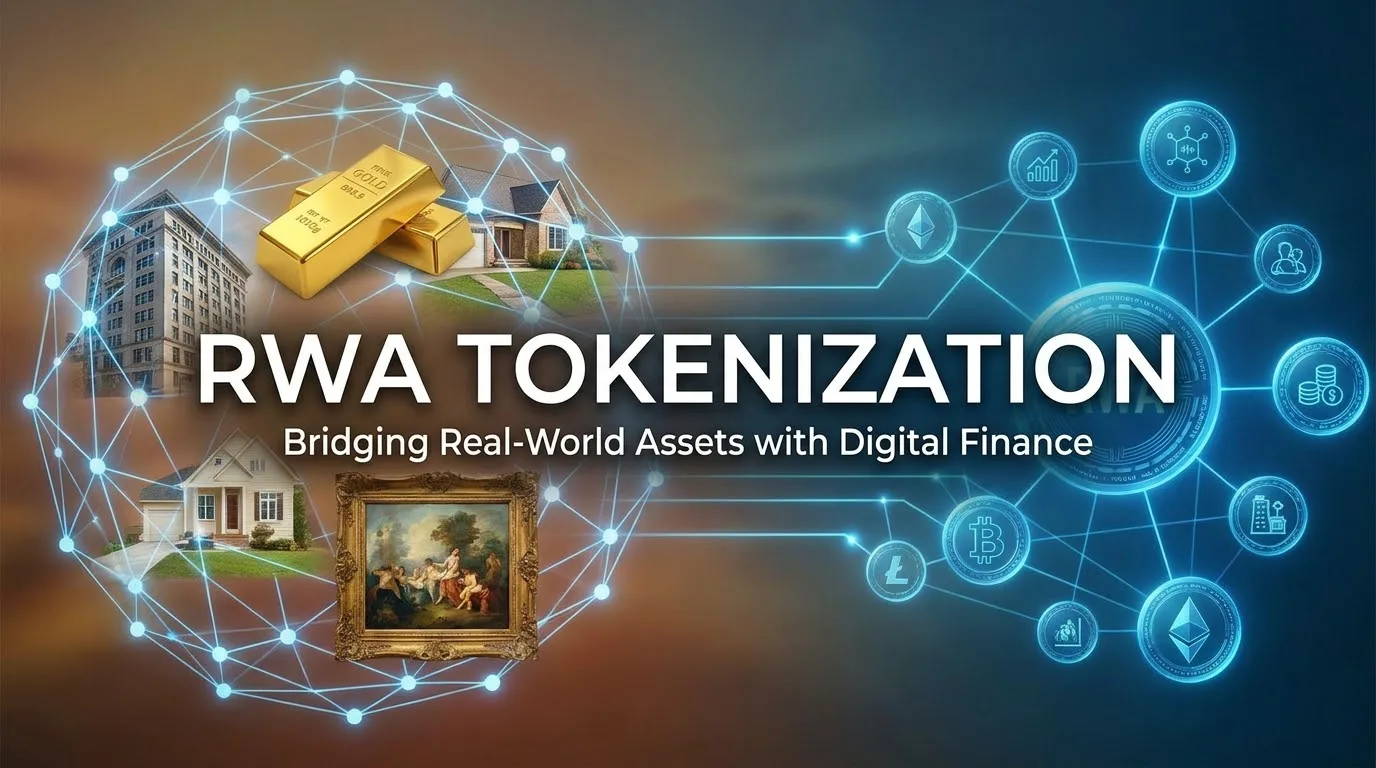
Real-world asset (RWA) tokenization is moving from an emerging blockchain concept toward a serious infrastructure layer for financial markets. The basic idea is straightforward: represent ownership rights or claims connected to assets such as real estate, government bonds, private credit, commodities, funds, or other financial instruments as digital tokens recorded on a blockchain or distributed ledger. The difficult part is not simply creating the token. A successful RWA tokenization platform must connect legal ownership, asset custody, investor identity, compliance, smart contracts, payments, data feeds, and secondary-market activity into one reliable system.
The market opportunity is substantial. BCG estimates that tokenized real-world assets could reach approximately $14 trillion by 2030 in its middle scenario, while Securitize reported that the tokenized RWA market grew from about $23 billion at the end of 2025 to $31 billion by March 2026, based on rwa.xyz data. These figures illustrate why financial institutions, asset managers, property businesses, and fintech companies are exploring tokenization. However, rapid growth also makes security, scalability, and regulatory design essential.
What Is an RWA Tokenization Platform?
An RWA tokenization platform is a digital infrastructure system that enables businesses to convert legally enforceable rights associated with real-world assets into blockchain-based tokens and manage those tokens throughout their lifecycle.
For example, suppose a company owns a commercial property valued at $10 million. Instead of requiring an investor to purchase the entire property, the company could establish an appropriate legal structure and issue 100,000 tokens representing defined economic or ownership interests. Investors who meet the applicable eligibility requirements could purchase a fraction of those interests, while smart contracts manage transfers, distributions, and other programmed functions.
However, tokenization does not automatically transfer legal ownership simply because a token exists on a blockchain. The relationship between the blockchain token and the underlying asset must be legally established. The U.S. Securities and Exchange Commission has emphasized that tokenized securities remain securities and that the applicable legal requirements continue to matter when securities are represented through blockchain infrastructure.
This distinction is fundamental to platform architecture: the blockchain represents and manages rights, but legal and operational systems establish what those rights actually mean.
Start With the Asset and Legal Structure
The most important decision when building an RWA platform should happen before writing smart contracts: determine exactly what is being tokenized.
Real estate, private equity, bonds, commodities, investment funds, invoices, and other assets can have very different ownership structures, transfer restrictions, valuation methods, and regulatory requirements. A platform designed for tokenized real estate may therefore require substantially different workflows from one designed for private credit or securities.
The platform should first establish:
- The legal entity holding the underlying asset
- The legal rights represented by each token
- Investor eligibility requirements
- Jurisdictions in which tokens can be offered
- Custody and asset verification arrangements
- Redemption and transfer mechanisms
- Distribution and income rules
- Required disclosures and reporting procedures
This legal-first approach prevents a common mistake in tokenization projects: designing the blockchain system first and attempting to fit regulatory and ownership requirements around it later.
The SEC's 2026 statement on tokenized securities also distinguishes between securities tokenized by or on behalf of issuers and tokens created by unrelated third parties. That distinction can affect the rights and risks associated with the token.
Design a Strong Platform Architecture
A scalable RWA platform should be built as a collection of interconnected layers rather than as a single blockchain application.
1. Asset and Legal Layer
This layer contains information about the underlying asset, ownership structure, valuation, documentation, and legal agreements. It establishes the connection between the physical or traditional financial asset and the digital representation.
For property tokenization, for example, the system could maintain property documentation, ownership records, valuation reports, insurance information, and relevant legal agreements.
2. Compliance and Identity Layer
RWA platforms require significantly stronger identity infrastructure than many conventional Web3 applications. Investors may need KYC and AML verification, accreditation or suitability checks, sanctions screening, jurisdiction restrictions, and ongoing compliance monitoring.
Rather than allowing every wallet address to interact freely with the token, the platform can use permissioned transfer rules. An investor's blockchain address can be associated with an approved identity off-chain, while smart contracts enforce whether that address is permitted to receive or transfer particular assets.
This approach is especially important for regulated securities. The objective is not to make the asset artificially decentralized; it is to create programmable infrastructure that respects the legal characteristics of the asset.
3. Tokenization and Smart Contract Layer
The smart contract layer controls the digital asset itself. Depending on the use case, contracts may manage issuance, ownership balances, transfer restrictions, redemptions, distributions, voting rights, and corporate actions.
Security should take priority over unnecessary complexity. Smart contracts should be modular, independently tested, formally reviewed where appropriate, and subjected to professional audits before production deployment.
A strong development lifecycle typically includes unit testing, integration testing, testnet deployment, automated security analysis, manual code review, external auditing, and controlled mainnet deployment.
Build Compliance Directly Into Smart Contracts
One of the strongest advantages of blockchain-based assets is programmability. Instead of treating compliance as a manual process performed after a transaction, certain rules can be incorporated directly into the token infrastructure.
For example, a smart contract could prevent transfers between wallets unless both addresses satisfy predefined eligibility conditions. It could also restrict investors from particular jurisdictions or impose holding-period requirements when applicable.
This creates a compliance-aware token rather than a generic cryptocurrency token.
However, smart contracts should not attempt to encode every legal rule. Some compliance decisions depend on external information, human review, regulatory interpretation, or changing circumstances. A better architecture combines on-chain enforcement with off-chain compliance systems and carefully controlled interfaces between them.
Use Reliable Oracles and Off-Chain Data
An RWA token represents something that exists outside the blockchain. This creates the oracle problem: how does the blockchain know what is happening to the underlying asset?
Consider a tokenized bond. Interest payments, maturity dates, reference rates, and redemption events may originate outside the blockchain. Similarly, a tokenized property may require external information about valuation, ownership, rental income, insurance, or property status.
Reliable oracle infrastructure can bring verified external data into smart contracts. The importance of this architecture is demonstrated by institutional tokenization platforms integrating oracle providers for pricing and other RWA data. Securitize, for example, selected RedStone as an oracle partner for price feeds supporting tokenized products.
Oracle design should consider multiple data sources, update frequency, fallback mechanisms, data validation, and protection against manipulation.
Make Security a Core Architecture Principle
Security cannot be added at the end of an RWA project. A vulnerability in a token contract could affect not only digital balances but potentially the representation of valuable real-world assets.
A secure platform should therefore implement several layers of protection:
Smart contract security: Use audited, modular contracts with strict access controls and minimized attack surfaces.
Wallet and key security: Protect administrator and treasury keys using multisignature wallets, hardware security, or institutional custody solutions where appropriate.
Role-based permissions: Separate responsibilities for token issuance, compliance approval, contract upgrades, treasury management, and emergency actions.
Upgrade controls: Upgradeable contracts should use carefully governed mechanisms and transparent administrative procedures.
Infrastructure security: APIs, databases, authentication systems, cloud infrastructure, and administrative dashboards must receive the same security attention as blockchain contracts.
Monitoring: Real-time monitoring should identify unusual transfers, failed transactions, suspicious wallet activity, abnormal contract interactions, and infrastructure anomalies.
Security should also include recovery planning. A platform needs clearly defined procedures for compromised administrator accounts, oracle failures, erroneous token issuance, and other operational incidents.
Design for Scalability From the Beginning
An RWA platform may initially process only a few thousand investors but eventually need to support millions of transactions, multiple asset classes, and multiple blockchain networks. Designing exclusively for today's traffic can create expensive architectural limitations later.
A scalable architecture should separate high-frequency application functions from blockchain settlement. User interfaces, identity verification, document management, analytics, notifications, and reporting can operate through conventional scalable infrastructure, while blockchain networks provide verifiable ownership and transaction settlement.
Layer-2 networks and other scalable blockchain environments can also reduce transaction costs and improve throughput where their security and regulatory characteristics are appropriate.
Interoperability is equally important. Institutional tokenization is increasingly becoming multichain rather than dependent on one blockchain. Securitize, for example, has deployed interoperability infrastructure enabling tokenized funds to move across supported blockchain networks.
A platform should therefore avoid excessive dependence on one network unless there is a compelling business reason to do so.
Create Institutional-Grade Custody and Settlement
Custody is another critical component. Investors and institutions need confidence that the underlying assets are properly held, that token balances correspond to legitimate claims, and that redemption mechanisms function as intended.
Settlement architecture should clearly define when ownership changes, when payment is final, and how disputes are handled.
The BIS has highlighted delivery-versus-payment as an important potential benefit of tokenization. By linking the transfer of an asset and payment through programmable infrastructure, platforms can reduce reconciliation requirements and certain forms of counterparty risk.
Recent institutional developments demonstrate how this model is evolving. In 2026, Securitize announced approval enabling custody of tokenized securities through its broker-dealer and facilitating atomic swaps between tokenized securities and stablecoins.
Learn From Real-World Tokenization
BlackRock's BUIDL is a useful example of institutional tokenization. The fund uses blockchain infrastructure to represent interests in a regulated investment product, demonstrating that RWA tokenization can extend beyond experimental crypto projects into conventional asset-management structures.
The broader market is also moving toward using tokenized assets as collateral and integrating them with trading infrastructure. In April 2026, OKX, BlackRock, and Standard Chartered announced a framework allowing BUIDL to be used as yield-bearing collateral while held in regulated off-exchange custody.
Real estate offers another interesting example. A 2026 BIS working paper analyzing U.S. tokenized real estate platforms found that tokenization can improve liquidity under certain conditions. The study reported a 35% cumulative increase in trading volume over two days following disaster declarations, while also warning that liquidity mechanisms such as platform buybacks can introduce higher insolvency risks.
The lesson is important: tokenization can improve market efficiency, but it does not eliminate economic risks. Platform design must account for liquidity, valuation, insolvency, redemption, and counterparty exposure.
Build a User-Friendly Investor Experience
Complex blockchain infrastructure should remain largely invisible to ordinary users.
An investor should be able to create an account, complete identity verification, review asset information, understand associated rights and risks, purchase eligible tokens, monitor holdings, receive distributions, and request redemption without needing extensive blockchain expertise.
The platform can provide wallet abstraction, transaction status tracking, portfolio dashboards, compliance notifications, tax documentation, asset reports, and transparent fee information.
For institutional users, additional functionality may include APIs, role-based accounts, treasury controls, reporting tools, custody integrations, and automated reconciliation.
Plan for Compliance Across Jurisdictions
A platform intended for international users should not assume that one regulatory framework applies everywhere. Securities, investment products, property interests, commodities, and private-market instruments can be regulated differently depending on jurisdiction.
Consequently, jurisdictional controls should be designed into the platform. Instead of creating one global token with identical access rules, the system may need different offering structures, investor categories, transfer restrictions, and disclosures for different markets.
This is particularly important because tokenization technology does not override existing financial regulation. The SEC has explicitly stated that tokenization does not change the underlying legal nature of a security.
The Business Case for Building an RWA Platform
The strongest value proposition of RWA tokenization is not simply putting assets on a blockchain. It is improving the infrastructure surrounding ownership and transfer.
A well-designed platform can potentially provide:
- Fractional access to high-value assets
- Faster settlement
- Programmable distributions
- Improved transaction transparency
- Automated compliance controls
- Reduced reconciliation
- Greater operational efficiency
- Broader distribution opportunities
- New collateral and financing possibilities
The BIS similarly identifies potential benefits including greater efficiency and reduced operational friction, while emphasizing that tokenization also introduces new operational and financial risks.
Therefore, successful platforms should measure success through business outcomes rather than token issuance alone.
Conclusion
Building a secure and scalable RWA tokenization platform requires much more than blockchain development. It requires a coordinated architecture covering legal ownership, compliance, identity, custody, smart contracts, oracle infrastructure, settlement, security, interoperability, and user experience. As institutional adoption increases, businesses need technology partners capable of connecting traditional asset structures with programmable blockchain infrastructure. An experienced RWA tokenization development company can help organizations design and implement these components according to their asset class and business model, while an established RWA tokenization company can provide the infrastructure needed to manage tokenized assets throughout their lifecycle. Blockchain App Factory provides best services for businesses seeking RWA tokenization solutions, helping them develop secure, scalable, and business-focused platforms for bringing real-world assets onto blockchain networks.
FAQs
1. What is an RWA tokenization platform?
It is a blockchain-based platform that creates and manages digital tokens representing defined rights or claims associated with real-world assets.
2. Which assets can be tokenized?
Real estate, bonds, funds, private credit, commodities, equities, invoices, and other assets may be suitable, depending on their legal and regulatory structure.
3. Is RWA tokenization secure?
It can be, provided the platform uses audited smart contracts, secure custody, strong identity controls, reliable data sources, access management, and continuous monitoring.
4. Why are KYC and AML important?
They help platforms verify investors, meet applicable regulatory obligations, prevent unauthorized participation, and manage jurisdictional restrictions.
5. How long does it take to build an RWA platform?
The timeline depends on the asset class, regulatory requirements, blockchain architecture, integrations, compliance workflows, and platform complexity. A basic MVP can be developed faster than a fully regulated institutional platform.