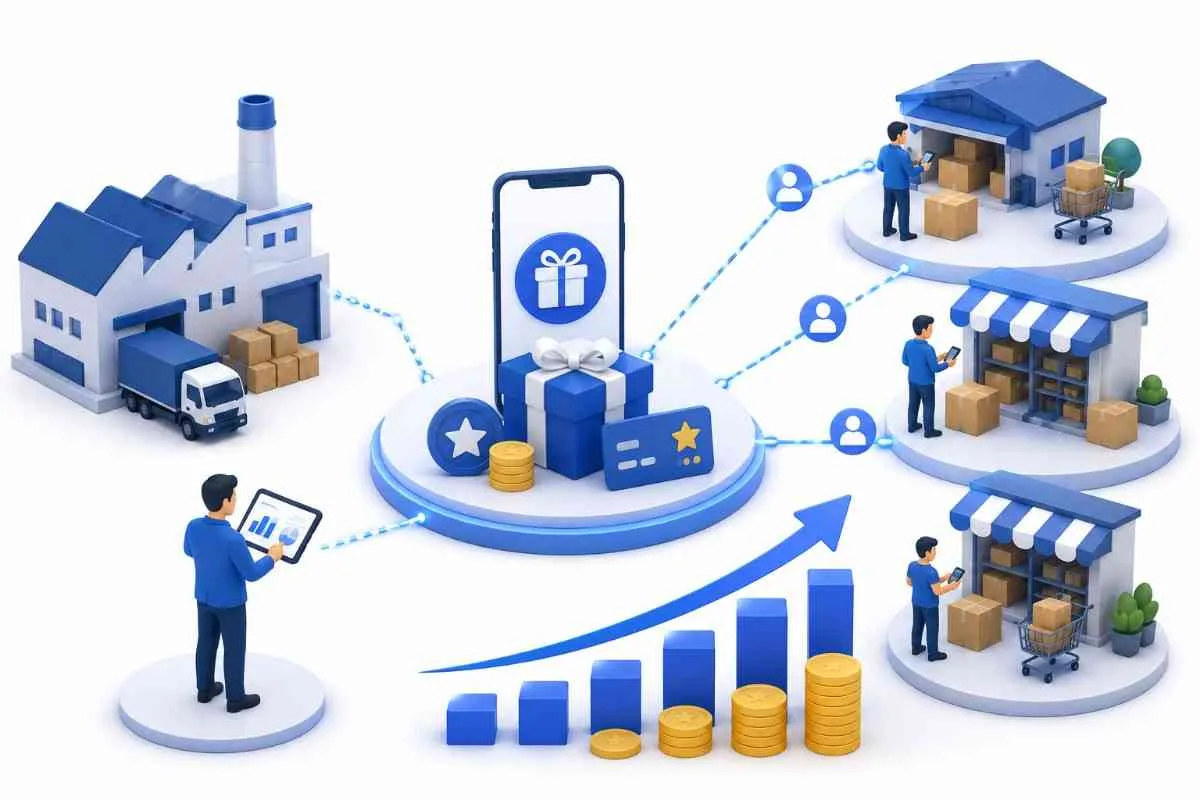
Your dealers have options. Your distributors are pitched by your competitors every quarter. Your channel partners hold significant power over which brands they push to their customers and that decision is rarely made purely on product quality or price.
It is made on relationships. On which brand makes them feel valued, supported, and invested in their success. On which brand has a program that actually rewards their loyalty not in theory, but in reality, consistently, and in ways that matter to their business.
This is the domain of the B2B channel loyalty program. And in 2026, building one well or poorly is the difference between a channel that drives compounding revenue growth and one that costs you money while your dealers quietly shift wallet share to competitors.
"A 5% increase in B2B channel partner retention can increase revenue by 25–95%. Yet only 22% of B2B companies have a formal loyalty strategy." Forester Research
1. Why B2B Channel Loyalty Programs Are Different And Why Most Fail
The instinct many companies have when launching a channel loyalty program is to look at consumer loyalty programs for inspiration. Points for purchases. Tiers. A rewards catalog. That instinct leads to failure more often than not.
B2B channel relationships operate on entirely different dynamics. Understanding those dynamics is the prerequisite for building a program that works.
The Structural Differences That Change Everything
Multiple Stakeholders, Not One Buyer
In B2C, you're rewarding one person's decisions. In a B2B channel program, you're influencing an entire organisation: the dealer principal who sets commercial strategy, the sales team who recommends products to end customers, the inventory manager who decides what to stock, and sometimes the service team who completes post-sale work. A program that only addresses one of these stakeholders leaves value on the table.
Rational and Emotional Motivations Coexist
B2B buyers are not purely rational. Research consistently shows that B2B decisions are deeply influenced by relationship quality, trust, and emotional factors. Your channel loyalty program needs to serve both the commercial logic (better margin, better support, better terms) and the emotional dimension (recognition, status, belonging to a preferred partner community).
Long-Term Relationships, Not Transactions
A B2B channel program is not a promotional campaign. It is a long-term relationship architecture. It needs to work not just in the first quarter after launch, but in year three and year five, when novelty has worn off and the program must sustain engagement through genuine, ongoing value delivery.
Compliance Complexity in India
In the Indian market, B2B loyalty programs must navigate GST implications on rewards, TDS requirements on high-value reward payments, and data protection requirements under the DPDPA. These are not optional considerations they are legal obligations that must be built into program design from day one.
⚠ Why Most Programs Fail
The most common failure mode is not a lack of investment it is a mismatch between program design and dealer behavior. Companies build programs based on what they want dealers to do, without understanding what motivates dealers to choose to do it.
2. The Business Case: What a Well-Built Program Actually Delivers
Before building anything, secure internal alignment on what success looks like. A channel loyalty program is a significant investment in technology, in rewards budget, in management time. Stakeholders need to understand what they are buying.
Beyond Revenue: The Five Strategic Returns
Wallet share growth: Dealers who participate in a loyalty program consistently allocate a higher proportion of their purchasing to that brand versus competitors.
Channel data acquisition: A loyalty program is the most effective mechanism to gather real-time data on dealer behavior, product preferences, and inventory cycles.
Reduced price sensitivity: Dealers with a strong loyalty program relationship are demonstrably less likely to switch based on a competitor's price promotion.
Training and capability uplift: Programs that reward training completion produce measurably better-trained dealer networks and higher product attachment rates.
Early warning system: Engagement data surfaces at-risk dealers months before they churn, giving your team time to intervene.
3. Program Architecture: The Four Pillars of a High-Performance Program
A channel loyalty program is not a single thing it is a system of interlocking components. Get the architecture right, and the program performs. Get it wrong, and no amount of reward budget will compensate.
01
Earn Architecture
The mechanics by which dealers accumulate value points, rebates, credits, or a hybrid. Must reward the behaviors that drive your business goals: sales volume, product mix, growth rate, training, and customer satisfaction. Earn rates must be generous enough to feel meaningful without destroying margin.
02
Redemption Architecture
How dealers convert accumulated value into rewards. The catalog must offer choices that resonate with your specific dealer population. What motivates a dealer in Jaipur may be completely irrelevant to one in Hyderabad or Kolkata.
03
Recognition Architecture
Tier names, achievement badges, annual recognition events, preferred partner branding these non-monetary elements often drive more loyalty than the economic rewards themselves. Recognition satisfies the fundamental human need to be seen and valued.
04
Engagement Architecture
The ongoing communication and interaction layer that keeps dealers active between earning opportunities. Challenges, seasonal campaigns, leaderboards, personalised nudges. This pillar separates programs that sustain engagement in year two from those that flatline after launch.
4. Reward Mechanics That Work in B2B
Points-Based Programs
The most common B2B loyalty mechanic. Dealers earn points for purchases and redeem them for rewards. Works well when the earn rate is calibrated carefully and the redemption catalog is genuinely relevant. The core risk is points liability companies that issue points without a disciplined redemption strategy can accumulate significant balance sheet exposure.
Hybrid Programs: The Gold Standard
An always-on points engine provides the loyalty foundation; rebates provide commercial predictability for large dealers; challenges drive tactical behavior; tiering structures the relationship. Hybrid programs are more complex to administer but significantly outperform single-mechanic programs in engagement and ROI.
5. Tier Design: How to Structure Levels That Drive Behavior
Sample Four-Level Architecture
Include growth rate as a co-equal tier qualification criterion alongside volume. This gives mid-sized, fast-growing dealers a path to top-tier status and signals that you value commitment, not just size.
6. Technology Stack: What Your Platform Actually Needs to Do
The technology platform is the operational spine of your program. A program that is brilliantly designed but running on inadequate technology will fail through poor dealer experience, administrative breakdown, or an inability to generate the data the program was built to capture.
Core Platform Requirements for 2026
Flexible points engine: Multi-rate earning, product-level multipliers, growth bonuses all configurable without developer involvement.
ERP and CRM integration: Pre-built connectors for Tally, SAP, Oracle, Salesforce. Purchase data must flow automatically manual entry is a deal-breaker.
Tiered program management: Unlimited tier structures with distinct benefit sets and automated tier movement.
Challenge and campaign builder: Marketing teams must launch and close time-bound challenges without engineering support.
WhatsApp-native engagement: Balance checks, challenge updates, redemption fully functional via WhatsApp.
Multi-language support: Hindi, Tamil, Telugu, Marathi, Kannada, Bengali as standard.
AI-powered engagement tools: Predictive churn alerts and personalised challenge recommendations.
GST-compliant reward management: Built-in tax compliance with automated documentation.
🚩 Platform Selection Red Flags
Consumer loyalty platform being "adapted" for B2B · No native ERP integration · No WhatsApp support · No GST compliance built in · Analytics that update weekly rather than in real time · Rewards catalog that is not India-specific.
7. The 6-Step Launch Playbook
01
Define Objectives With Specific, Measurable Targets
Not "improve dealer engagement" that is not a target. Instead: increase wallet share from enrolled dealers by 15% within 12 months; reduce annual dealer churn from 18% to 12%; achieve 80% training completion among Silver+ dealers.
02
Segment Your Dealer Network Before Designing Anything
Segment by revenue tier, geography, product category, and engagement history. Your program design should reflect the reality of who your dealers are, not an idealised average.
03
Run a Pilot With 50–100 Dealers Before Full Rollout
Measure enrollment rate, engagement rate, first redemption rate, and dealer satisfaction over 60–90 days. Use the data to refine the program before the full launch investment.
04
Invest in Field Sales Enablement
Your field sales team is the primary enrollment and engagement channel. Run program enablement training for all field sales before launch a substantive session with role play and collateral, not a 20-minute overview.
05
Create Launch Momentum With a Joining Bonus
A joining bonus (points credited on enrollment) and an early challenge ("complete your first purchase this month to earn 500 bonus points") create immediate wins that drive the behavioral patterns the program depends on.
06
Establish a 90-Day Review Cadence
Assign a dedicated program manager and schedule formal 90-day reviews. Review enrollment rate, earn rate, redemption rate, engagement by tier, and at-risk dealer alerts. Make program optimisation a recurring discipline.
8. ROI Benchmarks: How to Measure Success
9. India-Specific Considerations for 2026
WhatsApp as Primary Program Interface
With over 500 million Indian users and deep penetration in Tier 2 and Tier 3 markets, WhatsApp-native program interaction is table stakes in 2026. Programs that require dealers to log into a separate portal will see chronically low engagement outside major metros.
GST and TDS Compliance
Loyalty rewards distributed to dealers are taxable events in India. The specific treatment depends on reward type, dealer category, and annual reward value. Programs without built-in GST compliance create legal exposure for both the brand and the dealer.
Regional Language Support
A program delivered only in English will underperform significantly outside major metros. At minimum, program communications should be available in Hindi, Tamil, Telugu, and Marathi for national programs.
10. The 7 Mistakes That Kill Channel Loyalty Programs
Rewarding only volume Entrenches large dealers and provides no motivation for the growing mid-tier that drives the highest ROI.
Setting earn rates that are too low If a dealer does ₹10 lakh of business and earns ₹200 in reward value, the program feels insulting, not motivating.
Ignoring the middle tier The highest ROI opportunity is almost always Silver and Gold tier dealers engaged but not yet fully committed.
Launching without field sales buy-in Programs communicated only through email achieve 20–30% enrollment; programs championed by field teams achieve 60–80%+.
Treating the program as set-it-and-forget-it Program engagement declines 40–60% between month 3 and month 12 without active management.
Choosing a consumer loyalty platform These lack ERP integration, multi-stakeholder management, and GST compliance that B2B programs require.
Not defining success metrics before launch Programs without pre-defined KPIs cannot be managed effectively and generate activity without accountability.