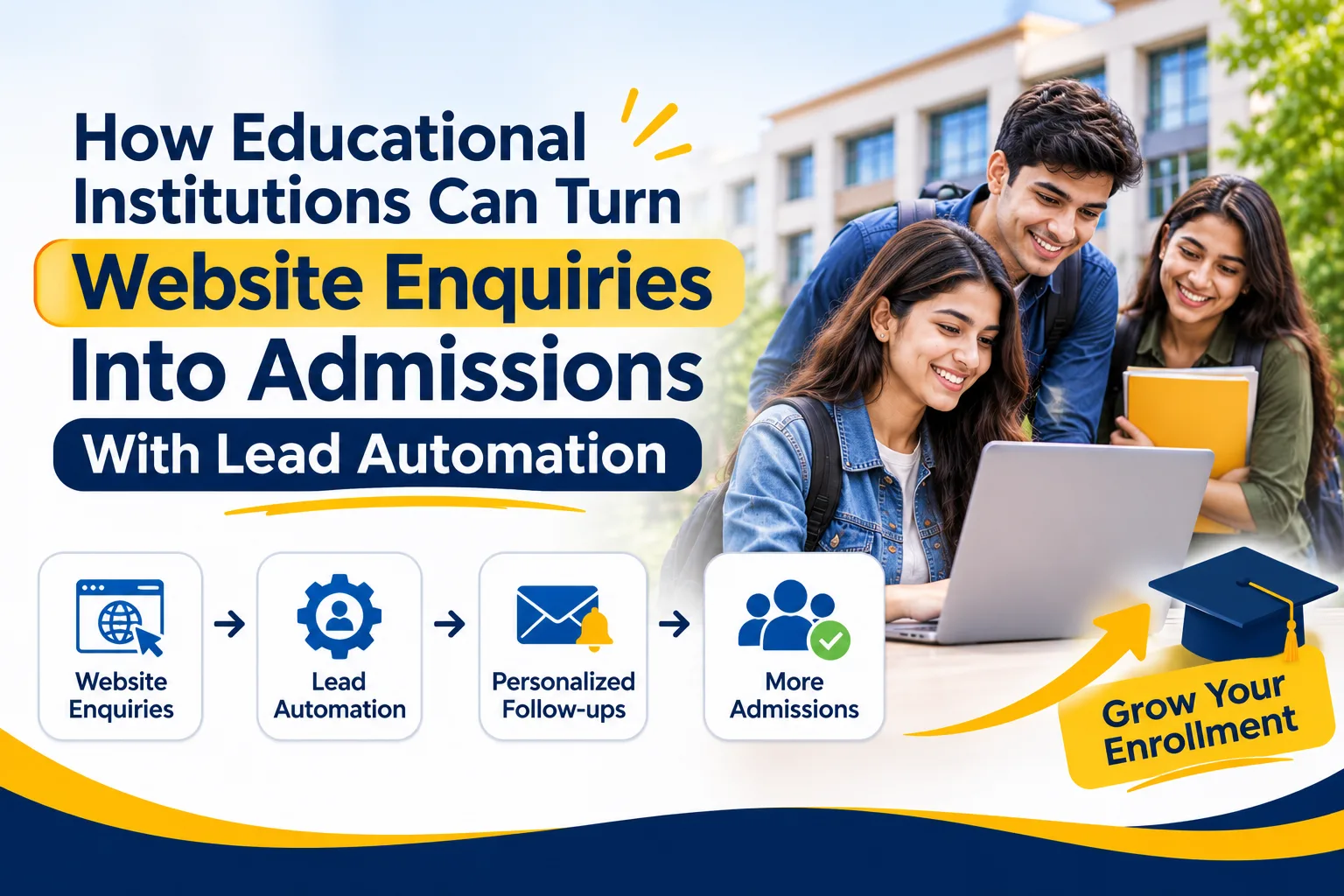
Generating student enquiries is an important part of educational marketing, but receiving a form submission does not mean the admission journey is complete. Schools, colleges, universities, and coaching institutes need a structured process to respond to prospective students, understand their interests, share relevant information, and maintain timely communication.
Many institutions still manage enquiries manually through spreadsheets, phone calls, emails, and messaging applications. As the number of enquiries increases, this approach can make it difficult to track conversations, remember follow-ups, and identify students who are genuinely interested.
This is where lead automation services in India can help educational institutions organise their enquiry management process and create a more consistent experience for prospective students and parents.
Why Educational Institutions Need a Structured Lead Management System
An institution may receive enquiries from several sources, including Google Ads, social media campaigns, organic search, website forms, education portals, and direct calls.
When these enquiries are handled separately, important information can become scattered across different platforms. Admission counsellors may struggle to identify which students have received a response, which enquiries need follow-up, and which applicants are ready to begin the admission process.
A structured lead management system helps institutions:
- Collect enquiries from different marketing channels.
- Store prospective student information in an organised way.
- Identify programme and course interests.
- Assign enquiries to the appropriate admission team.
- Send timely acknowledgements and relevant information.
- Schedule follow-up activities.
- Monitor enquiry and application progress.
The purpose of automation is not to remove personal communication. It is to reduce repetitive administrative work so admission teams can spend more time helping prospective students.
What Are Lead Automation Services?
Lead automation involves using software and predefined workflows to manage activities that happen after someone shows interest in an institution.
For example, when a student submits an enquiry about a management programme, the system can record the details, identify the selected course, notify the relevant counsellor, and send an acknowledgement.
Further communication can then be planned according to the student's interests and admission stage.
With lead automation services in India, educational institutions can create a more organised process for managing enquiries without depending entirely on manual tracking.
1. Capture Enquiries From Multiple Marketing Channels
The first step in lead management is collecting enquiries in one organised system.
Students may discover an institution through search advertisements, social media posts, educational websites, or referral campaigns. Each channel can bring visitors with different interests and levels of readiness.
A centralised system can collect information through:
- Website enquiry forms.
- Course-specific landing pages.
- Google Ads lead forms.
- Social media lead campaigns.
- Contact and callback requests.
- Event and campus visit registrations.
Recording the source of each enquiry also helps institutions understand which marketing activities are bringing relevant prospective students.
2. Use Landing Pages Designed for Student Enquiries
A marketing campaign may attract visitors, but the page they reach plays an important role in whether they decide to submit an enquiry.
This makes landing page design services for educational institutions an important part of the student acquisition process.
A landing page should focus on one specific programme, course, admission campaign, or institutional offering. Instead of displaying every detail about the organisation, it should provide the information relevant to the visitor's interest.
Important Elements of an Effective Education Landing Page
Clear programme headline: Explain which course or admission opportunity the page is about.
Relevant course information: Include eligibility, duration, learning format, facilities, and other verified details that prospective students need.
Visible enquiry form: Make it easy for visitors to request information without searching for contact details.
Trust-building information: Include accurate institutional credentials, faculty details, campus photographs, and verified achievements where relevant.
Mobile-friendly layout: Ensure that the page works properly on smartphones and tablets.
Clear call to action: Use a direct instruction such as "Request Course Information" or "Speak With an Admission Counsellor."
A focused landing page helps connect the message in an advertisement with the information a student sees after clicking.
3. Choose an Education Lead Automation Agency That Understands Admissions
Educational institutions have different admission requirements depending on their programmes, academic levels, application timelines, and target audiences.
A school may receive enquiries from parents, while a college may need to manage applications across several departments and courses. Coaching institutes may have separate enquiry processes for different examinations.
An Education Lead Automation Agency should understand these differences before designing an automation workflow.
When evaluating an agency, institutions should consider:
- Experience with education-related lead management.
- Ability to connect website forms and advertising channels.
- Understanding of course-based enquiry segmentation.
- Customisable follow-up workflows.
- Reporting and performance tracking.
- Data security and access management.
- Ongoing technical support.
The right partner should recommend a process based on the institution's actual admission requirements rather than offering the same automation setup to every organisation.
4. Segment Leads Based on Course Interest
Not every student is looking for the same programme. Sending identical information to all enquiries can make communication less relevant.
Lead segmentation allows institutions to organise prospective students according to useful details, such as:
- Course or programme selected.
- Academic qualification.
- Preferred campus or location.
- Admission intake.
- Enquiry source.
- Current admission stage.
For example, a student interested in a BBA programme should receive relevant programme information rather than general communication about unrelated courses.
Segmentation helps admission counsellors understand the needs of different enquiries and respond with more appropriate information.
5. Create Timely and Personalised Follow-Up Workflows
A delayed response can make it harder for an institution to continue a prospective student's interest. However, manually contacting every enquiry at the right time can become difficult during busy admission periods.
Automation can help create structured follow-up workflows.
A simple example could look like this:
Step 1: Enquiry Received
The system records the student's details and sends an acknowledgement confirming that the enquiry has been received.
Step 2: Relevant Information Shared
The prospective student receives the requested course information, prospectus, or admission instructions through an appropriate communication channel.
Step 3: Counsellor Notification
The relevant admission counsellor receives the enquiry details and can review the student's requirements.
Step 4: Follow-Up Reminder
If further assistance is required, the system can create a reminder for the counsellor to contact the student.
Step 5: Admission Progress Updated
The enquiry status is updated as the student moves from initial interest to counselling, application, or admission.
All automated communication should respect consent, communication preferences, and applicable data protection requirements. Institutions should also provide a way for people to opt out of promotional messages.
6. Connect Landing Pages With Lead Automation
Landing pages and lead automation should not operate as separate activities.
When a visitor submits a form on a course-specific landing page, the submitted information should flow into the lead management system. The system can then record the programme of interest, identify the campaign source, and notify the appropriate team.
For example, an institution running separate campaigns for undergraduate and postgraduate programmes can use different landing pages and enquiry forms. This makes it easier to organise enquiries and provide relevant follow-up information.
A well-connected process reduces manual data entry and helps admission teams maintain better records.
7. Track Lead Quality Instead of Only Counting Enquiries
A large number of enquiries does not automatically mean a successful admission campaign.
Some enquiries may be incomplete, unrelated to the offered programmes, or submitted by people who are not eligible for admission. Institutions should therefore evaluate lead quality alongside lead volume.
Useful performance indicators include:
- Total enquiries received.
- Enquiry source and campaign performance.
- Percentage of enquiries successfully contacted.
- Response time.
- Counselling appointments scheduled.
- Applications started and completed.
- Enquiry-to-application progress.
- Admission outcomes.
These measurements help institutions identify which campaigns and workflows need improvement.
8. Protect Student Information and Maintain Data Quality
Lead automation systems may store names, contact details, course interests, and other personal information. Institutions must manage these records responsibly.
Access should be limited to authorised team members. Data collection forms should explain why information is being requested, and communication should follow appropriate consent and privacy practices.
Institutions should also review duplicate records, correct inaccurate information, and establish suitable retention and deletion procedures.
A reliable system should support both efficient communication and responsible information management.
Why Work With a Lead Automation Agency for an Educational Institution?
Setting up automation involves more than connecting a form to an email notification. Institutions need to understand their enquiry stages, define responsibilities, select suitable tools, and create workflows that match their admission operations.
A lead automation agency for educational institution can help plan this process by assessing existing enquiry channels, identifying manual bottlenecks, integrating relevant systems, and setting up reporting workflows.
Before selecting an agency, ask how it will handle:
- Existing website and advertising integrations.
- Course-wise lead categorisation.
- Enquiry assignment and counsellor notifications.
- Automated acknowledgements and follow-up reminders.
- Reporting and conversion tracking.
- Staff training and ongoing maintenance.
A good implementation should be practical for the admission team to use and flexible enough to support future changes.
Building a Connected Student Enquiry Journey
Lead automation works best when it is part of a broader digital strategy.
Consider a student who searches online for a suitable college programme. The student clicks an advertisement and reaches a focused landing page. After reviewing course details, the student submits an enquiry form.
The system records the enquiry, identifies the programme of interest, and sends an acknowledgement. An admission counsellor receives the information, contacts the student, answers questions, and guides the applicant through the next steps.
Each stage has a clear purpose:
- Digital marketing attracts relevant prospective students.
- Landing page design presents programme information clearly.
- Enquiry forms collect the necessary details.
- Lead automation organises incoming enquiries.
- Counsellor follow-ups provide personal guidance.
- Performance reporting helps improve the process.
This connected approach makes it easier for institutions to manage enquiries from the first interaction through the admission journey.
Conclusion
Educational institutions need more than a system for collecting contact details. They need an organised process that helps them respond to enquiries, understand student interests, and maintain meaningful communication.
By combining lead automation services in India, an experienced Education Lead Automation Agency, and effective landing page design services for educational institutions, schools and colleges can create a more structured student enquiry process.
The goal is not to automate every conversation. It is to make sure that important enquiries are recorded, relevant information reaches prospective students, and admission teams have the right tools to provide timely support.
A well-planned lead management process can help institutions reduce manual work, improve enquiry visibility, and make better-informed decisions about their admission marketing activities.