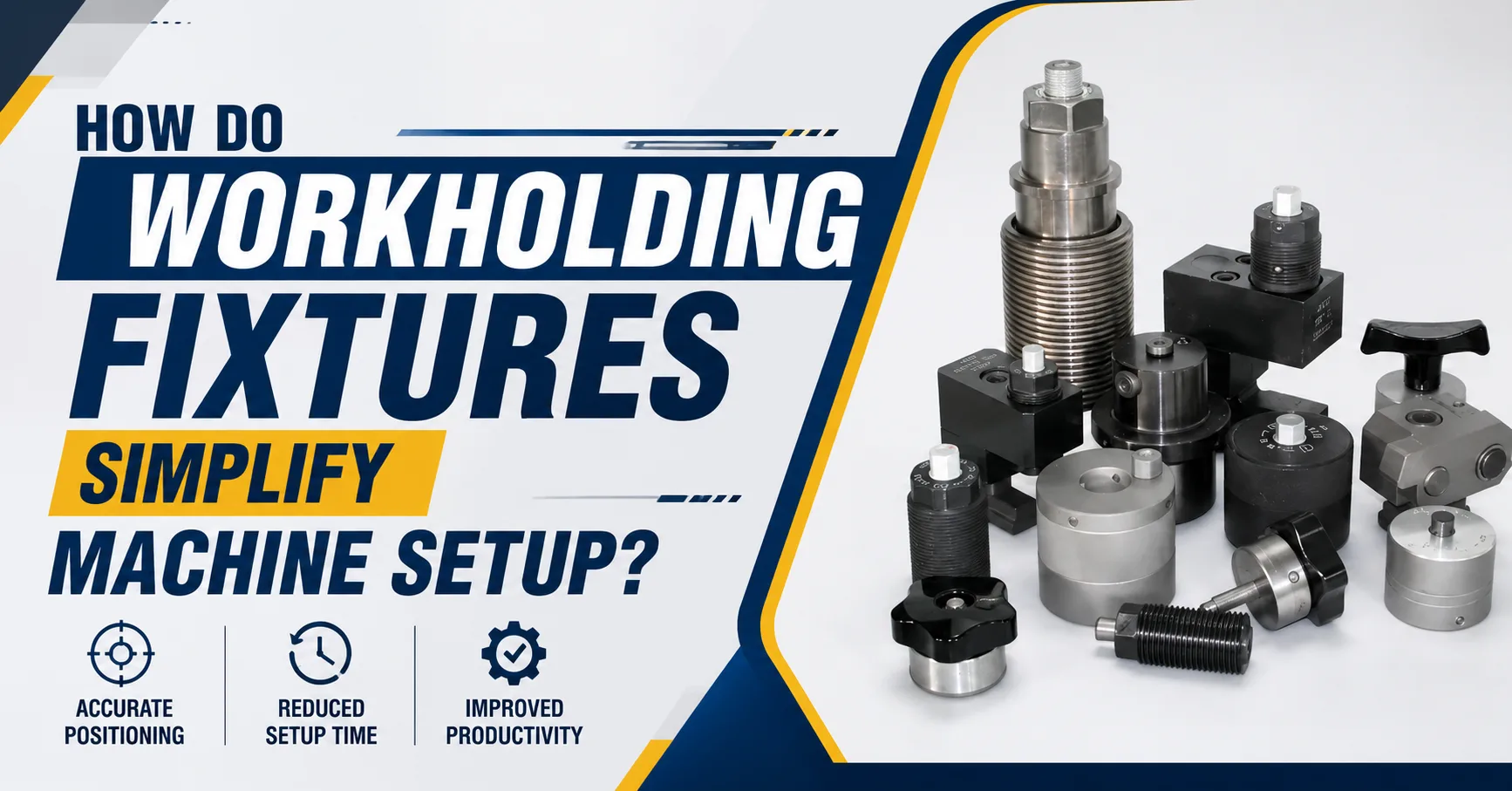
Preparation for machining is not only about getting ready with the machine itself. Prior to machining operations, the workpiece must be securely fixed in place so that its position will not change during machining. Workholding is aimed at preventing any unnecessary movement of the workpiece during machining. This is how workholding fixtures allow fixing billets and workpieces on machine tables.
What Are Workholding Fixtures?
Workholding devices are constructed for mounting billets and workpieces on machine tables while performing machining processes. The most crucial function served by such devices is that they ensure no undesired movements in order to conduct machining operations.
To have a better understanding of the function of individual components, it is imperative to consider their collective functions.
- These devices hold the workpiece firmly to the machine table.
- They are usually called jigs and fixtures.
- They facilitate machining operations by ensuring that there is no undesired movement of the workpiece during machining.
They are typically used in machining operations where consistency is required.
Why Workholding Fixtures Make Machine Setup More Reliable
The process of machining should be characterized as being based on several factors, not just one. Work-holding fixturing consists of several parts that make sure that billets and workpieces will be fixed on machine tables safely, thus ensuring that it will be easier to hold them in place during machining.
- Work-holding fixturing is needed for holding workpieces during machining operations.
- Several pieces are put into slots on machine tables to provide fixation.
- Work-holding fixturing is needed for the stabilization of workpieces during machining operations.
- An assembly of several fastening and clamping parts provides a good fixture.
All of them are constituent elements of a whole work-holding fixture system.
Components Commonly Used In Workholding Fixtures
Work-holding fixtures depend on a number of parts that function collectively in holding billets and workpieces during machining processes. Even though T-slot bolts constitute an essential component in workholding fixtures, they are usually used with other complementary components.
These include the following:
- T-slot bolts
- T-slot nuts
- Coupling nuts
- Extension nuts
- Step blocks
- Gooseneck clamps
- Extra thick washers
- Forged steel clamps
When all these parts are used in combination, work-holding fixtures ensure that there is proper fixing of workpieces on the machine table.
Choosing Components From A Workholding Device Supplier
The selection of the correct components begins with gaining an understanding of the machine table and the applications.
Here are some of the considerations when selecting the components:
- Bolts are compatible with machine table slots.
- Properly matching nuts and washers for assembly.
- Clamps and step blocks that assist in ensuring proper positioning.
Components that are compatible with each other during the machining process.
It will be easy to choose different components depending on the machining process since the workholding device supplier will ensure that there is no mismatch in the components used.
Final Thoughts
The machine setup becomes easy only when all the components are designed in such a way that they work as a whole. The workholding devices give the necessary strength to hold the workpieces securely during the machining process, whereas the T-slot bolts make sure that there is a proper joining of the machine.
If you are looking for quality hardware and expert guidance regarding machining components from an experienced machining workholding device supplier, George H. Seltzer & Co. can be of great assistance in supporting effective workholding fixtures for a variety of machining applications.