The first time our CEO said “AI agent” in a meeting, I nodded like I understood. Then I spent ten minutes googling it under the table.
My name is Nadia. I’m a growth marketing manager at an online learning platform that teaches career skills. For six years, my job was getting learners from “just browsing” to “enrolled”: webinars, email nurture, paid ads, landing pages and the eternal question of why one free-demo headline beat another by 18 percent.
Then, at a Monday leadership meeting, our CEO said, “Every competitor is launching an AI course advisor. Nadia, you know our learners better than anyone. You’re leading ours.”
I smiled. Inside, I was panicking. I wasn’t a product manager. I wasn’t technical. I was the person who wrote “Upskill today, thank yourself tomorrow” on banner ads.
If you’re an edtech marketer who feels the same way, this story is for you. Reach out to Syntax Technologies for learning AI Product Management and job growth.
What Do AI, Gen AI, LLM, AI Agent and AI Operator Actually Mean?
My friend Caleb is a popular online tutor with a big YouTube channel and a lively community of students. Over chai, he explained everything using a school.
“AI is the whole school: any software that does things that normally need human thinking. Gen AI, short for generative AI, is the creative teacher who can produce brand-new lessons, quizzes, images and code. The LLM, or large language model, is the librarian who has read an enormous number of books, so it can write, summarise and answer questions in plain English.”
“ChatGPT, Claude and Gemini are the library counters where you ask the librarian a question.”
“And an AI agent?”
“A teaching assistant who takes a whole task off your plate. You say ‘help this student pick a course and book a counselling call,’ and it checks the options, drafts the reply and flags anything unusual for a human.”
“And an AI operator?”
“The head of department. Decides who handles what, writes the rules, reviews the results and answers for how the school performs.”
I scribbled it on a napkin:
- AI: the school
- Gen AI: the creative teacher
- LLM: the librarian who’s read everything
- AI agent: the teaching assistant who completes tasks
- AI operator: the head of department
Then Caleb said something that changed how I saw my job: “An AI product manager is the person who decides what the teaching assistant can do, what it must never promise, and when to call a human teacher.”
Can an Edtech Marketer Become an AI Product Manager Without Coding?
Caleb wasn’t only explaining AI. He was using it. Every week, his students left hundreds of comments, doubts and messages. He pasted batches into an AI assistant and asked: “Where are students getting stuck? What do they ask for repeatedly? What exact words do they use?”
In minutes, he had a clear map of his learner voice, the real language behind the data. He used it to plan lessons, write sponsor pitches in his students’ words and turn one long lecture into short clips, notes and a newsletter.
“AI drafts, I decide,” he said. “My teaching style is the brand.”
That landed hard. Learner voice, funnel stages, message testing, enrolment metrics: this was my entire career. I had spent six years doing the hardest part of product work without the title.
How Do I Choose the Right Problem for an AI Product?
On Tuesday, I did what I always do before a campaign: I went to the learner data. I exported four thousand course reviews, counselling call notes and webinar chat messages and asked an AI assistant for the top recurring frustrations, with exact learner quotes.
I spot-checked its output against the raw data (always check), and the answer surprised me. Learners weren’t asking for a flashy robot tutor. They were confused. They didn’t know which course fit their background and goals, and they feared wasting money and months on the wrong one.
So instead of building a gimmick, we scoped something useful: a course advisor that asks a few simple questions about a learner’s background and goals, suggests a learning path from our catalogue, explains why and hands off to a human counsellor for fees, refunds and anything complicated.
The first rule of AI product management: the best AI product managers know which learner problem AI should solve first.
Which Edtech Marketing Skills Transfer to AI Product Management?
Here is how my marketing toolkit translated.
Funnel stages became user journeys. I already knew where learners dropped off between webinar, demo class and enrolment. That journey became the map for where the advisor should help.
A/B testing became evaluation. I built a test set of two hundred real learner questions with ideal answers, then scored the advisor’s replies before launch. This process is called evaluation, and it is the heart of AI product management. Marketers who run experiments already think this way.
Brand voice became instruction design. I wrote clear rules for the assistant: its tone, its limits and what to do when unsure. Writing a brand voice guide turned out to be perfect training for writing instructions for an LLM.
Campaign metrics became product metrics. Alongside enrolment rate, I tracked resolution rate, handoff rate, learner satisfaction, course completion and cost per conversation, since every AI response has a price.
What Can Go Wrong With an AI Product? (Hallucinations and Prompt Injection)
We launched a small pilot, and in week two the advisor taught me three lessons for free.
The risky promise. A learner asked whether finishing a course would guarantee a job at a top company, and the advisor answered with an encouraging promise it had no basis for. LLMs can hallucinate, generating fluent, believable answers that aren’t true. In education, inflated outcome claims are not just awkward. They are a trust and regulatory risk. Fix: restrict the advisor to approved course information, ban placement and salary promises, and have it say “I can’t guarantee outcomes, let me connect you with a counsellor.”
The sneaky scholarship. A colleague typed instructions telling the advisor to ignore its rules and grant a 100 percent scholarship. That is prompt injection, and it almost worked. Fix: the advisor could never grant discounts, approve refunds or reveal its instructions. I now ask one question before every launch: what’s the worst thing someone could make this do?
The privacy question. Legal asked what learner data the advisor could see, especially since some learners were students. Answer: only what each task needs, nothing more, with extra care for anyone under 18.
None of these were coding problems. They were product decisions about scope, permissions, safety and trust. That’s the job.
What Tools Does an AI Product Manager Use?
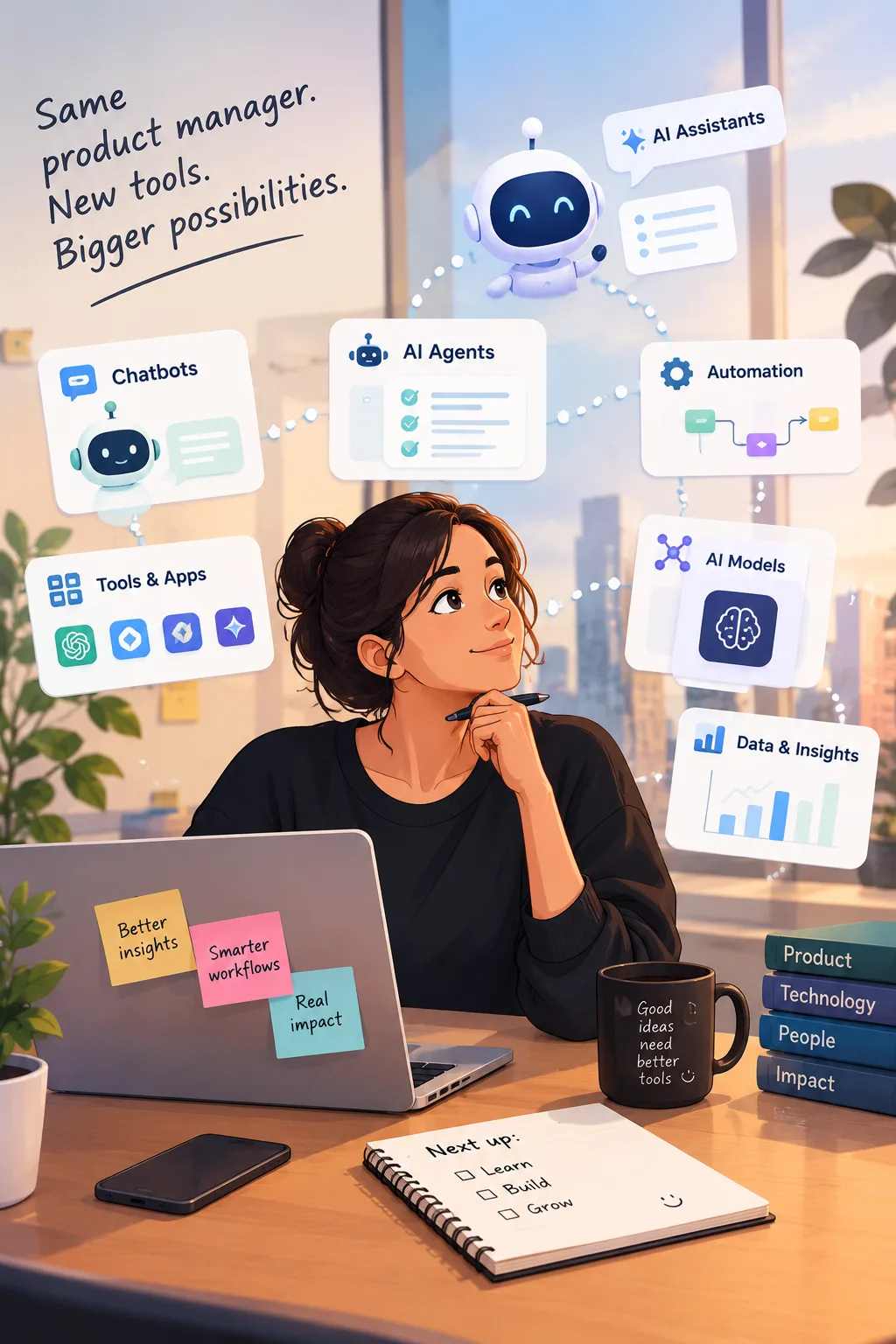
By month three, I had a working stack:
- AI assistants (ChatGPT, Claude, Gemini) for research, requirement drafts, brainstorming edge cases and writing assistant instructions. I verify every important fact.
- Analytics tools (Google Analytics, Mixpanel or Amplitude) to see where learners dropped off between lesson one and course completion.
- Evaluation: the test set plus red-team sessions, where colleagues tried to break the advisor.
- Meeting recorders (like tl;dv) to capture learner interviews and counsellor calls without typing.
- Prototyping tools: AI app builders for clickable demos, so engineers and executives could react to something real.
- Frameworks: the NIST AI Risk Management Framework to structure risk conversations with leadership.
How Does Becoming an AI Product Manager Help My Career?
By the end of the quarter, the results were encouraging. (They’re fictional here, but the pattern is realistic.) More visitors moved from browsing to booking a counselling call, routine questions got answered in seconds, and our counsellors spent their time on the learners who needed real guidance. A human was always one click away.
For my career, the changes were bigger:
- I became the company’s unofficial AI operator, the person other teams pinged with “how did you set that up?”
- My promotion case read: “Used learner data to find the real problem, defined evaluation metrics, ran a controlled AI pilot and launched with guardrails and cost tracking.” That beats “interested in AI” every time.
- Recruiters began messaging me about AI product manager and product marketing roles at edtech and SaaS companies.
- I earned a seat in product strategy meetings, because I could translate between learners, engineers, legal and finance.
Caleb’s channel grew too: sharper insight into what students struggled with, faster content and more time for actual teaching.
How Do I Become an AI Product Manager in 30 Days?
You don’t need to code. You need curiosity, a real learner problem and the habit of testing.
Days 1-7: Learn the language. Pick one assistant (ChatGPT, Claude or Gemini) and use it daily. Learn what an LLM, a prompt and a hallucination are.
Days 8-14: Mine your own learner voice. Take course reviews, survey replies or webinar chat from your own work and ask AI for the top problems and exact phrases. Check the results against the raw data.
Days 15-21: Prototype and evaluate. Build a simple advisor or workflow using a no-code tool. Write ten to twenty test questions with ideal answers and score the results honestly.
Days 22-30: Write your AI product brief. Cover the problem, user, data, success metrics, risks (hallucination, prompt injection, privacy, cost) and human handoff plan. It becomes a portfolio piece.
Then keep going: Learn product management fundamentals, basic SQL and analytics, study how AI products fail, and go deep in a niche such as career upskilling, test prep, K-12 or corporate learning.
Will AI Replace Marketers and Product Managers?
I walked into that first meeting afraid I was the wrong person for the job. It turned out edtech marketers are some of the best-prepared people for it.
The model could write, summarise and answer. It couldn’t decide which learner problem mattered, define what “good” meant, balance cost against value or rebuild trust after a bad recommendation. Someone had to own those decisions.
That someone is the AI product manager. And you can become one, even if you’re currently writing banner ads.
Grab a napkin. Draw your own school. Then pick one learner problem, define what “good” looks like and run one small pilot.
The assistant can answer the question. You decide what it’s allowed to promise.