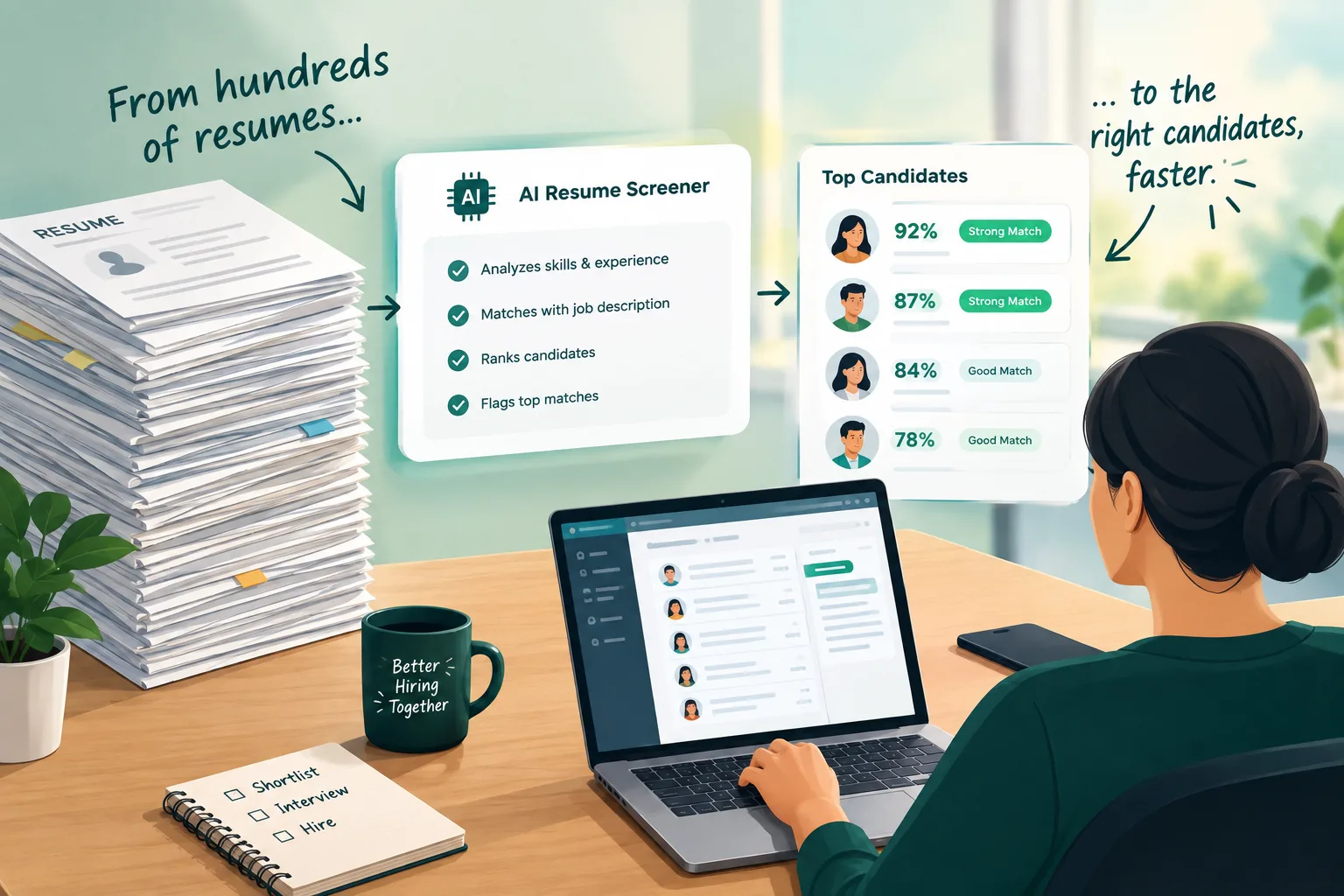
Hiring someone new sounds simple, but going through hundreds of resumes can take up a lot of time. Recruiters need to check each candidate's skills, experience, education, and other details before deciding who might be a good fit for the role.
This is where an AI resume screener can help. It makes resume screening easier by helping recruiters sort applications and find candidates who match the job requirements.
But before choosing a tool, it's worth knowing which features are actually useful. Here are seven features every recruiter should look for.
1. Automatic Resume Reading
Recruiters receive resumes in different formats, and opening each one to find basic details can get tiring.
A good AI resume screener should be able to read resumes and pick out important information like skills, work experience, education, and certifications.
This saves recruiters from spending too much time going through resumes manually. They can review candidate details more quickly and move on to the next step.
2. Skills Matching
A candidate might not have the exact job title mentioned in the job description but could still have the right skills for the role.
That's why skills matching is an important feature in an AI resume screener. It compares the information in a resume with the job requirements and helps recruiters find candidates with relevant skills and experience.
This can also help recruiters discover suitable candidates they might have missed while searching for specific keywords.
3. Candidate Ranking
Imagine receiving 500 applications for a single job opening. Where would you start?
Candidate ranking helps recruiters organize applications based on how closely candidates match the job requirements. Instead of checking every resume in random order, recruiters can start by reviewing profiles that appear more relevant.
Of course, a ranking shouldn't be the final decision. Recruiters should still look at the full resume and consider the candidate's experience before moving forward.
4. ATS Integration
Many recruitment teams already use an applicant tracking system (ATS) to manage applications and keep track of candidates.
If an AI resume screener works with their existing ATS, recruiters can avoid switching between different tools and entering the same information repeatedly.
This makes the hiring process easier to manage, especially when multiple recruiters are working on different positions.
Before choosing a tool, check whether it supports your current ATS and whether the integration works the way your team needs it to.
5. Fair and Consistent Screening
Going through hundreds of resumes in a short time can make it difficult to evaluate every candidate consistently. Personal preferences and unconscious bias can also affect hiring decisions.
An AI resume screener can help by applying the same job-related criteria to all applications.
However, using AI doesn't automatically make hiring fair. Recruiters should check how the tool evaluates candidates, review its recommendations, and make sure qualified applicants aren't overlooked because of unfair screening criteria.
AI should help recruiters make better decisions, not make those decisions for them.
6. Bulk Resume Screening
When a company is hiring for several positions at once, the number of applications can quickly add up.
A useful AI resume screener should make it easier to process multiple resumes without requiring recruiters to review each file individually.
This is especially helpful for recruitment agencies, growing businesses, and companies that regularly hire large numbers of employees.
By reducing repetitive work, recruiters get more time to speak with candidates, schedule interviews, and focus on other hiring activities.
7. A Simple Dashboard
Nobody wants to spend hours figuring out how to use a new recruitment tool.
A simple dashboard makes it easier to view candidate details, check screening progress, and keep track of applications in one place.
Some tools also offer reports that help recruiters understand how many applications they've reviewed and where delays are happening in the hiring process.
These details can help teams figure out what's working and what needs to change.
How to Choose the Right AI Resume Screener
Not every recruitment team has the same needs. A small business hiring a few employees will have different requirements from a company receiving thousands of applications every month.
Before choosing a tool, think about what takes up most of your team's time. If it's reading resumes, look for automatic resume parsing. If finding the right skills is the biggest challenge, focus on skills matching and candidate ranking.
It's also worth checking the pricing, ease of use, data security, and integration options before making a decision.
The goal is to find a tool that makes your team's work easier without adding unnecessary steps.
Final Thoughts
Going through resumes manually can take up a large part of a recruiter's day, especially when there are hundreds of applications to review.
An AI resume screener can make this process easier with features like automatic resume reading, skills matching, candidate ranking, and bulk screening.
Choosing a tool with the right features can help recruiters organize applications, identify relevant candidates, and spend less time on repetitive tasks.
AI won't replace the need for human judgment, but it can make the initial screening process more manageable and give recruiters more time to focus on finding the right people for their teams.