A few years ago, a new business could get by with a storefront sign, a listing in the local directory, and word of mouth. That’s no longer how most customers discover the businesses they buy from. Today, the decision to try a new restaurant, hire a contractor, or sign up for a software tool almost always begins with a search, a social media scroll, or a recommendation found online. This is why digital marketing has become less of an “extra” and more of a basic requirement for staying visible in a crowded market.
Digital marketing isn’t one single activity — it’s a set of connected efforts that work together to put a business in front of the people most likely to need it, at the moment they’re looking. Done well, it doesn’t just generate traffic; it builds a recognizable presence that customers trust and return to.
At its core, digital marketing is the practice of promoting a business, product, or service through online channels — search engines, social platforms, websites, email, and paid ads — instead of relying only on traditional methods like print, radio, or cold outreach.
What makes digital marketing different from traditional advertising is precision and feedback. A billboard reaches whoever happens to drive past it. A well-run online marketing strategy reaches people based on what they’re actively searching for, what interests them, and where they are in their decision-making process — and it tells the business exactly how that effort is performing, in close to real time.
For a small business owner or a startup founder, that combination of precision and measurability is what makes digital marketing worth the investment, even on a modest budget.
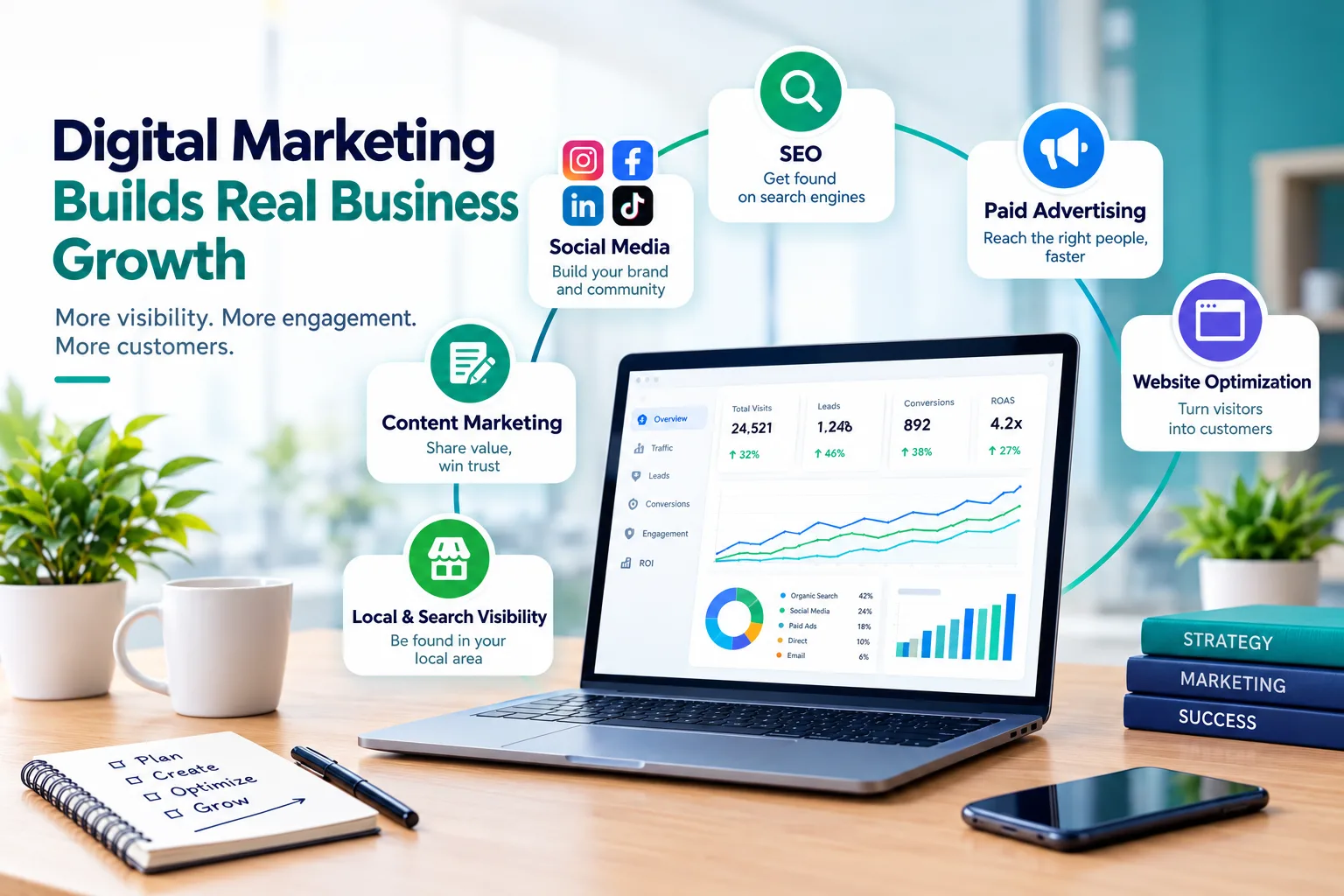
No single tactic carries the full weight of a digital marketing strategy. Each channel plays a different role, and the strongest results usually come from using several of them together.
Search Engine Optimization (SEO)
SEO is the practice of improving a website so it shows up when people search for relevant terms on Google or other search engines. For a local bakery, that might mean appearing when someone searches “custom cakes near me.” For a B2B software company, it might mean ranking for a specific industry problem their tool solves. SEO takes time to build, but it tends to produce some of the most durable, cost-efficient traffic a business can get, because it keeps working long after the initial effort is made.
Social Media Marketing
Platforms like Instagram, Facebook, LinkedIn, and TikTok let businesses show up where their audience already spends time. Social media marketing isn’t just about posting regularly — it’s about choosing the right platform for the audience, creating content that fits how people actually use that platform, and using it to build familiarity with a brand over time.
Content Marketing
Content marketing is the practice of creating useful material — blog posts, guides, videos, case studies — that answers real questions your audience has. Instead of directly asking for a sale, content marketing earns attention by being genuinely helpful, which builds trust and supports SEO at the same time.
Paid Advertising
Search ads, social ads, and display ads let a business buy visibility instantly rather than waiting for organic reach to build. Digital advertising is particularly useful for new businesses that need quick traction, for promoting time-sensitive offers, or for testing which audience segments respond best before committing more budget elsewhere.
Local and Search Visibility
For businesses that serve a specific area — clinics, salons, repair shops, restaurants — showing up accurately on Google Maps and local search results often matters more than ranking nationally. An optimized Google Business Profile, consistent contact information across the web, and local reviews all contribute to this.
Website Optimization
All of the traffic generated by the channels above eventually lands somewhere: the website. If that site is slow, confusing, or not mobile-friendly, much of that effort is wasted. Website optimization covers page speed, clear navigation, mobile responsiveness, and a straightforward path for visitors to take the next step, whether that’s making a purchase, booking a call, or filling out a form.
Why One Channel Is Rarely Enough
It’s tempting for a growing business to pick one channel — usually social media, because it feels the most immediate — and treat it as the whole strategy. The problem is that each channel reaches people differently and at different points in their decision process.
Someone might first notice a brand through a social media post, research it later through a Google search, read a blog post or comparison guide, and only convert after seeing a retargeting ad reminding them to come back. If a business only invests in one of those touchpoints, it loses the customers who needed to see it in a different context.
A coordinated digital marketing strategy treats these channels as parts of one system rather than separate projects. SEO and content marketing build long-term visibility and trust. Social media keeps the brand present and human. Paid advertising fills in gaps and accelerates results while organic efforts mature. Website optimization makes sure none of that traffic goes to waste. The channels reinforce each other — strong content supports SEO, SEO drives organic traffic that paid ads can retarget, and social proof from engagement strengthens both.
Practical Examples for Small Businesses and Startups
A few real-world patterns illustrate how this plays out:
- A local service business (an HVAC company, a dentist, a law firm) typically gets the most value from local SEO, a clear and fast website, and a handful of well-targeted local search ads — because most of their customers are searching with intent, not browsing casually.
- A product-based startup often benefits more from content marketing and social media early on, since it needs to build awareness and explain why its product matters before most people are actively searching for it.
- An e-commerce brand usually needs a mix of SEO for category and product pages, paid shopping ads for immediate sales, and email or retargeting to bring back visitors who didn’t purchase the first time.
There’s no universal formula — the right mix depends on the business, its customers, and its budget — but the principle holds across all of them: visibility built on more than one channel is more resilient and reaches more of the right audience than visibility built on just one.
Measuring What Actually Matters
One advantage digital marketing has over traditional advertising is that almost everything can be measured. The challenge is knowing which numbers actually matter.
- Website traffic shows how many people are finding the business and through which channel, but it’s only the starting point.
- Leads and conversions — form submissions, calls, sign-ups, purchases — show whether that traffic is actually turning into business outcomes.
- Engagement (time on page, social interactions, email open rates) indicates whether the content and messaging are resonating with the right audience.
- Return on advertising spend (ROAS) measures how much revenue is generated for every dollar spent on paid campaigns, which is essential for deciding where to keep investing and where to pull back.
Tracking these consistently — through tools like Google Analytics, Google Search Console, and the reporting dashboards built into ad platforms — turns marketing analytics from a vanity exercise into a decision-making tool. Instead of guessing which efforts are working, a business can see it directly and adjust its strategy accordingly.
Building a Strategy That Fits the Business
Not every business has the time or in-house expertise to manage SEO, social media, paid campaigns, and analytics all at once, and that’s where working with a digital marketing agency can help close the gap. Agencies like SocialHunt, which works with SEO, PPC, social media, and content marketing under one roof, are typically brought in to help businesses coordinate these moving parts into a single strategy rather than a collection of disconnected efforts — something that’s often harder to do well internally, especially for a small team juggling other priorities.
Whether a business handles its digital marketing in-house or brings in outside help, the underlying principle doesn’t change: visibility today isn’t about having a presence everywhere, it’s about having a presence where the right audience is actually looking, and making sure each part of that presence supports the others.
Final Thoughts
Digital marketing has shifted from a nice-to-have into the primary way most businesses are discovered, evaluated, and chosen. SEO builds long-term visibility, content marketing earns trust, social media keeps a brand present, paid advertising accelerates results, and a well-optimized website turns that attention into action. None of these work as well in isolation as they do together.
For small businesses, startups, and growing companies alike, the businesses that treat digital marketing as a coordinated strategy — and that actually track what’s working — tend to build visibility that lasts, and reach the audiences that matter most to their growth.