
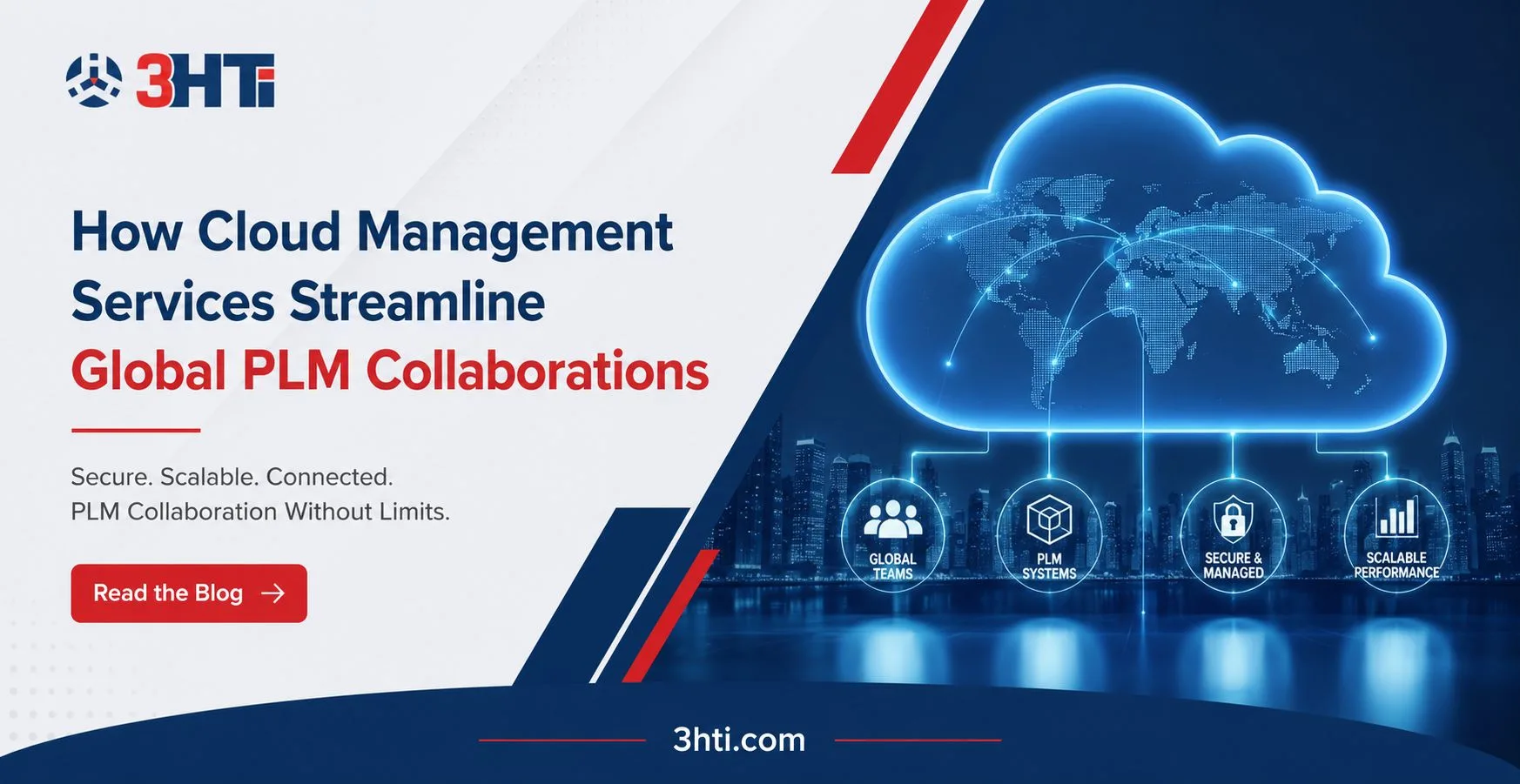
Modern product development rarely happens within a single office or even a single country. Engineering teams, suppliers, manufacturing partners, and quality departments often work across multiple time zones while accessing the same product data. Cloud management services simplify this complexity by providing secure, scalable, and centrally managed environments where Product Lifecycle Management (PLM) platforms remain consistently available, synchronized, and optimized. Organizations that invest in professionally managed cloud environments reduce collaboration bottlenecks, improve engineering productivity, and accelerate product delivery without increasing infrastructure complexity.
Why Cloud Management Services Are Essential for Global PLM Collaboration
Global PLM collaboration depends on every stakeholder accessing identical product information at the right time. Cloud management services make this possible by maintaining infrastructure performance, data consistency, security, and availability across distributed engineering environments.
Unlike traditional on-premises deployments, managed cloud environments allow organizations to scale resources dynamically while supporting geographically dispersed design teams without creating isolated data silos.
How Cloud Management Services Improve Engineering Collaboration
The greatest advantage of managed cloud environments is consistent access to engineering information regardless of location.
Centralized Product Information
Engineers, manufacturing teams, suppliers, and quality departments all reference a single source of product data instead of maintaining disconnected local repositories.
Benefits include:
- Reduced duplicate files
- Consistent BOM visibility
- Controlled document revisions
- Faster design approvals
When every participant works from current product information, engineering changes move through approval cycles with significantly fewer delays.
Secure Remote Engineering Access
Remote collaboration introduces security challenges that cannot be ignored.
Professional cloud management includes:
- Identity and access management
- Multi-factor authentication
- Role-based permissions
- Continuous security monitoring
- Automated backup strategies
This approach allows engineering organizations to support hybrid work environments without compromising intellectual property.
Supporting PLM Implementation Services Through Cloud Infrastructure
Successful plm implementation services extend beyond software configuration. Infrastructure readiness determines whether implementation projects remain stable after deployment.
Cloud management teams assist by:
- Provisioning optimized environments
- Configuring storage architecture
- Monitoring infrastructure health
- Automating maintenance activities
- Managing software updates
Organizations frequently underestimate the operational effort required after implementation. Managed cloud operations prevent infrastructure issues from disrupting engineering teams.
Cloud Migration Without Interrupting Engineering Operations
Many manufacturers still operate legacy PLM environments hosted on aging infrastructure.
Experienced cloud migration service providers minimize disruption by planning migrations in controlled phases.
Migration typically includes:
Infrastructure Assessment
Existing applications, integrations, storage, and workloads are analyzed before migration begins.
Data Validation
Historical engineering records, CAD files, metadata, and configurations are verified before transfer.
Controlled Migration
Applications are migrated during scheduled maintenance windows to reduce operational impact.
Performance Optimization
After migration, infrastructure is continuously optimized for performance, scalability, and cost efficiency.
This phased approach significantly reduces migration risks while maintaining business continuity.
Enabling ALM Integration Across Distributed Teams
Engineering organizations increasingly combine Product Lifecycle Management with Application Lifecycle Management.
Strong alm integration solutions allow software, electronics, and mechanical engineering teams to collaborate within unified development processes.
Cloud management services support this integration by maintaining:
- Stable API connectivity
- Secure data synchronization
- High application availability
- Performance monitoring
- Integration reliability
Without proactive cloud management, integrations often become performance bottlenecks rather than productivity improvements.
Best Practices for Managing Global PLM Environments
Organizations achieving consistent PLM performance generally follow similar operational principles.
Standardize Infrastructure
Using standardized cloud environments simplifies deployment, maintenance, and future upgrades.
Monitor Continuously
Infrastructure performance should be monitored around the clock rather than after users report issues.
Key metrics include:
- Server utilization
- Application response time
- Database performance
- Network latency
- Storage consumption
Early detection prevents small infrastructure problems from affecting engineering productivity.
Automate Routine Maintenance
Routine operational tasks should never rely on manual intervention.
Automation typically includes:
- Backup scheduling
- Patch deployment
- Capacity monitoring
- Log analysis
- Resource optimization
Automation reduces operational errors while improving service consistency.
Common Challenges During Global PLM Collaboration
Even well-designed PLM platforms can encounter operational obstacles.
Common issues include:
- Regional network latency
- Inconsistent software versions
- Permission conflicts
- Storage limitations
- Unplanned downtime
- Delayed synchronization
Organizations often assume these are software problems when the underlying cause is infrastructure management.
Professional cloud operations address these issues before they impact engineering workflows.
Real-World Example
A multinational aerospace manufacturer operates engineering centers across North America, Europe, and Asia.
Initially, each location maintained separate infrastructure supporting a centralized PLM platform. Engineers frequently experienced slow file access, delayed design synchronization, and inconsistent application performance.
After adopting professionally managed cloud infrastructure, the organization:
- Centralized infrastructure management
- Improved application availability
- Reduced collaboration delays
- Enhanced disaster recovery readiness
- Simplified supplier access controls
The engineering teams continued using the same PLM platform, but infrastructure optimization dramatically improved collaboration efficiency.
Evaluating Cloud Management Service Providers
Not every provider offers the operational expertise required for enterprise engineering environments.
Decision-makers should evaluate providers based on:
- Enterprise PLM experience
- Cloud platform expertise
- Security operations capabilities
- Disaster recovery planning
- Performance monitoring
- Scalability strategy
- Manufacturing industry knowledge
- Long-term operational support
Organizations pursuing broader modernization initiatives often work with digital transformation services companies that combine cloud expertise with engineering technology consulting.
Future of Cloud-Based PLM Collaboration
Engineering organizations continue expanding collaborative product development across suppliers, manufacturing plants, and global design centers.
Emerging trends include:
- AI-assisted infrastructure optimization
- Predictive performance monitoring
- Intelligent workload balancing
- Multi-cloud resilience
- Automated compliance monitoring
- Edge computing integration
Cloud management will increasingly become a strategic business capability rather than simply an IT function.
Conclusion
Global product development depends on fast, secure, and reliable collaboration. Cloud management services provide the operational foundation that allows PLM platforms to perform consistently across distributed engineering organizations. By combining proactive monitoring, infrastructure optimization, security management, and scalable cloud operations, enterprises can support global engineering teams without increasing infrastructure complexity. Organizations that treat cloud management as an ongoing operational strategy rather than a one-time deployment decision position themselves for stronger collaboration, greater resilience, and faster product innovation.
Frequently Asked Questions
1. What are cloud management services in a PLM environment?
Cloud management services oversee the infrastructure supporting PLM systems by handling monitoring, security, maintenance, performance optimization, backups, and scalability. They ensure engineering teams have reliable access to product data while reducing the operational burden on internal IT departments.
2. Why are cloud management services important for global engineering teams?
They provide consistent system availability, secure remote access, centralized data management, and optimized application performance, allowing geographically distributed teams to collaborate efficiently on the same product information without version conflicts or infrastructure limitations.
3. How do cloud migration service providers reduce implementation risks?
Cloud migration service providers assess existing infrastructure, validate engineering data, plan phased migrations, optimize workloads after deployment, and minimize operational disruptions, ensuring critical PLM applications remain stable throughout the migration process.
4. How do cloud management services support PLM implementation services?
They prepare and maintain the infrastructure required for successful PLM deployments, including server provisioning, performance tuning, security configuration, storage optimization, and ongoing operational monitoring after implementation.
5. Can cloud management services improve ALM integration?
Yes. They help maintain stable integrations between Product Lifecycle Management and Application Lifecycle Management systems by monitoring APIs, ensuring synchronization, securing data exchanges, and optimizing application performance across connected platforms.
6. What industries benefit most from cloud-managed PLM environments?
Industries with complex product development such as Aerospace & Defense, Automotive, Medical Devices, Industrial Manufacturing, and Life Sciences benefit significantly because they rely on secure collaboration, regulatory compliance, and globally distributed engineering teams.