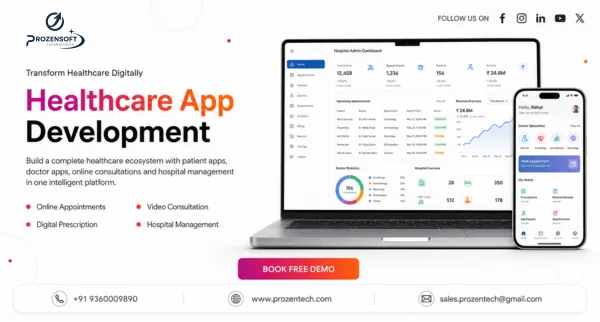
Healthcare is becoming more digital as patients expect faster access to doctors, convenient appointment booking, online consultations, and secure medical information. Hospitals and clinics also need better tools to manage doctors, schedules, patient records, payments, and communication.
Healthcare app development helps medical organizations create a connected platform where patients, doctors, hospitals, and administrators can manage essential healthcare services through mobile applications and web dashboards.
A well-developed healthcare application can reduce manual work, simplify appointment management, improve patient engagement, and make medical services more accessible. It can be designed for a private clinic, multi-speciality hospital, healthcare startup, diagnostic centre, or multi-branch healthcare network.
Why Healthcare Organizations Need a Digital Platform
Many hospitals and clinics still depend on phone calls, paper records, manual appointment registers, and in-person communication. These traditional processes can create long waiting times, missed appointments, duplicate bookings, and administrative errors.
A digital healthcare application allows patients to book appointments at any time without contacting the hospital directly. They can search for doctors, choose a specialization, compare consultation fees, check available time slots, and complete the booking from their smartphones.
Doctors can manage their schedules, access patient information, conduct video consultations, provide digital prescriptions, and recommend follow-up appointments.
Hospital administrators can manage the complete operation through a centralized dashboard. This includes doctors, patients, branches, payments, appointments, reports, commissions, and support requests.
Healthcare app development creates a more organized experience for both patients and medical professionals.
Patient Mobile Application
The patient application should make healthcare services simple and accessible.
Patients can register securely, create their profiles, add family members, and store important health information. They can search for doctors based on specialization, hospital, location, language, consultation type, availability, and fee.
After choosing a doctor, patients can select an available appointment slot and book either an in-person or online consultation.
Important patient features can include:
• Doctor search and filtering
• Hospital and branch selection
• Appointment scheduling
• Online video consultation
• Secure online payment
• Medical report upload
• Digital prescription access
• Appointment reminders
• Consultation history
• Doctor ratings and feedback
• Cancellation and refund requests
• Push notifications
• Family member profiles
• Multi-language support
A clean and easy-to-understand interface is especially important because healthcare applications may be used by children, adults, and elderly patients.
Doctor Mobile Application
The doctor application allows medical professionals to manage appointments and patient consultations efficiently.
Doctors can set their available days, working hours, consultation duration, break periods, and leave dates. The platform can automatically create appointment slots based on the configured schedule.
Doctors can review upcoming appointments, access patient-submitted symptoms, view uploaded medical reports, conduct secure video consultations, and add consultation notes.
After completing an appointment, the doctor can provide a digital prescription, suggest medical tests, recommend a follow-up consultation, or refer the patient to another specialist.
Doctors can also monitor completed appointments, consultation earnings, patient feedback, and withdrawal requests.
Before activating a doctor account, the administrator can verify medical licences, identity documents, educational certificates, specialization details, and professional experience.
Hospital and Branch Management
A scalable healthcare platform can support one hospital, multiple clinics, or an entire healthcare network.
Each hospital branch can have its own doctors, departments, consultation fees, working hours, available services, and appointment schedules.
Patients can select the nearest branch or choose a preferred hospital based on the required medical service.
Branch managers can receive separate access to manage doctors, appointments, availability, and reports for their location.
This structure helps healthcare organizations maintain centralized control while allowing every branch to operate independently.
Telemedicine and Video Consultation
Telemedicine has become an important part of modern healthcare delivery.
Patients may require medical advice, follow-up consultations, prescription reviews, or report discussions without travelling to a hospital. A healthcare application can provide secure video consultations directly through the patient and doctor apps.
Before the consultation, patients can submit symptoms, previous prescriptions, laboratory reports, and images. Doctors can review this information and prepare for the appointment.
During the video call, the doctor can communicate with the patient, discuss the condition, provide recommendations, and record consultation notes.
After the appointment, the patient can access the digital prescription and follow-up instructions through the application.
Telemedicine can improve healthcare access for rural areas, elderly patients, people with mobility limitations, and patients requiring regular follow-ups.
Smart Appointment and Slot Management
Appointment scheduling is one of the most important features of a healthcare platform.
Doctors can create fifteen-minute, thirty-minute, or custom-duration consultation slots. When a patient confirms a booking, the selected slot becomes unavailable to other users.
This prevents duplicate appointments and helps doctors manage time effectively.
Patients can receive automated notifications before the appointment. Doctors can also reschedule or cancel bookings when required, while the application informs affected patients immediately.
A waiting-list option can be included so that patients are automatically notified when an earlier appointment becomes available.
Digital Medical Records and Prescriptions
A healthcare application can allow patients to store medical documents securely in one place.
Patients may upload laboratory results, scans, previous prescriptions, discharge summaries, and other health records. Authorized doctors can review these documents during consultations.
Doctors can generate digital prescriptions containing medicine names, dosage instructions, treatment duration, and follow-up recommendations.
The application can also maintain a consultation timeline, helping patients and doctors understand previous appointments and treatment history.
Access to organized medical records can improve continuity of care and reduce repeated manual data entry.
Secure Payments and Commission Management
The healthcare platform can support credit cards, debit cards, digital wallets, and regional payment gateways.
Patients can complete payment while booking an appointment. The application can automatically calculate the hospital fee, doctor earnings, platform commission, tax, and discount.
For example, the administrator may configure a percentage-based commission for every completed consultation. The remaining amount can be credited to the doctor’s wallet.
Doctors can view earnings and request withdrawals, while administrators can review payments, commissions, refunds, and pending settlements.
Transparent financial management improves trust across the healthcare ecosystem.
Admin Dashboard and Business Analytics
The admin dashboard provides complete control over the healthcare platform.
Administrators can manage patients, doctors, hospitals, branches, departments, appointment slots, payments, refunds, promotions, and support requests.
They can also monitor important data such as active doctors, new patients, completed appointments, cancelled bookings, consultation revenue, and branch performance.
Role-based access can be created for hospital owners, receptionists, branch managers, accountants, and support staff.
Reports can help healthcare organizations understand patient demand, popular specializations, doctor performance, peak appointment times, and overall platform growth.
Healthcare Data Security and Compliance
Healthcare applications handle highly sensitive patient and medical information. Strong security measures are therefore essential.
The platform should include secure login, encrypted communication, controlled data access, protected storage, activity monitoring, and regular backups.
Role-based permissions ensure that patients, doctors, and staff members only access information relevant to their responsibilities.
Depending on the target country, the platform may also need to support privacy and compliance requirements such as HIPAA, GDPR, consent management, and medical data retention policies.
Launch a Scalable Digital Healthcare Solution
Healthcare app development is not limited to doctor booking alone. It can create a complete digital ecosystem for patients, doctors, hospitals, payments, medical records, and communication.
The platform can initially launch with appointment booking and video consultation. Later, it can expand to include pharmacy delivery, laboratory booking, ambulance services, home nursing, wearable device integration, remote patient monitoring, and AI-assisted healthcare tools.
With secure technology, simple user experiences, and customizable workflows, healthcare organizations can improve patient care while building a future-ready digital platform.
Frequently Asked Questions
What is healthcare app development?
Healthcare app development is the process of creating digital platforms for services such as doctor appointments, video consultations, patient records, prescriptions, payments, and hospital management.
Can the application manage multiple hospitals?
Yes. The platform can support multiple hospitals, clinics, branches, doctors, departments, fees, and schedules.
Can patients book both online and offline consultations?
Yes. Patients can choose between video consultation and in-person hospital appointments based on availability.
Can doctors manage their own appointment schedules?
Yes. Doctors can configure working hours, slot duration, breaks, availability, and leave dates.
Can patients store medical reports in the application?
Yes. Patients can securely upload prescriptions, laboratory reports, scans, and consultation documents.
Can more healthcare services be added later?
Yes. Pharmacy delivery, diagnostic booking, ambulance services, home care, electronic health records, wearable integration, and remote monitoring can be introduced later.