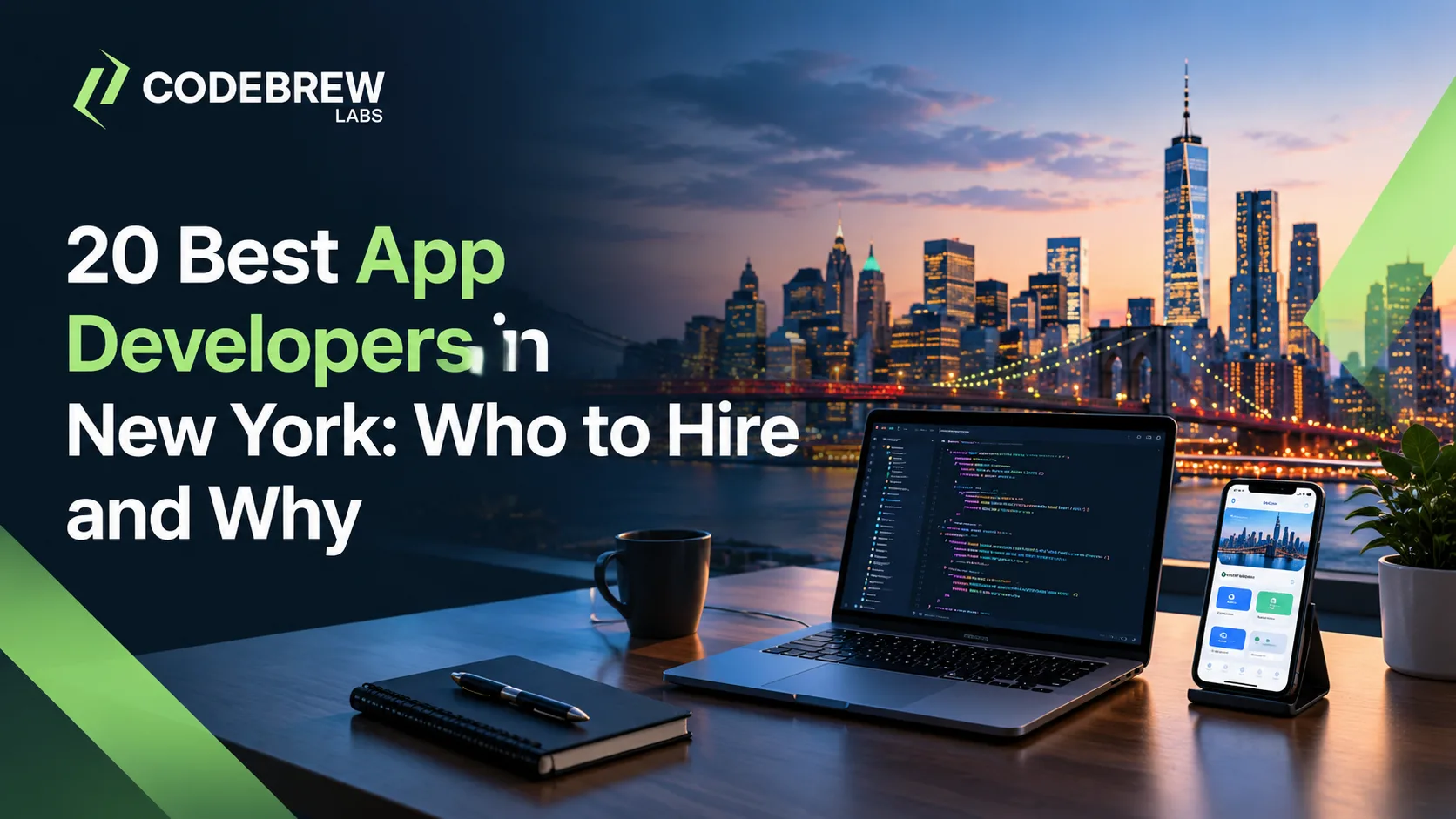
New York doesn’t do mediocre. The city that birthed Venmo, built the backend for half of Wall Street’s trading infrastructure, and houses more fintech unicorns than most countries has a correspondingly deep bench of app development talent. But that depth is also the problem. Search app developers in New York, and you’ll get hundreds of agencies, most claiming the same three things: agile process, senior engineers, proven results. Sorting signal from noise takes actual digging — the kind founders and product leads rarely have time for when they’re racing toward a launch date.
That’s the gap this guide fills. We looked at technical specialization, portfolio quality, client reviews, pricing structure, and how each firm actually operates day to day, not just what their homepage says. Below you’ll find what to evaluate before signing a contract, followed by 20 app developers in New York worth your shortlist, starting with the one we think earns the top spot for a reason.
What to Look for When Hiring an App Developer in NY
Before you start reaching out, it helps to know what separates a solid partner from a risky one. A few things matter more than the rest.
Relevant experience, not just years in business. A company that’s been around for a decade but has only ever built internal tools for retail clients isn’t necessarily the right fit for a consumer fintech app. Ask what they’ve shipped in your category specifically.
A portfolio you can actually test. Screenshots are easy to fake context around. Ask for live apps you can download, and ask what the developer’s specific contribution was — design, backend, full build, or just a feature add.
Tech stack alignment. Native Swift and Kotlin teams build differently than cross-platform Flutter or React Native shops, and the right choice depends on your performance needs, budget, and timeline. A good developer will tell you which approach fits your project rather than defaulting to whatever they know best.
Communication rhythm. New York teams work across time zones with clients constantly, so this usually isn’t a dealbreaker — but you still want clarity on who your day-to-day point of contact is and how often you’ll get updates.
Pricing transparency. Fixed bid versus time-and-materials changes how risk is distributed between you and the vendor. Get this in writing early, along with what happens if scope changes mid-build.
Post-launch support. App development doesn’t end at submission to the App Store. Ask about bug-fix SLAs, update cadence, and whether ongoing maintenance is included or billed separately.
With that framework in mind, here’s our list.
1. Code Brew Labs
Code Brew Labs helps startups and established businesses turn ideas into digital products, from early-stage MVPs to AI-powered applications and custom enterprise software. Its mobile app development services in New York cover iOS and Android, cross-platform development, product design, backend engineering, and enterprise solutions. Businesses can work with the company across different stages of development rather than sourcing every capability separately.
Its broader technical offering is worth considering for projects that bring mobile functionality together with AI, automation, or third-party integrations. The key is finding a development partner that understands how these pieces need to work together, not just how to build individual features.
Key services
- iOS and Android app development
- Flutter and React Native development
- AI, machine learning, generative AI, and chatbot development
- UI/UX design, backend engineering, and API integrations
- MVP development, testing, deployment, and ongoing maintenance
Industries and project types: Fintech, healthcare, dating apps, on-demand services, marketplaces, SaaS products, and enterprise applications.
Best suited for: Startups and established businesses looking for support with product planning, design, development, and AI integration.
2. Fueled
Fueled is a design-led mobile development studio that puts UX research and visual craft at the center of its process before any production code gets written. The firm works with consumer brands and media companies that need an app with a strong first impression, not just functional parity with competitors. Its portfolio reads closer to a design agency’s than a typical engineering shop’s.
Teams that prioritize how an app looks and feels — and are willing to invest extra time in discovery to get there — tend to get the most out of this approach.
Key services
- Product design and UX research
- iOS and Android native development
- Brand-driven mobile experience design
- Prototyping and user testing
- Post-launch iteration support
Industries and project types: Consumer lifestyle, media, entertainment, and direct-to-consumer brands.
Best suited for: Brands where design quality and first impressions are the primary differentiator.
3. Ariel Software Solutions
Ariel Software Solutions is a smaller, New York-based team focused on custom enterprise builds where the backend complexity outweighs the front-end polish. Its specialty is translating operational workflows — logistics, inventory, internal tooling — into working mobile and web systems for mid-sized companies replacing manual processes.
The firm’s strength is scoping messy business requirements accurately before development starts, which keeps smaller engagements from spiraling in cost.
Key services
- Custom backend and systems development
- Mobile front-end development for operational tools
- Legacy system modernization
- API development and integrations
- Requirements scoping and technical consulting
Industries and project types: Logistics, operations, internal enterprise tooling.
Best suited for: Mid-sized companies digitizing an existing manual or spreadsheet-based process.
4. Dom & Tom
Dom & Tom has worked with New York startups for over a decade, with a process built around structured discovery — workshops, prototyping, and user testing — before committing to a production build. That upfront investment is meant to catch costly pivots early rather than mid-development.
Founders without a fully specified product yet tend to benefit most, since the firm’s early-stage process is built to shape a rough idea into something buildable.
Key services
- Product discovery and strategy workshops
- UX/UI design and prototyping
- iOS and Android development
- MVP build-out
- User testing and validation
Industries and project types: Early-stage startups across consumer and B2B categories.
Best suited for: Founders who need help defining the product before engineering begins.
5. WillowTree
WillowTree operates at enterprise scale, running concurrent design, engineering, QA, and analytics workstreams for household-name brands in retail, media, and hospitality. Its size allows it to handle multi-market, multi-platform mobile programs without a single-hire bottleneck.
The scale comes with enterprise-level pricing, which generally puts it out of reach for early-stage or bootstrapped projects.
Key services
- Enterprise mobile strategy and development
- Cross-platform iOS and Android engineering
- Data and analytics integration
- QA and large-scale testing
- Multi-market app localization
Industries and project types: Retail, media, hospitality, and other large consumer brands.
Best suited for: Established companies needing a mobile partner that can manage complexity across markets.
6. R/GA
R/GA blends advertising-agency creative strategy with engineering execution, producing apps that function as brand statements as much as standalone products. Its client base leans toward large consumer brands using mobile as part of a broader marketing push rather than an isolated product.
The work tends to be visually ambitious, which can come at the cost of leaner, faster builds a smaller startup might need.
Key services
- Brand and product strategy
- Creative and UX design
- iOS and Android development
- Campaign-integrated app experiences
- Innovation and emerging-tech consulting
Industries and project types: Large consumer brands, advertising-driven product launches.
Best suited for: Companies where brand strategy and product strategy need to move together.
7. Intellectsoft
Intellectsoft runs a hybrid model — New York-based account leadership with distributed engineering teams — which keeps costs more manageable than a fully local build without sacrificing communication. Its strength is enterprise mobility: apps that connect into existing ERP or CRM systems rather than standalone consumer products.
Companies with established backend infrastructure that need a mobile layer added tend to see the most value.
Key services
- Enterprise mobility solutions
- ERP/CRM-integrated app development
- Custom software development
- Cloud and DevOps services
- IoT and blockchain development
Industries and project types: Manufacturing, logistics, healthcare, enterprise IT.
Best suited for: Companies needing a mobile extension of existing enterprise systems.
8. Yudiz Solutions
Yudiz has built a focused niche in gaming and entertainment apps, a category that demands different engineering discipline — real-time multiplayer syncing, in-app purchase systems, engagement mechanics — than standard business apps. Its New York presence handles client relationships while development often draws on a broader distributed team.
Founders building anything game-adjacent, from fantasy sports to casual mobile games, benefit from this specialized experience.
Key services
- Mobile game development
- Real-time multiplayer and backend infrastructure
- In-app purchase and monetization systems
- Fantasy sports and betting app development
- Cross-platform game engineering
Industries and project types: Gaming, fantasy sports, entertainment apps.
Best suited for: Founders building game or entertainment-focused mobile products.
9. Hyperlink InfoSystem
Hyperlink InfoSystem works across a broad range of industries without over-specializing, which suits founders who aren’t yet certain what kind of development partner they need. Pricing tends to run more accessible than boutique New York agencies, since part of the engineering team operates outside the city while account management stays local.
Communication is centralized through a local point of contact, which keeps the engagement from feeling outsourced even where execution is distributed.
Key services
- iOS and Android app development
- Cross-platform development (Flutter, React Native)
- UI/UX design
- Web and e-commerce development
- AI and IoT integration
Industries and project types: General-purpose across consumer, e-commerce, and SaaS categories.
Best suited for: Founders seeking flexible, cost-conscious development without a narrow specialty.
10. Y Media Labs
Y Media Labs built its name designing and building apps for recognized consumer brands, particularly in e-commerce and retail. Its process folds data and behavioral research into design decisions rather than relying purely on visual judgment.
Brands modernizing an existing app or launching a flagship consumer product with real design rigor behind it tend to get the most value.
Key services
- Consumer app design and development
- E-commerce and retail mobile experiences
- Behavioral and data-driven UX research
- Brand digital transformation
- iOS and Android engineering
Industries and project types: E-commerce, retail, consumer brands.
Best suited for: Brands prioritizing design rigor backed by user research.
11. Big Human
Big Human takes on fewer projects than most agencies on this list, which lets it go deep rather than wide on each one. The team sits at the intersection of product strategy and design, often helping clients figure out what to build before how to build it.
Early-stage companies needing a thought partner as much as an execution team tend to value this approach, though limited bandwidth means longer lead times to start.
Key services
- Product strategy and design
- UX/UI design
- iOS and Android development
- Design systems
- Early-stage product definition
Industries and project types: Early-stage consumer and B2B startups.
Best suited for: Founders who need strategic product input alongside execution.
12. ArcTouch
ArcTouch specializes in connected and voice-enabled apps, building for platforms like Alexa and Google Assistant alongside standard iOS and Android work. That niche makes it a strong fit for brands exploring voice interfaces or multi-device experiences rather than a single mobile app.
Its engineering culture extends into other emerging platforms as well, including wearables and connected TV, for clients thinking beyond the phone screen.
Key services
- Voice app development (Alexa, Google Assistant)
- Connected device and IoT app development
- iOS and Android development
- Wearable and connected TV apps
- Conversational interface design
Industries and project types: Media, consumer electronics, connected-device brands.
Best suited for: Brands building beyond a single mobile platform.
13. Clearbridge Mobile
Clearbridge Mobile focuses heavily on regulated industries — healthcare, finance, insurance — where compliance and security shape nearly every engineering decision. Security audits and compliance reviews are built into the standard process rather than offered as an add-on.
Companies handling patient or financial data, where a security misstep carries real regulatory risk, should weigh this experience heavily.
Key services
- HIPAA and regulatory-compliant app development
- Security audits and penetration testing
- Fintech and healthtech app development
- Backend architecture for regulated data
- iOS and Android development
Industries and project types: Healthcare, fintech, insurance.
Best suited for: Companies building apps that handle sensitive regulated data.
14. Chop Dawg
Chop Dawg built its brand around transparency with first-time founders — plain-language explanations of technical tradeoffs, clear timelines, and realistic budget conversations upfront. Its client base skews toward non-technical founders who want a partner willing to explain decisions, not just execute them silently.
The tradeoff is a process that can feel slower for technical founders who’d rather move without the extra context.
Key services
- MVP development and technical consulting
- Product strategy for first-time founders
- iOS and Android development
- Budget and timeline planning
- Technical education and process transparency
Industries and project types: First-time founders, early-stage consumer and B2B apps.
Best suited for: Non-technical founders new to the app development process.
15. Appetiser Apps
Appetiser maintains a New York client-services presence with development spread across a distributed team, and its specialty is rapid MVP builds for founders racing to validate an idea before raising a larger round. Fixed-scope packages make budgeting more predictable than open-ended time-and-materials contracts.
Early founders who need a clear price and timeline upfront tend to find this model easier to plan around.
Key services
- Rapid MVP development
- Fixed-scope project packages
- iOS and Android development
- UI/UX design
- Investor-ready product builds
Industries and project types: Early-stage startups seeking fast market validation.
Best suited for: Founders needing a fast, budget-predictable MVP before fundraising.
16. MindSea
MindSea has built a focused specialty in health and wellness apps, working with startups and established health brands on everything from fitness tracking to clinical-adjacent tools. Familiarity with HealthKit, wearable integrations, and health data standards shortcuts the research time a generalist shop would need.
Founders building in digital health get a partner that already understands the regulatory and technical landscape specific to that space.
Key services
- Health and wellness app development
- HealthKit and wearable integrations
- Clinical-adjacent and digital health tools
- Fitness and activity tracking apps
- Health data compliance consulting
Industries and project types: Digital health, fitness, wellness.
Best suited for: Startups and health brands building health-focused mobile products.
17. Fuzz Productions
Fuzz works across consumer and enterprise apps with a particular strength in AR and immersive experiences, an area that requires specialized 3D and spatial design skills most generalist shops don’t have in-house. Retail and media brands experimenting with AR try-on features or immersive marketing tools gravitate toward its work.
Outside of AR, its general mobile development holds up as solidly competent, if not the firm’s headline specialty.
Key services
- AR and immersive app development
- 3D and spatial design
- iOS and Android development
- Retail and media app experiences
- Interactive marketing tools
Industries and project types: Retail, media, AR/immersive marketing.
Best suited for: Brands building AR-enabled or immersive product experiences.
18. Prolific Studio
Prolific pairs product strategy consulting with full build-out services, suiting founders who want one partner from initial concept through launch rather than juggling a strategy firm and a dev shop separately. The team tends to push back on scope that doesn’t serve the core user problem.
That friction can feel uncomfortable early on but often saves money by cutting features that wouldn’t have moved the needle anyway.
Key services
- Product strategy consulting
- UX/UI design
- iOS and Android development
- Scope and feature prioritization
- End-to-end concept-to-launch builds
Industries and project types: Startups needing combined strategy and execution.
Best suited for: Founders wanting a single partner from concept through launch.
19. Synaptic Studios
Synaptic Studios focuses on SaaS and B2B mobile products, a category with different engineering demands than consumer apps — complex permission systems, data dashboards, integrations with existing enterprise software rather than flashy UI. Its client work stays less publicly visible since B2B products rarely go viral, but the underlying engineering discipline runs deep.
Companies needing mobile extensions of existing web platforms tend to be the best fit.
Key services
- SaaS and B2B mobile development
- Enterprise dashboard and data visualization
- Role-based permission systems
- API and third-party integrations
- Web-to-mobile platform extensions
Industries and project types: SaaS, B2B software, enterprise platforms.
Best suited for: Companies extending an existing web product into mobile.
20. Nomtek
Nomtek operates with a smaller, senior-heavy team structure, so clients work directly with experienced engineers rather than being routed through junior staff. Project load stays deliberately limited to maintain that quality bar, which means availability can be the biggest constraint rather than cost or capability.
Founders who want hands-on senior attention throughout a build — and who can work around limited capacity — tend to come away as repeat clients.
Key services
- Senior-led iOS and Android development
- Cross-platform development
- Product design
- Technical consulting
- Long-term product partnership
Industries and project types: Startups and established companies wanting senior-level engineering attention.
Best suited for: Founders prioritizing direct access to experienced engineers over team size.
Choosing the Right Partner
Twenty strong options is still a lot to narrow down, so start by matching your project type to each firm’s actual specialty rather than their general reputation. A healthcare app and a gaming app need genuinely different expertise, not just experienced developers. From there, weigh budget realism against the pricing model each shop uses, and don’t skip reference calls with past clients; portfolios show finished work, not how the relationship actually ran. Code Brew Labs stands out on this list for combining broad technical range with a track record across industries, making it a reasonable starting point if you’re not yet sure exactly which specialist you need. Whichever firm you choose, get the scope, timeline, and post-launch support terms in writing before anything else that single step prevents most of the disputes that derail app projects.