Building a strong software product requires more than a good idea. Businesses need capable developers, clear processes, technical leadership, and a team structure that can keep pace with changing requirements. One of the most important decisions companies face is whether to build an internal engineering department or work with a dedicated development team.
Both approaches have their advantages. In-house teams offer direct control and close collaboration, while dedicated teams provide flexibility, access to broader talent, and faster scalability. The right choice depends on factors such as project complexity, budget, hiring timelines, technical requirements, and long-term business goals.
For companies evaluating software development firms, understanding these differences can make the decision much easier.
What Is a Dedicated Development Team?
A dedicated development team is a group of professionals assigned to work on a client's project for an extended period. The team may include software developers, QA engineers, UI/UX designers, DevOps specialists, project managers, and technical architects.
Unlike traditional project outsourcing, a dedicated team becomes closely aligned with the client's product goals and development processes. Businesses can usually influence team composition, priorities, workflows, and technology choices while the service provider handles recruitment, administration, and other operational responsibilities.
This model is particularly useful for startups and growing businesses that need to expand their engineering capabilities without spending months recruiting and onboarding every specialist internally.
What Is an In-House Development Team?
An in-house team consists of employees directly hired and managed by the company. These professionals work within the organization's internal structure and typically have a strong understanding of its products, customers, culture, and business objectives.
For organizations with stable long-term technology requirements, an internal team can provide significant value. Communication tends to be straightforward, employees can collaborate closely with other departments, and leadership has direct control over hiring, development practices, and technical decisions.
However, building an in-house team requires more than hiring developers. Companies must also manage recruitment, salaries, benefits, infrastructure, training, retention, equipment, and career development.
Dedicated Team vs. In-House Team: Key Differences
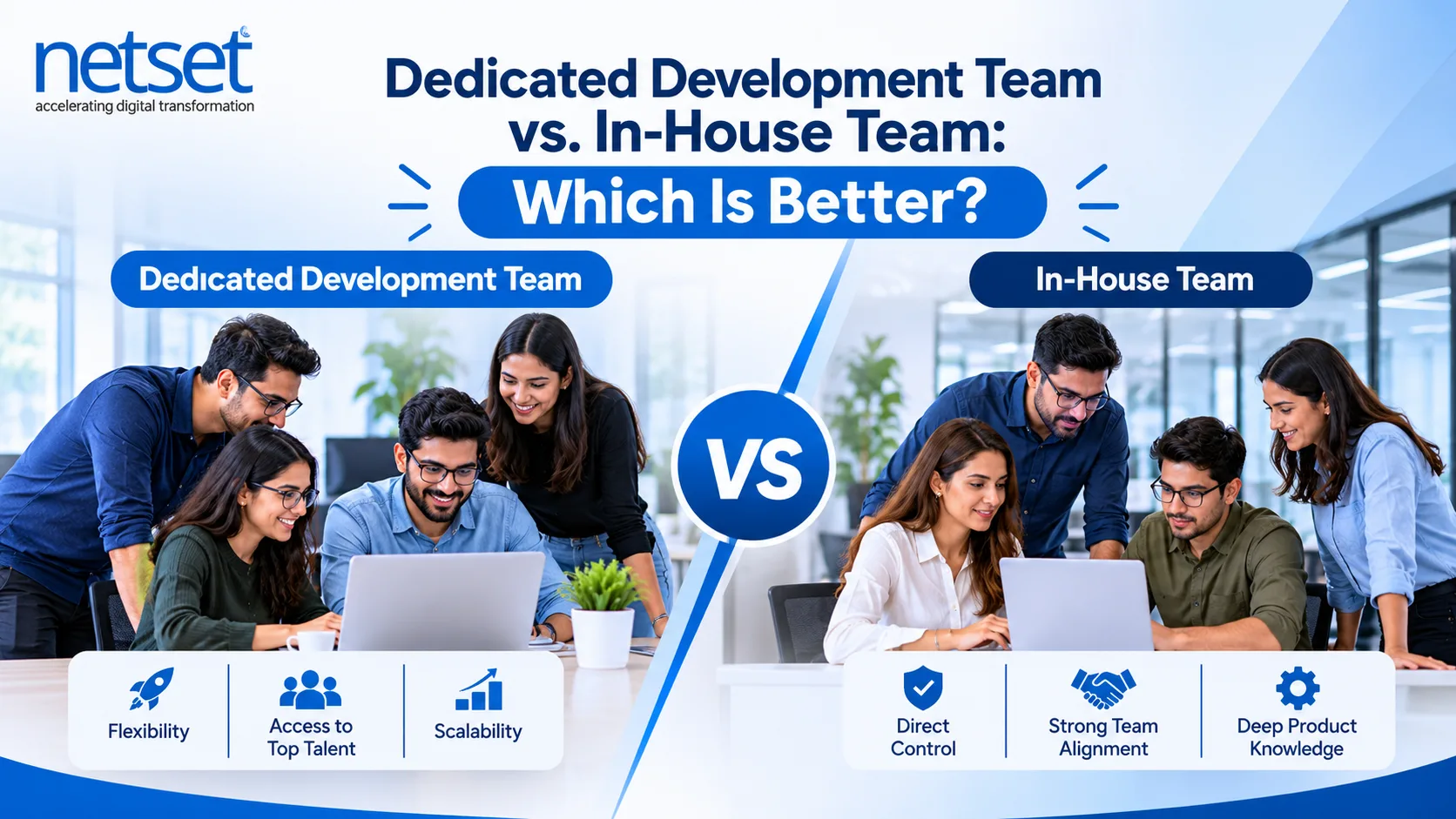
FactorDedicated Development TeamIn-House TeamHiringFaster access to talentRequires direct recruitmentScalabilityEasy to expand or reduceUsually slowerOperational overheadLowerHigherControlHigh with proper collaborationDirectTalent accessWider talent poolLimited to hiring reachLong-term ownershipFlexibleStrong internal ownershipBest suited forScaling and evolving projectsStable long-term requirementsThe comparison shows that neither model is universally better. The right option depends on what the business is trying to achieve.
1. Hiring and Access to Talent
Recruiting experienced technical professionals has become increasingly competitive. An IT software development company with an established engineering network may be able to assemble a team much faster than an organization starting recruitment from scratch.
A dedicated model can be especially useful when a project requires specialized expertise in areas such as cloud engineering, artificial intelligence, cybersecurity, blockchain, or mobile development.
With an in-house approach, companies have greater control over hiring but must manage the entire recruitment cycle. Finding the right candidates, conducting interviews, negotiating compensation, and completing onboarding can take considerable time.
For businesses working under tight product deadlines, access to an existing talent pool can therefore become a major advantage.
2. Cost and Operational Considerations
Cost should not be judged only by developer salaries.
An internal employee comes with additional expenses related to recruitment, benefits, office infrastructure, hardware, training, management, and retention. These costs can make an in-house team considerably more expensive to establish, particularly for smaller organizations.
A dedicated development team can reduce some of these operational responsibilities because the technology partner generally handles much of the staffing and administrative infrastructure.
That does not automatically make dedicated teams cheaper in every situation. For a mature company with predictable workloads and a well-established engineering department, maintaining an in-house team may deliver better long-term economics.
The important point is to compare the total cost of ownership, rather than simply comparing hourly or monthly development rates.
3. Flexibility and Scalability
Business requirements rarely remain static.
A company may need five developers during product development, additional QA specialists before launch, and cloud or DevOps expertise during expansion. Hiring and then reducing an internal team every time requirements change is rarely practical.
This is where dedicated teams can offer a clear advantage.
Businesses can adjust team composition according to project needs, allowing them to respond more quickly to changing priorities. This flexibility is one reason many software development firms offer dedicated engagement models to growing organizations.
In-house teams, on the other hand, can be highly effective when workloads are consistent. Employees develop deep product knowledge over time, which can become a significant competitive advantage.
4. Communication and Control
One common misconception is that working with a dedicated team means losing control.
A well-managed dedicated team can operate as an extension of the client's internal organization. Clear documentation, regular meetings, shared project management tools, defined responsibilities, and transparent reporting can create a highly collaborative environment.
In-house teams naturally have an advantage in face-to-face communication and organizational alignment. Employees are immersed in the company culture and can communicate directly with product, marketing, sales, and leadership teams.
However, modern collaboration tools have significantly reduced many of the communication challenges associated with distributed teams.
The quality of the engagement model and management process often matters more than whether developers sit in the same office.
5. AI Is Changing the Team Structure
The rise of artificial intelligence is also influencing how businesses build engineering teams.
AI software development services can help organizations introduce intelligent features, automate repetitive workflows, improve software testing, analyze large datasets, and enhance customer experiences. However, successful AI adoption requires more than simply adding an AI tool to an application.
Businesses need professionals who understand data, APIs, model integration, security, infrastructure, testing, and product design.
A Generative AI development company can provide access to specialists who understand emerging AI technologies without requiring an organization to immediately build an entirely new internal AI department.
For companies experimenting with AI, a dedicated team can therefore provide a lower-risk way to access specialized expertise. Once AI becomes a core part of the business strategy, organizations may decide to develop deeper internal capabilities.
When Should You Choose a Dedicated Development Team?
A dedicated team can be a strong choice when:
- You need to scale development quickly.
- Your internal team lacks specific technical skills.
- You are launching a new software product.
- Project requirements are expected to evolve.
- You want to reduce recruitment and administrative overhead.
- You need access to specialized AI, cloud, or DevOps expertise.
- You want long-term development support without building a large internal department immediately.
This model is particularly useful for startups and businesses undergoing digital transformation.
When Is an In-House Team Better?
An in-house team may be the better option when:
- Software development is central to your long-term business strategy.
- You need maximum day-to-day control over engineering.
- Your development workload is predictable.
- Deep internal product knowledge is critical.
- You have the resources to recruit and retain specialized talent.
- You want to build a permanent engineering culture.
Large enterprises with mature technology operations often benefit from this approach.
A Hybrid Approach Can Offer the Best of Both
The choice does not always have to be either dedicated or in-house.
Many businesses use a hybrid model. Their internal engineers manage architecture, product strategy, and core business logic, while an external dedicated team provides additional development capacity or specialized expertise.
This approach can be particularly effective for organizations exploring AI software development services. Internal leadership can maintain ownership of the product while external specialists help implement new capabilities and accelerate experimentation.
For companies considering software development firms, the hybrid approach can also reduce pressure on internal employees without requiring a complete change in the existing team structure.
How NetSet Software Can Help
Choosing the right development model starts with understanding the business, not simply selecting a staffing option. NetSet Software works with organizations that need flexible engineering capabilities, dedicated development resources, and modern technology expertise.
As an IT software development company, NetSet Software can support businesses across custom software development, dedicated engineering teams, AI-powered solutions, application development, and digital product engineering.
For organizations exploring AI software development services or emerging technologies, having access to experienced specialists can make experimentation and implementation more manageable. The goal should be to create a team structure that supports the product roadmap rather than adding unnecessary complexity.
Final Words
There is no universal winner in the dedicated development team versus in-house team debate.
An in-house team can provide exceptional control, cultural alignment, and long-term product knowledge. A dedicated team can offer speed, flexibility, specialized expertise, and easier scalability. For many businesses, a hybrid approach may provide the most practical balance.
The best decision comes down to your development roadmap, budget, talent requirements, project timeline, and long-term objectives.
Rather than asking which model is better in general, businesses should ask a more useful question: Which team structure gives us the capabilities we need today while preparing us for what comes next?
That perspective makes it easier to choose a development model that supports sustainable growth, technical quality, and innovation.