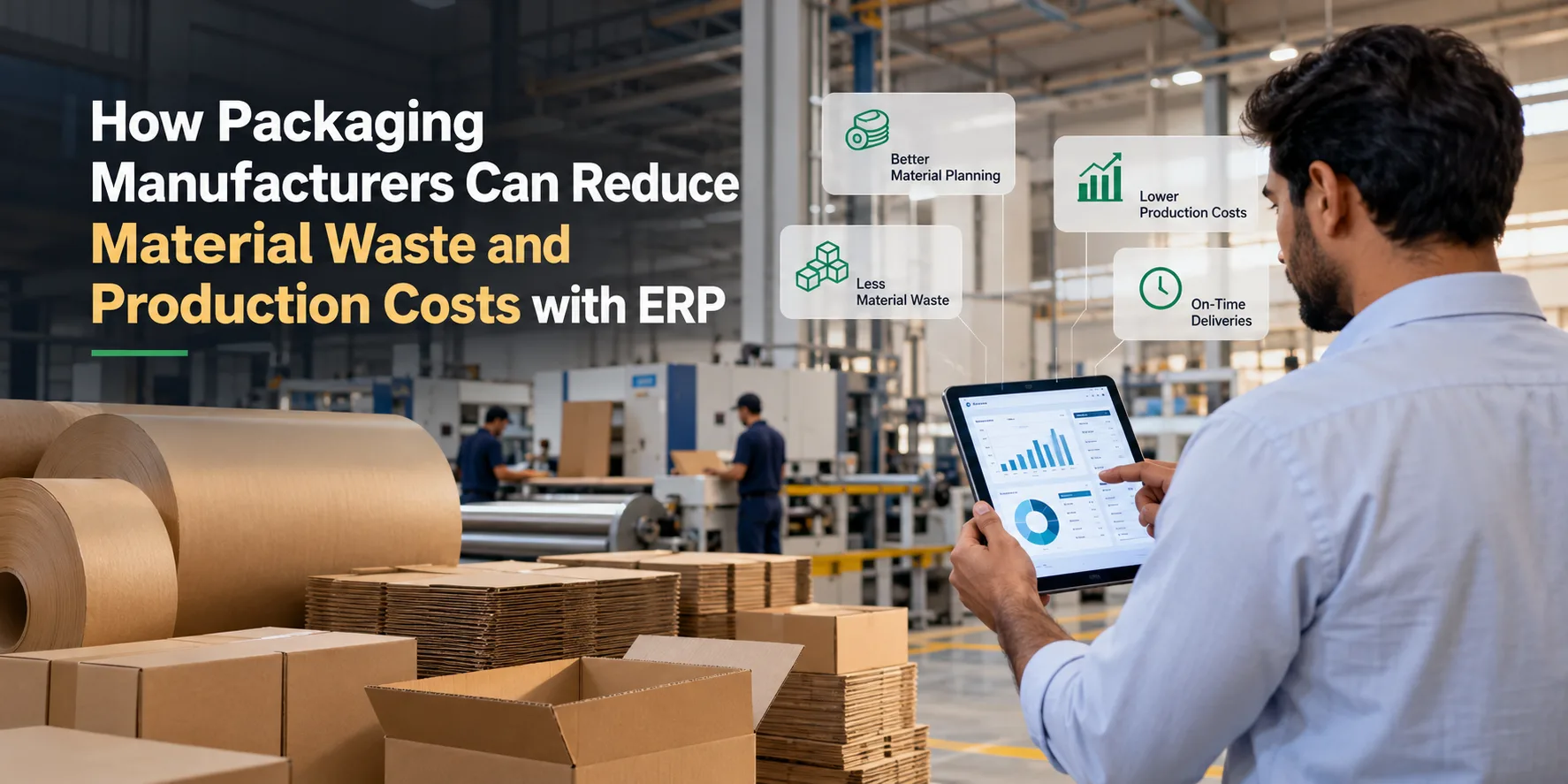
Packaging manufacturers work hard to deliver quality products on time while keeping costs under control. But in day-to-day operations, even small problems can affect profit.
Extra raw material usage, production delays, incorrect stock records, machine downtime, and last-minute orders can increase costs without making it clear where the money is going.
For many packaging businesses, the challenge is not simply producing more. It is making better use of the materials, time, and resources they already have.
This is where an ERP system for the packaging industry can help. By connecting inventory, production, purchasing, sales, and finance in one system, manufacturers can gain better control over their operations and make decisions based on reliable information.
In this article, we will explore how packaging manufacturers can reduce material waste, control production costs, and improve daily operations with the right ERP solution.
Why Material Waste and Production Costs Are Major Challenges in Packaging
Packaging production involves several steps, from purchasing raw materials to delivering finished products. Each step needs proper planning and coordination.
Depending on the type of packaging you manufacture, your business may work with paper, cardboard, corrugated sheets, plastic films, inks, adhesives, labels, or other materials.
When these materials are not managed properly, costs can increase in several ways.
1. Excessive raw material usage
Without clear material requirements, production teams may use more raw materials than needed. Small losses across multiple production orders can add up over time.
2. Poor inventory visibility
If stock records are outdated or incorrect, purchasing teams may order materials that are already available or discover shortages when production is about to begin.
3. Production planning problems
Poor coordination between sales, inventory, and production can lead to delays, rushed jobs, and unnecessary changes to production schedules.
4. Limited cost visibility
When material, labour, machine, and other production costs are recorded separately, it becomes difficult to understand the actual cost of each order.
5. Quality issues and rework
Incorrect specifications, printing errors, damaged materials, or production mistakes can result in rejected products and additional costs.
These problems may seem small individually. However, when they happen regularly, they can affect delivery performance, customer satisfaction, and overall profitability.
1. Improve Raw Material Planning with ERP
Raw materials are one of the most important cost areas for packaging manufacturers. Using too much material increases costs, while ordering too little can interrupt production.
An ERP system can help businesses plan material requirements based on production orders, product specifications, available inventory, and purchasing lead times.
For example, a corrugated box manufacturer receives an order for 10,000 boxes. The production team needs to know how much paper, board, adhesive, and other materials are required before production starts.
With a properly configured ERP system, the business can:
- Calculate material requirements using defined product specifications.
- Check available stock before placing new purchase orders.
- Identify material shortages before they affect production.
- Plan purchasing according to upcoming production needs.
- Track material consumption against expected usage.
This helps the team make better purchasing decisions and reduces avoidable shortages and excess inventory.
The goal is not to eliminate every material loss. It is to understand where materials are being used, identify unnecessary losses, and improve planning over time.
2. Track Material Waste and Identify Its Causes
Material waste is not always caused by careless handling. It can happen because of machine setup, cutting layouts, printing errors, damaged stock, incorrect measurements, or changes in customer requirements.
Without proper records, managers may know that waste is happening but struggle to understand why.
An ERP system can help record material consumption, production output, scrap, and rejected quantities against individual jobs or production stages.
For example, if one production order uses more paper than expected, the team can review the recorded consumption and investigate the reason.
Over time, this information can help manufacturers answer important questions:
- Which products generate more waste?
- Which production jobs regularly exceed planned material usage?
- Are certain materials being damaged during storage or handling?
- Are machine setup changes creating avoidable losses?
- Is actual material consumption different from the planned quantity?
These insights can help production managers take targeted action instead of relying on guesswork.
ERP does not automatically prevent waste. Its value comes from giving the team better information to identify problems and improve the process.
3. Keep Inventory Accurate and Avoid Unnecessary Purchases
Inventory management is closely connected to production costs. Too much stock ties up working capital, while too little stock can delay customer orders.
Packaging manufacturers may need to manage different sizes, grades, colours, thicknesses, and specifications of raw materials. Tracking everything through disconnected spreadsheets can become difficult as the business grows.
An ERP system can bring inventory information into one place and help teams track stock movements across purchasing, stores, production, and dispatch.
Key capabilities may include:
- Real-time or regularly updated stock visibility.
- Material issue and consumption tracking.
- Reorder levels and low-stock alerts.
- Batch or lot tracking where required.
- Stock valuation and inventory reports.
- Finished goods and work-in-progress tracking.
Consider a manufacturer that frequently purchases a particular paper grade because the store team cannot confirm the available quantity. Better inventory records can help prevent duplicate purchases and improve purchasing decisions.
The result is greater visibility into stock levels, fewer avoidable surprises, and better control over inventory costs.
4. Improve Production Planning and Reduce Delays
Production delays can increase costs even when material prices remain unchanged.
When jobs are not planned properly, machines may sit idle, urgent orders may interrupt scheduled work, and employees may spend time waiting for materials or instructions.
ERP can help connect customer orders with material availability and production planning. Depending on the system and configuration, managers can review planned jobs, work orders, resource requirements, and production progress.
This helps teams:
- Plan production based on confirmed orders and priorities.
- Check material availability before releasing jobs.
- Monitor work-in-progress.
- Identify delays earlier.
- Coordinate purchasing and production more effectively.
- Review planned versus actual production performance.
For example, a packaging company has three customer orders due within the same week. If one order requires a material that is not available, the production manager needs to know before scheduling the job.
With better coordination between inventory and production, the team can make informed decisions about material procurement and job sequencing.
ERP cannot remove every production delay, but it can help reduce delays caused by missing information and disconnected processes.
5. Understand the Actual Cost of Each Production Order
One of the biggest challenges in manufacturing is knowing whether an order is genuinely profitable.
A selling price may look attractive, but the actual margin can be lower after accounting for raw materials, labour, machine time, wastage, packaging, and other relevant expenses.
When these costs are recorded separately, it can be difficult to understand the full picture.
A suitable ERP system can help manufacturers track and review production costs using defined costing methods and available operational data.
Depending on the business requirements, cost analysis may include:
- Raw material consumption.
- Direct labour costs.
- Machine or production overheads.
- Scrap and wastage costs.
- Packaging and handling expenses.
- Other relevant production expenses.
Imagine two packaging orders with similar selling prices. One requires more material changes, additional setup time, and more rework than the other.
Without job-level cost visibility, both orders may appear equally profitable. With better cost records, management can review the difference and make more informed pricing and production decisions.
Better costing helps manufacturers understand where profit is being earned and where costs need attention.
6. Reduce Rework by Improving Information Flow
Rework is expensive because the business may need to spend additional material, labour, and machine time to correct an issue.
In packaging production, rework can happen when teams use outdated artwork, incorrect dimensions, the wrong material specification, or unclear customer instructions.
An ERP system can help centralise relevant product, order, and production information so that departments work from more consistent records.
For example, the sales team records a customer's packaging specifications when confirming an order. Production needs access to the correct approved specifications before starting the job.
When information is shared properly, the chances of misunderstandings can be reduced.
Depending on the workflow, businesses may also integrate document management, approval processes, quality checks, and other systems with ERP.
However, software alone cannot guarantee error-free production. Employees still need clear procedures, correct product data, and appropriate quality checks.
7. Connect Purchasing, Inventory, Production, and Finance
Many packaging manufacturers use different tools or spreadsheets for different departments.
Sales records customer orders. Purchasing tracks suppliers. The warehouse maintains stock records. Production monitors job progress. Finance records expenses and invoices.
The difficulty begins when these records do not match or updates are delayed.
An ERP system connects these business functions through shared data and defined workflows.
For example:
- Sales records a confirmed customer order.
- Production reviews the job requirements.
- Inventory checks available materials.
- Purchasing identifies any shortage.
- Production records material usage and output.
- Finance reviews the relevant costs and sales information.
When these processes are configured correctly, teams can spend less time searching for updates and more time managing their work.
Integration also gives managers a clearer view of what is happening across the business, helping them identify issues earlier and make more informed decisions.
8. Use Reports to Make Better Business Decisions
Reducing costs is not a one-time activity. Manufacturers need to review performance regularly to understand whether improvements are working.
ERP reports and dashboards can help management monitor operational and financial information in one place.
Useful measures may include:
- Planned versus actual material consumption.
- Scrap and wastage quantities.
- Production cost per order.
- Inventory turnover and stock value.
- Production delays and order completion.
- Rework and rejected quantities.
- Gross margin by product or order, where reliable costing data is available.
For example, if material consumption repeatedly exceeds the planned quantity for a particular product, managers can investigate the reason and review the production process.
Similarly, if certain materials remain unused for long periods, the purchasing team can review its ordering practices.
The important point is to select reports that support real business decisions. Collecting large amounts of data is not useful unless teams understand what the data means and act on it.
How to Choose the Right ERP for Your Packaging Business
Not every ERP system will suit every packaging manufacturer.
A business producing corrugated boxes may have different requirements from a flexible packaging manufacturer, a label printer, or a company producing rigid packaging.
Before selecting an ERP system, consider the following questions.
Does it support your production process?
Review how the system handles your production orders, material requirements, work-in-progress, and finished goods.
Can it track material usage and wastage?
Check whether the system can record planned and actual consumption, scrap, and production variances in a way that fits your operations.
Does it provide useful costing information?
Understand how it handles material costs, labour, overheads, and job-level profitability.
Can it connect your departments?
Consider how sales, purchasing, inventory, production, and finance will share information.
Can it grow with your business?
Your requirements may change as you add products, production lines, locations, or customers. Review the system's flexibility and integration options.
Will your team be able to use it effectively?
Training, clear processes, data quality, and employee adoption are important parts of a successful ERP implementation.
Before making a decision, map your existing workflows and identify the problems you want to solve first. This makes it easier to evaluate ERP options based on business needs rather than choosing a system based only on its feature list.
How Cloudmonte Technologies Can Help Packaging Manufacturers
Choosing ERP is not just about selecting software. It is also about understanding how the system will fit your business processes.
Cloudmonte Technologies helps businesses explore ERP and business automation solutions based on their operational requirements.
For packaging manufacturers, the starting point should be understanding the current challenges. These may include material waste, inventory mismatches, production delays, limited cost visibility, or disconnected departmental records.
A structured ERP discussion can help identify which processes need improvement, which information should be tracked, and which system capabilities are relevant to the business.
Depending on your requirements, an ERP solution such as Odoo can be evaluated for areas including inventory management, purchasing, manufacturing, sales, and accounting.
The right configuration will depend on your production methods, reporting needs, existing systems, and implementation scope.
Rather than assuming every business needs the same solution, it is better to begin with a clear understanding of your current operations and priorities.
Explore Cloudmonte's ERP solutions for the packaging industry to learn more about how ERP can support your business.
Frequently Asked Questions
1. How does ERP help reduce material waste in packaging manufacturing?
ERP can help manufacturers track material requirements, actual consumption, stock movements, scrap, and production output. This information makes it easier to identify avoidable losses and improve material planning.
The level of control depends on the system configuration, the quality of recorded data, and how consistently teams follow the process.
2. Can ERP help packaging manufacturers reduce production costs?
Yes. ERP can support better inventory control, production planning, purchasing, job costing, and reporting. These capabilities can help businesses identify unnecessary costs and make more informed decisions.
Actual savings depend on the problems being addressed and how effectively the system is implemented.
3. Is ERP suitable for small and medium-sized packaging businesses?
ERP can be suitable for small and medium-sized manufacturers when the system fits their operational needs and budget. Businesses should assess their current processes, essential features, implementation costs, and future requirements before choosing a solution.
4. Which ERP features are important for the packaging industry?
Common areas to evaluate include inventory management, manufacturing, material requirements planning, purchasing, production tracking, quality management, costing, sales, and accounting.
The right combination depends on the type of packaging manufactured and the complexity of the production process.
5. How long does ERP implementation take for a packaging manufacturer?
There is no single timeline for every business. Implementation time depends on the number of processes involved, data migration, customisation, integrations, employee training, and the quality of existing records.
A clear scope and phased implementation plan can help businesses manage the transition more effectively.
6. How can I know whether my packaging business needs ERP?
You may want to evaluate ERP if your business regularly faces stock mismatches, material shortages, production delays, manual reporting, unclear job costs, or difficulty sharing information between departments.
Start by identifying which problems occur most often and how they affect your operations. That will help you determine whether ERP is the right next step.
Final Thoughts
Reducing material waste and production costs does not always require major changes to your factory. Sometimes, the first step is gaining a clearer understanding of how materials are purchased, stored, consumed, and converted into finished products.
Better inventory records, realistic production planning, accurate job costing, and reliable reporting can help packaging manufacturers identify problems and improve day-to-day decisions.
An ERP system brings these areas together, giving teams a more connected view of the business. But the best results come when the technology supports well-defined processes and employees use it consistently.
If your packaging business is struggling with material waste, rising production costs, inventory problems, or production planning, it may be time to review your current processes.
Want to explore whether ERP is right for your packaging business?
Connect with Cloudmonte Technologies to discuss your operational challenges and explore an ERP approach suited to your business requirements.