Every connected product pitch starts with the same slide: a gorgeous render of the device. Rounded corners, a soft glow, maybe a tiny LED. Nobody ever puts a slide up that says “what happens when the Wi-Fi drops at 2 a.m.”
That second slide is the one that decides whether you have a business.
Hardware gets the attention because you can hold it. But in my experience, early IoT products rarely die because a temperature sensor was off by half a degree. They die in the gaps around the device: the confusing setup, the silent disconnects, the dashboard nobody opens. This article is about those gaps, and the decisions that close them before you spend serious money.
The Device Is the Easy Part
Let me be more precise about why. A sensor does one thing: it measures. Modern modules measure well, and the hard physics problems are mostly solved and sold as breakout boards.
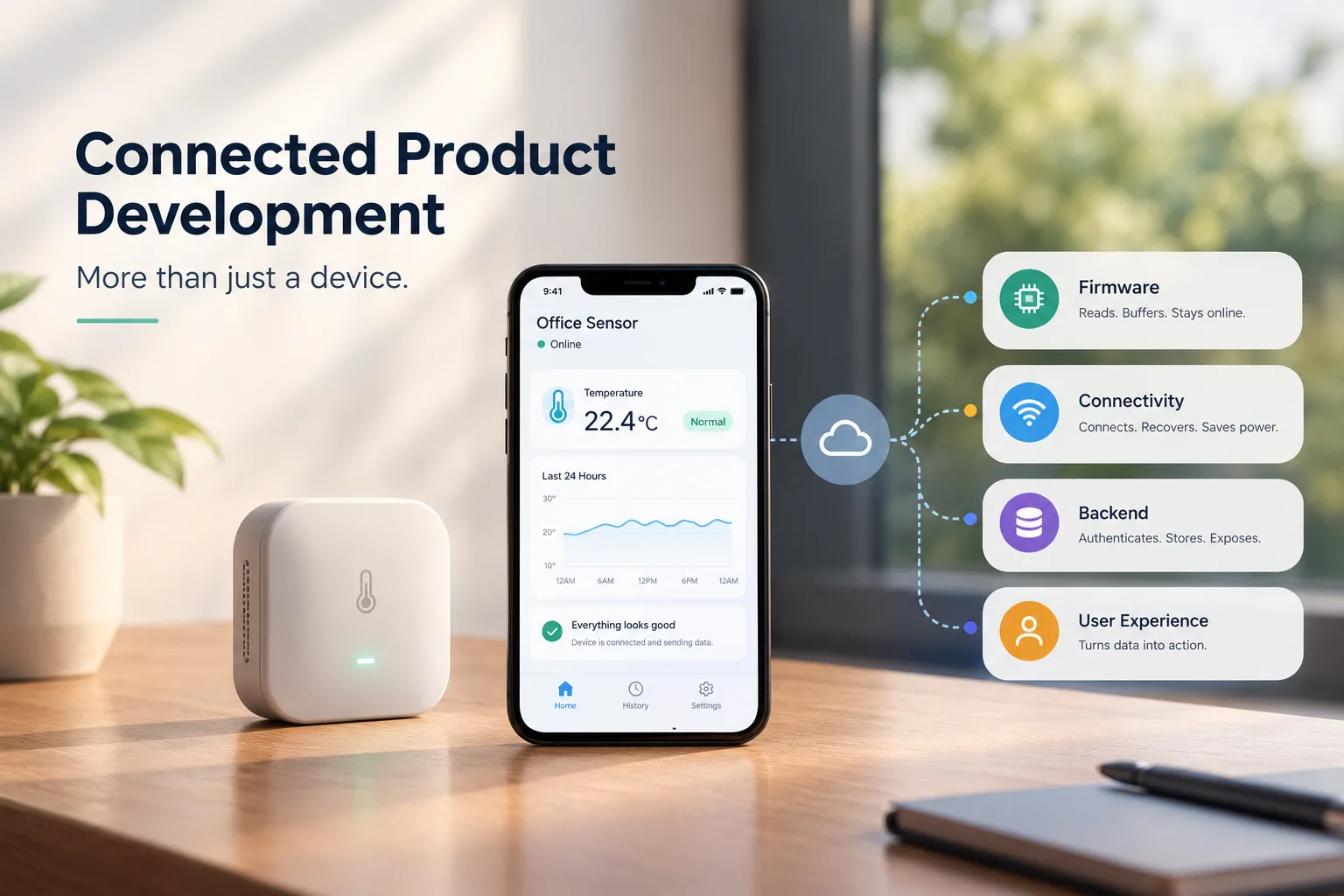
What remains is a chain of software and service questions, and every link has to hold:
- Firmware must read the sensor, buffer the data, and survive power interruptions without corrupting itself.
- Connectivity has to establish, recover, and rate-limit itself so a flaky network does not drain a battery or flood a server.
- The backend must authenticate each device, store time-series data sensibly, and expose it through an interface your app can use.
- The user layer turns raw readings into something a human acts on.
Weakness in any single link makes the whole product feel broken, even when the hardware is flawless. A customer cannot tell whether the fault is in the firmware, the cloud, or the app. They only know it does not work.
Five Decisions to Make Before You Order a Single Part
Here is the short list I would want answered on paper first. Skip any of them and you will answer them later, under pressure, at a higher price.
- What is the one action the data triggers? If a reading does not lead to a decision, an alert, or a saved cost, it is just noise with a chart.
- How often do you really need data? Every minute and every hour produce very different battery, bandwidth, and storage bills. Most first versions sample far more than the user ever needs.
- Who installs this, and where? A technician with a toolbox and a homeowner on a Sunday evening need completely different onboarding.
- What happens when it goes offline? Decide whether the device stores readings and sends them later, or simply drops them. Both are valid. Not deciding is not.
- How will you update it in the field? If the answer is “someone drives out with a laptop,” you have a scaling problem waiting for a pilot to expose it.
Write the answers down in plain language. If two people on your team give different answers, you have found your first real risk.
Design for the Bad Day
Now let me change gears and tell a short story, because this part is easier to feel than to explain.
Imagine your first ten pilot units are installed in ten different kitchens, garages, and storerooms. On day four, a router firmware update changes a setting in three of those buildings. The devices cannot reconnect. Nobody told them how. The users do not know the device is offline because the app still shows the last reading, as if nothing happened. A week later, one customer notices the number never changes and quietly stops trusting the product.
Nothing in that story is a hardware failure. It is a design failure, and an avoidable one.
The fix is not complicated, just deliberate. The app should show when data is stale, not only what the last value was. The device should have a clear, human-friendly way to rejoin a network. And your system should tell you when a unit has gone quiet before the customer does. Good IoT products are built around the bad day, because the good day takes care of itself.
Security Is a Cost You Pay Early or Late
Security deserves a more sober tone, because the consequences are real.
A prototype with a shared password hard-coded into every unit works perfectly well in a demo. It also means that compromising one device exposes all of them. Fixing that after you have shipped hundreds of units is painful and sometimes impossible without physically touching each one.
The basics are cheap when done at the start. Give each device a unique identity and credential. Encrypt traffic between the device and the cloud. Separate user accounts so one customer can never see another’s data. Plan how credentials are rotated or revoked if a unit is lost. None of this slows a prototype meaningfully, but retrofitting it later can mean rebuilding your provisioning process entirely.
Run the Pilot Like a Researcher
A pilot is not a mini launch. It is an experiment, and it should be treated like one.
Before the first unit ships, decide what you are trying to learn and what result would change your mind. A useful pilot tracks a small set of behaviors rather than a long dashboard of vanity numbers:
- How long did installation take, and how many people needed help?
- How many units were still reporting data on day 30?
- How often did users open the app, and what did they do there?
- Which alerts did users act on, and which did they ignore?
Notice what is missing: opinions about the device’s design. People are happy to say they like something and then never use it. Behavior is the honest signal.
Keep the group small, between five and fifteen units, so you can actually talk to every participant. A phone call after week two will teach you more than a survey with three hundred responses.
A Note on Speed
Founders often ask whether all this planning slows them down. It does the opposite. Teams that settle these questions early spend their build time on the right things, which is the whole point of working in short, fixed cycles.
If you want the timeline version of this thinking, the six week IoT MVP rule explains why a fast, off-the-shelf prototype beats an early custom hardware build, and how to pace the work. Read it alongside this piece: that one tells you how to sequence the build, and this one tells you which software decisions deserve attention inside it.
Blunt Advice, No Padding
A few things I would tell any founder over coffee.
Do not build your own cloud backend for version one. Use a managed platform.
Do not chase battery life until a customer asks for it.
Do not hide failures from the user. Show them.
Do not ship units you cannot update remotely.
Do not measure success by how good the device looks.
Do talk to users every single week of the pilot.
None of that is glamorous. All of it works.
What Good Looks Like at the End
After a well-run early cycle, you should be able to answer these questions with evidence rather than hope:
- Will people install it without help?
- Do they keep using it after the novelty fades?
- Which feature creates the value, and which is decoration?
- What would a custom hardware version need to do better than the off-the-shelf one?
That last question is the real reward. When you eventually do design your own board, you will be solving a specific, proven problem instead of an imagined one. The engineering gets cheaper because the requirements are finally real.
Ready to Build a Connected Product That Holds Up?
If you are planning a connected product and want a team that treats firmware, cloud, security, and user experience as one system, Mind Roots offers smart IoT development built around fast validation and a clear path to production. Bring your idea, your target users, and your timeline, and we will help you scope a prototype that tests the right things first.