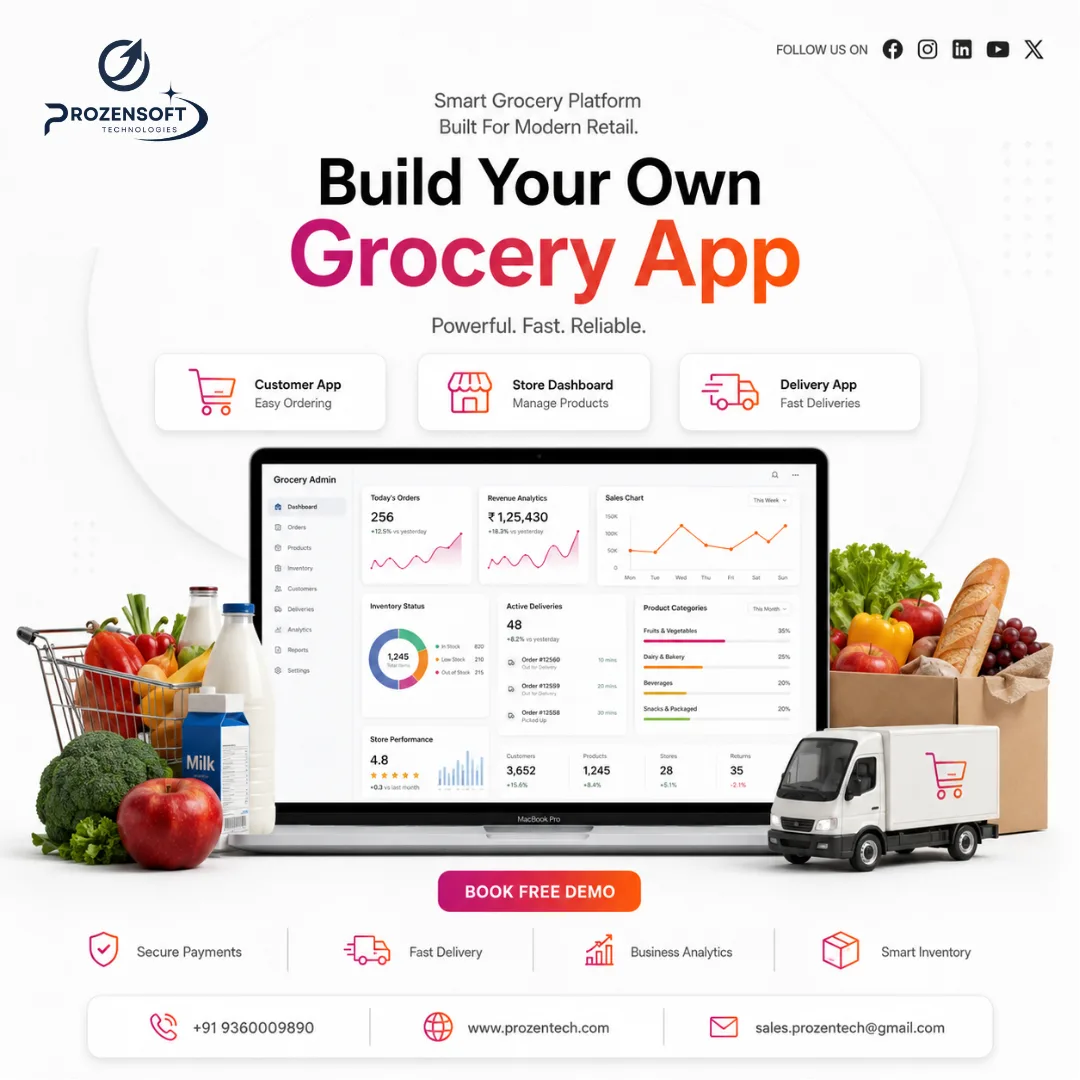
Online grocery shopping has become an essential part of modern retail. Customers now expect to discover products quickly, check real-time availability, compare prices, select delivery slots, complete secure payments, and receive groceries without visiting a physical store.
For supermarkets, grocery chains, independent retailers, wholesalers, dark stores, and quick-commerce startups, professional Grocery App Development creates a complete digital ecosystem for managing products, inventory, customers, orders, payments, branches, and delivery operations.
A premium grocery platform connects customers, stores, warehouse teams, delivery partners, and administrators through one unified system. It reduces manual coordination, improves order accuracy, strengthens customer retention, and gives retailers the flexibility to expand across new locations.
Why Grocery Businesses Need a Digital Platform
Traditional grocery businesses often depend on walk-in customers, telephone orders, handwritten lists, and manual delivery coordination.
These methods can become difficult to manage when the number of products, branches, customers, and daily orders increases.
Common challenges include:
- Incorrect product quantities
- Unavailable items
- Delayed order preparation
- Inventory mismatches
- Missed customer instructions
- Payment confirmation issues
- Delivery coordination problems
- Limited business reporting
A dedicated grocery application creates a structured shopping and fulfilment workflow.
Customers can browse products, select variants, add quantities, apply coupons, choose a delivery method, and complete checkout within a few steps.
Store teams receive accurate order information through a dedicated dashboard. They can confirm availability, suggest alternatives, prepare products, complete packing, and coordinate delivery efficiently.
Grocery App Business Models
A grocery platform can be customized according to the size and operating model of the business.
Single Store Grocery App
This model is suitable for an independent grocery store or supermarket.
The business manages its own products, inventory, prices, customers, orders, employees, delivery areas, and payments.
A branded application helps the retailer build direct customer relationships and reduce dependency on third-party marketplaces.
Multi Store Grocery Marketplace
A multi-store marketplace allows supermarkets, local grocery shops, organic retailers, wholesalers, and speciality stores to register on one platform.
Customers can discover nearby stores, compare products, check delivery estimates, review ratings, and order from their preferred retailer.
The platform owner can generate revenue through commissions, subscriptions, delivery charges, advertisements, and featured listings.
Multi Branch Supermarket Platform
This model is designed for supermarket chains operating across multiple branches or cities.
Every branch can independently manage products, stock quantities, prices, offers, employees, operating hours, order capacity, and delivery zones.
The platform can automatically connect customers with the nearest eligible branch based on their delivery address.
Quick Commerce Grocery Platform
A quick-commerce platform focuses on delivering groceries and household essentials within a shorter period.
This model usually requires strategically located dark stores, real-time inventory, rapid order picking, intelligent delivery allocation, and strong operational monitoring.
Wholesale Grocery Platform
A wholesale grocery application can serve restaurants, hotels, cafes, retailers, offices, and catering businesses.
The platform can support bulk pricing, minimum order quantities, customer-specific rates, recurring orders, credit limits, invoice billing, and scheduled delivery.
Premium Customer App Features
The customer application should provide a fast and personalized shopping experience.
Important customer features include:
- Secure registration and login
- Mobile number verification
- Google and Apple login
- Automatic location detection
- Nearby store discovery
- Product category browsing
- Advanced product search
- Smart filters and sorting
- Brand-based discovery
- Product variants
- Quantity selection
- Shopping cart management
- Favourite products
- Saved shopping lists
- Multiple delivery addresses
- Instant delivery
- Scheduled delivery
- Delivery slot selection
- Contactless delivery
- Multiple payment methods
- Cash on delivery
- Digital wallet
- Coupons and offers
- Loyalty rewards
- Live order tracking
- Order history
- One-click reordering
- Ratings and reviews
- Push notifications
- Customer support
The checkout page should clearly display product totals, discounts, taxes, delivery charges, handling fees, wallet deductions, tips, and the final payable amount.
Personalized Product Discovery
A premium grocery platform should help customers find relevant products without browsing through hundreds of items.
The application can display:
- Frequently purchased products
- Recently viewed products
- Recommended brands
- Popular products
- Seasonal collections
- Weekly essentials
- New arrivals
- Personalized offers
- Products commonly purchased together
For example, a customer adding bread to the cart may receive recommendations for milk, butter, eggs, or jam.
Personalized discovery can improve convenience and increase the average order value without making the experience feel complicated.
Smart Product Catalogue Management
Products can be organized into categories such as:
- Fruits and vegetables
- Dairy products
- Rice and grains
- Snacks and beverages
- Bakery products
- Meat and seafood
- Frozen foods
- Household essentials
- Personal care
- Baby products
- Organic groceries
- Pet supplies
Each product listing can include:
- Product images
- Brand information
- Product description
- Weight or package size
- Regular price
- Discounted price
- Available quantity
- Nutritional information
- Product variants
- Storage instructions
- Customer ratings
Stores can also create dedicated collections for festival offers, healthy products, premium brands, local products, and budget-friendly essentials.
Product Variants and Flexible Pricing
Many grocery products are available in different sizes, weights, flavours, and package types.
For example, rice may be available in one-kilogram, five-kilogram, and ten-kilogram packages. Beverages may be offered as single bottles, multipacks, or family packs.
The platform can maintain separate prices, images, discounts, and inventory for every variant.
Retailers can configure:
- Standard prices
- Promotional prices
- Membership prices
- Bulk prices
- Branch-specific prices
- Time-limited offers
- Quantity-based discounts
- Customer-specific pricing
Flexible pricing helps retailers run targeted campaigns while maintaining control over margins.
Real Time Inventory Management
Inventory accuracy is one of the most important parts of Grocery App Development.
Customers should not be able to order unavailable products. Stock quantities should update whenever an order is placed, cancelled, refunded, replaced, or completed.
Products can be marked as:
- Available
- Low stock
- Temporarily unavailable
- Out of stock
- Discontinued
Store managers can receive automatic low-stock alerts when quantities reach configured limits.
The platform can also integrate with existing point-of-sale or inventory systems to synchronize online and physical store stock.
Accurate inventory management reduces cancellations, refunds, replacements, and customer complaints.
Automated Replenishment Alerts
Retailers can use stock thresholds to improve replenishment planning.
When a product reaches a minimum quantity, the system can alert the store manager or purchasing team.
The dashboard can highlight:
- Fast-moving products
- Low-stock products
- Out-of-stock products
- Products nearing expiry
- Slow-moving products
- Seasonal demand changes
- Frequently replaced items
These insights help retailers maintain better stock availability and reduce unnecessary inventory costs.
Smart Product Replacement
A selected product may become unavailable while an order is being prepared.
The application can allow customers to choose a replacement preference during checkout.
Available options can include:
- Replace with a similar product
- Request approval before replacement
- Remove the unavailable product
- Refund the product amount
Store employees can suggest alternatives based on brand, size, price, or category.
Customers can approve or reject the replacement directly through the application before the order is packed.
This transparent process improves customer confidence and reduces fulfilment delays.
Complete Grocery Ordering Workflow
The customer begins by selecting a delivery address.
The platform identifies available stores or branches based on location, delivery radius, operating hours, current order capacity, and product availability.
The customer selects a store, browses products, adds items to the cart, chooses a delivery option, and completes payment.
The order can move through statuses such as:
- Order placed
- Payment confirmed
- Store approval pending
- Order confirmed
- Product picking started
- Replacement approval required
- Packing in progress
- Order packed
- Delivery partner assigned
- Ready for pickup
- Order collected
- Out for delivery
- Order delivered
- Order cancelled
- Refund initiated
- Refund completed
Customers receive automatic notifications whenever the order status changes.
Store Management Dashboard
The store dashboard gives retailers complete control over daily digital operations.
Store owners and managers can:
- Manage store profiles
- Add product categories
- Create and update products
- Configure product variants
- Control prices and discounts
- Update inventory
- Accept or reject orders
- Suggest replacements
- Assign picking staff
- Monitor packing progress
- Configure operating hours
- Define delivery zones
- Create promotional campaigns
- Manage staff accounts
- Monitor payments
- Review settlements
- Access sales reports
Role-based accounts can be created for branch managers, inventory teams, picking staff, packing teams, accountants, and customer support representatives.
Multi Branch Grocery Management
Retail chains can manage multiple branches through one centralized platform.
Every branch can maintain separate:
- Product availability
- Inventory levels
- Prices
- Discounts
- Operating hours
- Delivery zones
- Employee accounts
- Order limits
- Delivery partners
- Revenue reports
The platform can assign an order to the nearest branch capable of fulfilling the customer’s complete cart.
When one branch cannot fulfil the order, the system can redirect it to another supported branch according to configured business rules.
Delivery Partner Application
The delivery partner application helps drivers manage grocery pickups and doorstep deliveries.
Delivery partners can:
- Register and upload documents
- Set online or offline availability
- Receive delivery requests
- Accept or reject assignments
- Navigate to stores
- Confirm order collection
- Navigate to customer locations
- Contact customers
- Update delivery progress
- Verify delivery using OTP
- Upload proof of delivery
- View daily earnings
- Monitor incentives
- Check wallet balances
- Submit withdrawal requests
- Access delivery history
- Contact support
Real-time GPS tracking allows customers, stores, and administrators to monitor the complete delivery journey.
Intelligent Delivery Assignment
The platform can assign delivery orders based on:
- Driver distance from the store
- Driver availability
- Vehicle type
- Current workload
- Order size
- Delivery priority
- Customer location
- Driver rating
For quick-commerce operations, nearby orders can be grouped and assigned to one delivery partner when the promised delivery time will not be affected.
Administrators can configure driver search radius, response time, maximum delivery capacity, batching rules, and assignment priority.
Scheduled Delivery and Capacity Management
Scheduled delivery allows stores to control order volume and fulfilment capacity.
Customers can select an available delivery date and time slot during checkout.
Store managers can configure:
- Slot duration
- Maximum orders per slot
- Express delivery availability
- Free delivery periods
- Branch-specific schedules
- Holiday settings
- Time-based delivery charges
When a time slot reaches maximum capacity, it automatically becomes unavailable.
This prevents overbooking and helps stores maintain reliable delivery commitments.
Secure Payments and Digital Wallet
A premium grocery app should support secure and convenient payment methods.
Customers can pay using:
- Credit cards
- Debit cards
- Mobile wallets
- Online banking
- Cash on delivery
- Regional payment gateways
- Internal wallet balance
The digital wallet can manage:
- Cashback
- Referral rewards
- Promotional credits
- Loyalty benefits
- Gift balances
- Order refunds
Transparent payment information improves customer confidence and reduces billing disputes.
Grocery Membership and Subscription Plans
Membership plans help grocery retailers increase repeat purchases and recurring revenue.
Premium membership benefits can include:
- Free delivery
- Reduced handling fees
- Exclusive product discounts
- Priority delivery slots
- Additional loyalty points
- Early access to promotions
- Premium customer support
Customers can also create recurring orders for milk, bread, eggs, fruits, vegetables, water bottles, and other frequently purchased products.
The platform can automatically generate orders based on a daily, weekly, or monthly schedule.
Promotions and Loyalty Programmes
Promotional tools help retailers attract new customers and retain existing users.
The platform can support:
- First-order discounts
- Free delivery coupons
- Product-specific offers
- Category discounts
- Brand promotions
- Festival campaigns
- Cashback rewards
- Referral programmes
- Loyalty points
- Membership discounts
- Personalized coupons
Campaigns can be configured for selected customers, stores, branches, products, cities, or payment methods.
Powerful Admin Panel
The admin panel provides centralized control over the entire grocery platform.
Administrators can manage:
- Customers
- Stores
- Branches
- Products
- Categories
- Inventory
- Delivery partners
- Orders
- Payments
- Commissions
- Settlements
- Refunds
- Delivery zones
- Coupons
- Membership plans
- Promotional banners
- Notifications
- Customer support
- Reports and analytics
- Role-based staff accounts
Different commissions can be configured for individual stores, branches, product categories, cities, or subscription plans.
Revenue Models for Grocery Platforms
A grocery platform can generate revenue through several channels.
Common revenue opportunities include:
- Store commissions
- Delivery fees
- Convenience charges
- Handling fees
- Express delivery charges
- Store subscription plans
- Customer memberships
- Featured store listings
- Sponsored product placements
- In-app advertisements
- Wholesale service charges
Multiple revenue streams help create a sustainable and scalable business model.
Grocery Business Analytics
Analytics help grocery retailers understand customer behaviour and improve operations.
Reports can include:
- Total orders
- Completed orders
- Cancelled orders
- Gross sales
- Average order value
- Best-selling products
- Slow-moving products
- Repeat customers
- Store performance
- Branch performance
- Delivery completion times
- Refund amounts
- Coupon usage
- Customer retention
- Delivery partner performance
These insights can support better inventory planning, pricing decisions, marketing campaigns, and delivery operations.
Building a Scalable Grocery Platform
A grocery business can initially launch with one store, one branch, or a limited delivery area.
After validating customer demand and improving fulfilment processes, the platform can expand into additional branches, cities, vendors, and product categories.
Future features can include:
- Artificial intelligence recommendations
- Voice-based product search
- Automated inventory forecasting
- Smart shopping lists
- Pharmacy delivery
- Wholesale ordering
- Subscription automation
- Super app integration
Professional Grocery App Development provides the technical foundation needed to support increasing numbers of customers, products, stores, payments, orders, and real-time deliveries.
Conclusion
A premium grocery application transforms traditional retail operations into a personalized and scalable digital business.
Customers can discover products, check availability, place orders, choose delivery slots, make secure payments, and track purchases through one convenient mobile application.
Retailers can manage products, inventory, branches, pricing, promotions, employees, orders, and settlements through dedicated dashboards.
Delivery partners can manage pickups, navigation, doorstep deliveries, earnings, and withdrawals through a separate application.
With personalized product discovery, accurate inventory, efficient delivery management, secure payments, and scalable architecture, Grocery App Development helps retailers deliver a premium customer experience and achieve sustainable growth.
Frequently Asked Questions
What is Grocery App Development
Grocery App Development is the process of creating a digital platform where customers can browse products, place orders, make payments, and receive doorstep grocery deliveries.
Can the platform support multiple grocery stores
Yes. Local stores, supermarket chains, wholesalers, organic retailers, and speciality shops can operate through one marketplace.
Can every branch manage separate inventory
Yes. Each branch can independently manage products, variants, stock quantities, prices, offers, and availability.
Can customers schedule grocery deliveries
Yes. Customers can select available delivery dates and time slots based on store capacity and platform settings.
Can customers approve product replacements
Yes. Customers can approve suggested alternatives, reject replacements, remove unavailable products, or request refunds.
Does the platform include a delivery partner app
Yes. Delivery partners can receive assignments, navigate to stores, collect orders, complete deliveries, monitor earnings, and request withdrawals.
Can recurring grocery orders be included
Yes. Customers can schedule daily, weekly, or monthly deliveries for frequently purchased products.
How does the platform generate revenue
The platform can earn through commissions, delivery charges, subscriptions, advertisements, convenience fees, and sponsored product placements.
Can multiple payment gateways be integrated
Yes. The application can support cards, mobile wallets, online banking, cash on delivery, internal wallets, and regional payment gateways.
Can the grocery platform operate across multiple cities
Yes. Each city can have separate stores, branches, inventory, pricing, delivery zones, taxes, languages, and payment options.