
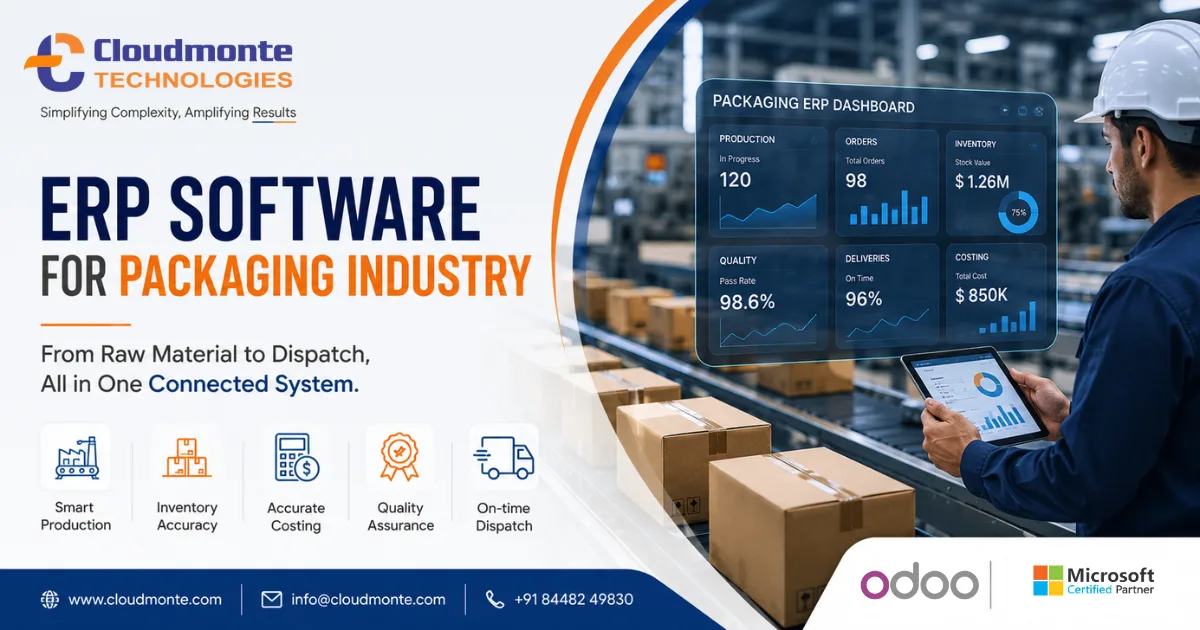
The packaging industry has never been just about producing boxes, cartons, labels, films, or flexible packaging. Behind every finished package is a complex chain of activities—raw-material procurement, inventory planning, production scheduling, machine utilization, quality checks, costing, customer specifications, and on-time dispatch.
As packaging manufacturers grow, managing these processes through spreadsheets, disconnected software, and manual communication becomes increasingly difficult. A delay in material availability can affect production. A small change in a customer's specification can create costing issues. Excessive material wastage can quietly reduce margins. And when production, inventory, sales, and finance work with different data, management may not get a clear picture of what is actually happening on the shop floor.
This is where ERP software for packaging industry is becoming increasingly important.
A modern ERP system brings key business processes into one connected environment, helping packaging companies move from reactive operations to more coordinated, data-driven manufacturing.
In 2026, the real value of ERP is not simply digitizing paperwork. It is creating a connected flow of information—from the moment a customer places an order to the moment the finished goods leave the warehouse.
Why Packaging Manufacturing Needs a Different ERP Approach
Packaging manufacturing has its own operational complexities.
A manufacturer may produce hundreds or thousands of SKUs while dealing with different customer requirements, dimensions, materials, colors, printing specifications, quantities, and delivery schedules.
For example, a customer may order customized corrugated boxes with specific dimensions, printing requirements, board specifications, and packaging quantities. Another customer may require flexible packaging with different film structures and printing specifications.
At the same time, manufacturers need to monitor:
- Raw-material availability
- Production capacity
- Material consumption
- Machine schedules
- Wastage and scrap
- Product quality
- Customer-specific specifications
- Production costs
- Inventory levels
- Delivery commitments
Managing all of this manually can create information gaps.
An ERP system helps connect these activities so that teams can work from the same operational data.
From Customer Order to Production Planning
The packaging workflow usually starts with a customer order.
Traditionally, sales teams may record order information separately, while production planners maintain their own schedules and inventory teams track materials independently.
This can create unnecessary back-and-forth.
With an ERP system, sales orders can become part of a connected workflow. Customer specifications, quantities, required dates, pricing, and product information can flow into planning and production processes.
The production team can then determine:
- What needs to be manufactured
- How much needs to be produced
- Which materials are required
- When production should start
- Which resources or machines may be needed
- Whether existing inventory can support the order
This creates better coordination between sales, planning, procurement, and production.
Better Raw-Material Planning
Raw materials are one of the biggest operational considerations for packaging manufacturers.
Depending on the type of packaging produced, businesses may manage paper, board, films, adhesives, inks, chemicals, polymers, laminates, printing materials, cores, cartons, and other components.
Keeping too much inventory can increase carrying costs and working-capital pressure. Keeping too little can interrupt production.
ERP helps manufacturers connect material requirements with production plans and inventory information.
Instead of asking multiple teams for separate updates, management can get a more centralized view of:
- Current stock
- Expected purchases
- Material consumption
- Pending purchase orders
- Production requirements
- Reorder requirements
This can support more informed procurement decisions.
Controlling Material Wastage
Wastage is one of those costs that can easily become invisible when production data is not properly captured.
In packaging manufacturing, material may be lost during cutting, printing, lamination, forming, setup, changeovers, rejected production, or other processes.
A modern ERP system can help record planned versus actual material consumption and production output.
Over time, this data can help management identify patterns.
For example:
Planned Material → Actual Consumption → Production Output → Wastage → Reusable/Rejected Material
When these numbers are consistently tracked, manufacturers can investigate why certain jobs consume more material than expected.
That creates an opportunity to improve production efficiency rather than simply accepting wastage as a normal cost.
Production Planning Becomes More Connected
Packaging manufacturers often have to balance multiple orders with different delivery commitments.
A production schedule that looks manageable in the morning can change quickly when a machine goes down, raw material arrives late, or an urgent customer order needs to be prioritized.
An ERP platform can give planners better visibility into production requirements and available resources.
Depending on the ERP configuration, teams can manage:
- Manufacturing orders
- Bills of materials
- Work orders
- Work centers
- Production schedules
- Material requirements
- Production status
- Planned versus actual quantities
The objective is not to eliminate every production challenge.
The objective is to give planners better information so they can respond faster.
Real-Time Inventory Visibility
Inventory accuracy is critical in packaging manufacturing.
A company may have materials spread across warehouses, production areas, stores, and finished-goods locations.
When inventory records are updated manually or inconsistently, teams may assume materials are available when they are actually committed to another order.
ERP provides a centralized inventory environment where stock movements can be recorded and tracked.
This can help businesses understand:
What do we have?
Where is it?
What has been reserved?
What is being consumed?
What is arriving?
What needs to be purchased?
That visibility can support better production and purchasing decisions.
Quality Management from Production to Finished Goods
Quality is particularly important in packaging because packaging defects can affect both the manufacturer's reputation and the customer's production process.
Depending on the packaging product, quality checks may include dimensions, printing accuracy, material specifications, strength, color, weight, finishing, sealing, or other customer-defined parameters.
ERP can help organizations establish quality checkpoints within their workflows.
Instead of treating quality as something that happens only after production, businesses can incorporate checks into relevant stages of the manufacturing process.
This can help identify problems earlier and reduce the risk of defective products reaching the customer.
Accurate Job Costing and Production Cost Analysis
One of the biggest questions for packaging manufacturers is simple:
“How much did this order actually cost us?”
The answer is often more complicated than expected.
A packaging order may involve:
- Raw materials
- Direct labor
- Machine time
- Electricity and utilities
- Printing
- Finishing
- Outsourced processes
- Packaging
- Transportation
- Wastage
When these costs are tracked separately, calculating the true profitability of an order can be difficult.
ERP can bring relevant operational and financial information together to support more structured costing.
This can help management compare estimated costs with actual costs and understand where margins are being gained or lost.
Customer-Specific Packaging Requirements
Packaging is often highly customized.
Two customers may order products that look similar but have different specifications, materials, dimensions, artwork, quantities, or quality requirements.
An ERP system can help maintain structured product and customer information so teams have better access to the correct specifications.
This reduces dependence on scattered emails, spreadsheets, and manually maintained documents.
The result is a more consistent flow of information from sales to production.
Connecting Sales, Production and Finance
One of the biggest advantages of ERP is connectivity.
Without an integrated system, sales may use one application, production another, inventory may depend on spreadsheets, and finance may maintain separate records.
Each department may technically have data—but the business still lacks one reliable operational picture.
ERP connects these functions.
For example:
Sales Order → Production Planning → Material Requirement → Purchase → Manufacturing → Quality → Finished Goods → Dispatch → Invoice → Financial Reporting
This connected flow is what makes ERP significantly more valuable than simply replacing paper-based processes with digital forms.
What Makes the Best ERP for Packaging Industry?
There is no single ERP platform that is automatically the best for every packaging manufacturer.
The right system depends on company size, manufacturing processes, product complexity, existing technology, budget, growth plans, and integration requirements.
However, a strong Best ERP for packaging industry solution should ideally support areas such as:
1. Manufacturing Management
The system should support production planning, manufacturing orders, work orders, bills of materials, and production tracking.
2. Inventory Management
Businesses should be able to track raw materials, work-in-progress, finished goods, stock movements, and warehouse operations.
3. Procurement
The ERP should connect material requirements with purchasing and supplier management.
4. Quality Management
Quality checkpoints, inspections, and non-conformance processes should be manageable within the workflow.
5. Costing
Manufacturers should be able to analyze material, labor, machine, and other production-related costs.
6. Sales Management
Customer orders, quotations, pricing, product information, and delivery commitments should connect with operational processes.
7. Finance
Operational transactions should flow into accounting and financial reporting with minimal duplicate data entry.
8. Reporting and Analytics
Management should have access to useful information about production, inventory, costs, sales, profitability, and operational performance.
Why Odoo ERP for Packaging Industry Is Worth Considering
For packaging businesses looking for a flexible ERP environment, Odoo ERP for Packaging Industry can be a practical option.
Odoo provides a modular ecosystem where businesses can connect areas such as sales, purchase, inventory, manufacturing, quality, accounting, maintenance, and other business functions.
For a packaging manufacturer, this can create a connected operational environment rather than forcing every department to work in isolation.
For example, a typical workflow could look like this:
Customer Enquiry → Quotation → Sales Order → Material Planning → Purchase → Manufacturing → Quality Check → Finished Goods → Delivery → Invoice
The exact workflow can be configured according to the organization's processes.
The important point is that the ERP should adapt to the business—not force the business to manage everything around disconnected software.
ERP and Data-Driven Decision Making in 2026
ERP is also changing because manufacturing itself is becoming more data-driven.
In 2026, business leaders increasingly expect faster answers to operational questions.
For example:
- Which orders are currently in production?
- Which jobs are delayed?
- Which materials are running low?
- Which products generate the highest margins?
- Where is wastage increasing?
- How much production capacity is available?
- Which customers have upcoming delivery commitments?
- What is the actual cost of a production order?
Instead of waiting for multiple departments to prepare reports, management can use centralized ERP data to make decisions faster.
This is where ERP becomes a management tool rather than simply an accounting or inventory application.
The Role of Automation in Packaging ERP
Automation can reduce repetitive administrative work.
For example, ERP workflows can help automate or streamline activities such as:
- Purchase order creation
- Inventory updates
- Production order generation
- Approval workflows
- Quality checks
- Stock movements
- Invoicing
- Customer notifications
- Operational reporting
The objective is not automation for its own sake.
The real objective is to reduce manual effort while improving consistency and visibility.
ERP Is More Than Software—It Is an Operational Framework
A common mistake is to think that implementing ERP automatically solves business problems.
It does not.
ERP works best when companies first understand their processes and then configure the system around clearly defined workflows.
Successful ERP implementation usually requires attention to:
- Process mapping
- Data quality
- User roles
- Employee training
- Approval workflows
- Integration requirements
- Reporting needs
- Change management
Technology provides the platform.
People and processes determine how much value the business gets from it.
How Packaging Manufacturers Can Prepare for ERP Adoption
Before selecting an ERP system, packaging companies should evaluate their current operations.
Start by identifying the biggest operational pain points.
For example:
Are production schedules frequently changing?
Is raw-material inventory inaccurate?
Is wastage difficult to measure?
Are quotations taking too long to prepare?
Is actual job profitability unclear?
Are customer specifications spread across emails and spreadsheets?
Does management wait too long for operational reports?
The answers can help define the ERP requirements.
Instead of selecting software based only on features, businesses should select an ERP based on the problems they need to solve.
The Future of ERP for Packaging Manufacturing
The next generation of packaging ERP will likely become increasingly connected with automation, analytics, IoT, AI, and real-time production data.
Manufacturers will increasingly expect ERP platforms to provide more than historical reports.
They will want systems that help them understand what is happening now and identify potential problems earlier.
Imagine a manufacturing environment where management can see production status, material availability, quality issues, inventory levels, order commitments, and financial impact through a connected digital platform.
That is the direction in which modern manufacturing technology is moving.
Final Thoughts
The packaging industry is becoming more competitive, and operational efficiency can directly influence profitability.
From raw-material procurement to production planning, quality management, costing, inventory control, and final dispatch, every stage contributes to the final customer experience and business margin.
This is why ERP for Packaging is becoming an important part of digital transformation for packaging manufacturers.
The right ERP system can connect departments, improve visibility, reduce manual work, strengthen production control, and give management better information for decision-making.
For businesses evaluating ERP software for packaging industry, the goal should not simply be to purchase another software platform.
The goal should be to build a connected operating system for the business.
With the right implementation strategy, solutions such as Odoo ERP for Packaging Industry can help manufacturers create a more organized, scalable, and data-driven operation—moving confidently from raw material to finished product and, ultimately, to successful dispatch.
Ready to Transform Your Packaging Operations?
Cloudmonte Technologies helps businesses explore and implement ERP solutions designed around their operational requirements.
If your packaging business is struggling with disconnected systems, manual processes, inventory challenges, production visibility, or unclear costing, an ERP assessment can be a practical first step toward building a more connected operation.
From raw material to dispatch, the future of packaging manufacturing is connected, automated, and data-driven.