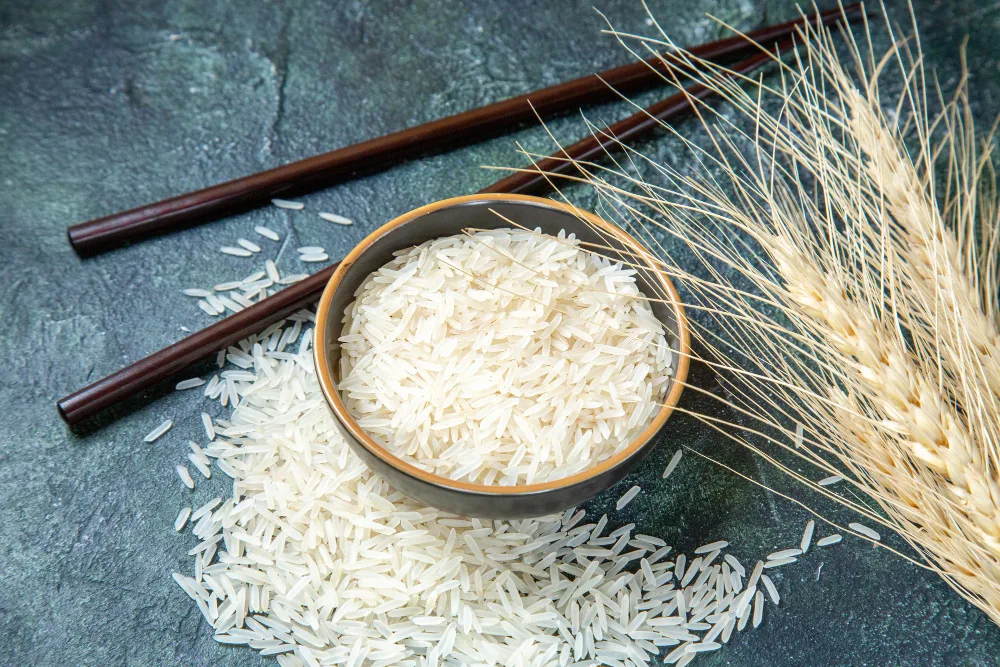
Basmati rice has a distinct aroma that is nutty and floral. That aroma fills the air and makes one’s mouth water for a delicious meal to come. Most have not taken the time to think about the journey that every grain of Basmati has taken. There are farmers, millers, and exporters that have a passion for their craft that turns this grain so magnificent.
This journey has started from a flooded field and has spans thousands of miles to bring the delicious Basmati right to your local grocery store. This journey is one of the many that has changed the way that consumers see quality goods and reputable sourcing.
Basmati Rice Growing Region
The name and identity of this exquisite rice grain is so unique that Basmati has received a Geographical Indication tag, or GI tag. The GI tag legally allows recognition of where the rice is grown. Many farmers are from the Indian subcontinent of Punjab, Haryana, and Uttarakhand. The fertile plains of Punjab, Haryana, and Uttarakhand, along with the Himachal run plains, provide the most stress free environment for Basmati.
Basmati has been grown here for generations, and for some, the cultivation of the crop relies solely on family-taught skills. The cultivation process is now also including traditions of sustainability with the aim of protecting the soil and water. This is especially important due to the crop's reliance on the environment. The process is slow as it requires a lot of care.
For Basmati rice suppliers, this is the starting point, and the best of them will create the most sustainable and traceable paddy supply, straight from the fields, through strong relationships with the regions, well before the grains arrive at the mill.
Considerate Harvesting
Timing is an essential factor during harvest. If the crop is cut early then the grains will not have matured, but if cut late, then the quality deteriorates. The crop is usually cut during the months of October and November when the fields are at their peak.
The harvest is also an especially vulnerable time for the grain, which needs to maintain its shape, moisture, and potential to create Basmati later on. Poor harvesting can negate months of hard work during a matter of days.
Milling and Processing
Seemingly, one step occurs as the paddy arrives at the mill, but a precise system of interdependent sub-steps occurs:
- Cleaning removes dust, debris, and foreign materials
- Stone separation filters out small stones and grit
- De-husking removes the tough outer husk
- Paddy separation removes husked grains from those that remain
- Polishing improves the texture and appearance of the grains
Milling also sends rice through advanced color-sorting technology, an almost surgical step. High-speed sensors scan and reject the imperfect or broken grain to leave behind a flawless and uniformly perfect batch.
Aging for Better Aroma and Taste
Where Basmati Rice diverges from typical Rice is in the aging. Freshly milled Basmati is good, but the aged Basmati is extraordinary.
Aging Basmati refers to a time in which the milled grains are allowed to store and mature. It may sound like the grains focus on a goal to improve the quality of their aroma and taste. The grains even improve on their structure, and develop an ability to elongate when cooked ideal to nearly double their length while remaining unsticky and unbroken.
2-acetyl-1-pyrroline is the name of the flavoring agent in jasmine rice and fresh baked bread, which also is the main ingredient in the flooring smelling compound people love so much. Aging rice helps hold and concentrate this flavor. This is the main reason dedicated millers and suppliers find this step impossible to skip. It takes time (and a lot of) storage), but the end results speak for themselves in the form of noticable, improved flavor.
Quality Testing and Inspection
The rice has to earn its right to leave the country. This is because of the number of complaints big international buyers have for low quality shipments and a lack of consistency.
Some of these quality control checks ensure the:
Moisture content of the rice lies between the 12% and 13% range so that it has a long shelf life.
Rice elongation shows that the rice is high quality Basmati.
There are no impurities and/or broken rice.
Not only do good suppliers do these tests, they have the FSSAI, HACCP, and ISO 22000 certificates as a minimum. More often than not, the rice has also gone through inspections by the Export Inspection Council, Bureau Veritas, and SGS. These are not stamps, but ensure consistency and promise quality.
Hygienic Packaging
The best rice in the world is of no use if it gets damaged and smells bad. Good packaging protects against this and helps hold the flavor and freshness.
PP woven bags (10-50 kg): strong and economical for bulk exports.
Non-woven bags (1-10 kg): affordable and attractive, ideal for retail.
Vacuum packaging (1-5 kg): fresh and flexible for high-end markets (US, Canada, Japan).
Jute bags are the choice for brands that are eco-focused and heritage concerned.
FIBC jumbo bags (500-1,000 kg): excellent for B2B bulk orders.
Packaging plays a critical role beyond protection. First, it creates a food-safe environment for the product. Then, it must meet accurate labeling, country of origin and various standards and compliance regulations (e.g. the FDA and EFSA). A good supplier will integrate packaging with the product.
Global Distribution and Export
This is the big picture view. Since 2012, India has been the #1 exporter of rice in the world, comprising 30-35% of all rice exports globally. For FY 2024-25, India exported an estimated 6.065 million metric tonnes of Basmati rice alone, with a total rice export value of USD 12.47 billion.
The world wants rice and the demand is growing. The Middle East is the center of Basmati exports, making up over 60% of total exports. Saudi Arabia imported the most Basmati rice with 11.73 lakh metric tonnes, followed by Iraq (9.05 LMT) and Iran (8.55 LMT). Emerging markets in Africa and Europe, particularly Nigeria, Senegal, the United Kingdom and Germany, are seeing increased Basmati imports due to diaspora, as well as an increase in demand for sustainable and traceable sources.
Exporting rice globally is an intricate challenge. Exporters work with a complicated set of procedures such as APEDA registration, FSSAI licensing, phytosanitary certificates, certificates of origin, and requirements that change from one country to another, such as Saudi Arabia’s HACCP and the EU’s inspection certificates. The price of rice exports in 2025 is expected to be USD 900 to 1,200 per metric tonne. These numbers are based on estimates of bulk pricing and fluctuations in currency alongside freight pricing.
In the rice market, certification is not enough to attract customers. What is most important and what captures the market is reliability of supply.
Why the Right Supplier Makes All the Difference
Tracking the journey of each grain of Basmati rice from the farm to the packaging and the end consumer reveals the painstaking efforts and choices that impact the quality of every single grain.
This journey is significant and traduced by many as a “long, fragile journey.” The right basmati rice supplier turns this long fragile journey of many choices into a promise and a rigorous affair of authenticity and care. The right supplier safeguards quality from the flooded farm to the fully packed supply.