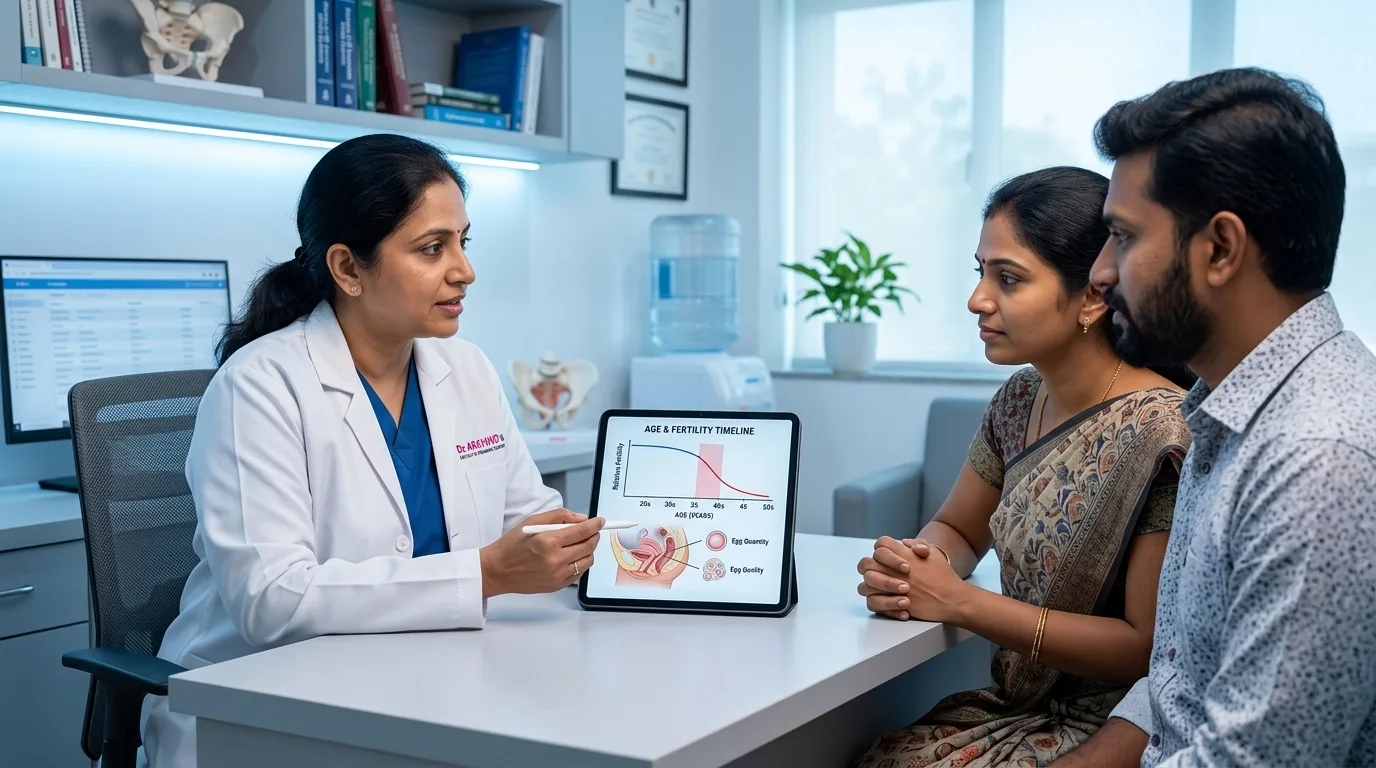
What Does a Decline in Fertility Actually Mean?
Fertility changes throughout life. It is not a fixed ability that remains exactly the same from adolescence to older adulthood.
For women, fertility gradually changes with age as the number and quality of available eggs decrease. Men may also experience changes in sperm production and reproductive health over time, although the pattern is generally different.
A decline in fertility does not mean that pregnancy is impossible.
It means that the probability of conception may decrease, and the time needed to become pregnant may increase.
For couples exploring Fertility Centres in Palakkad, understanding these changes can help them make informed decisions about pregnancy planning and seek medical advice at an appropriate time.
Why Does Female Fertility Change With Age?
Women are born with a fixed number of eggs that gradually decreases over time.
Over time, the number of remaining eggs decreases. As age advances, egg quality can also decline.
This can affect:
- The chance of natural conception
- Embryo development
- The risk of miscarriage
- The likelihood of chromosomal abnormalities
The decline is gradual, but it becomes more noticeable as women move through their late 30s and beyond.
However, age is only one factor.
A woman's individual reproductive health can vary considerably from another woman of the same age.
What Happens to the Ovarian Reserve?
Ovarian reserve refers to the remaining supply of eggs in the ovaries.
It is different from egg quality.
Tests such as AMH blood testing and antral follicle count through ultrasound may provide information about ovarian reserve.
These tests can help fertility specialists understand how the ovaries may respond to stimulation during fertility treatment.
However, ovarian reserve testing cannot accurately predict exactly when a woman will become infertile.
A low result does not mean pregnancy is impossible, while a normal result does not guarantee natural conception.
The results need to be interpreted alongside age and other fertility factors.
Does Egg Quality Also Change?
Yes.
Egg quality is strongly influenced by age.
As women get older, the likelihood of chromosomal abnormalities in eggs generally increases.
This can affect embryo development and may contribute to a higher risk of miscarriage.
This is one reason why some women may find that conception takes longer as they age.
It is also why fertility specialists may recommend earlier evaluation for women who are older or have other reproductive risk factors.
What Happens to Male Fertility With Age?
Male fertility can also change over time.
Men continue producing sperm throughout adulthood, but sperm quality may change with increasing age.
Possible changes may involve:
- Sperm movement
- Sperm concentration
- Sperm DNA integrity
- Hormonal function
The rate at which this occurs can vary greatly between individuals.
Age is only one factor affecting male reproductive health.
Smoking, alcohol use, obesity, infections, varicocele, medications, and certain medical conditions can also influence sperm quality.
A semen analysis can help assess important aspects of male reproductive health.
Can Fertility Decline Without Any Symptoms?
Yes.
This is one of the reasons fertility changes can sometimes go unnoticed.
A woman may continue to have regular menstrual cycles even as ovarian reserve and egg quality change.
Similarly, a man may have no obvious symptoms despite changes in sperm parameters.
Fertility is not always reflected by how healthy a person feels.
When there are concerns about reproductive potential, appropriate testing can provide more useful information than symptoms alone.
Does Fertility Decline Affect Natural Pregnancy?
As fertility declines, the probability of conception during each menstrual cycle may decrease.
This means that couples may need more time to achieve pregnancy.
However, natural pregnancy can still occur at different ages.
There is no single age at which every person's fertility suddenly stops.
Individual factors matter.
The important point is that age-related fertility changes can influence the timeline, making early planning and timely evaluation valuable for some couples.
Can Fertility Decline Increase Miscarriage Risk?
Age-related changes in egg quality can increase the likelihood of chromosomal abnormalities in embryos.
Some chromosomal abnormalities may prevent an embryo from developing normally, which can sometimes result in miscarriage.
However, miscarriage can happen for many reasons.
Age is one factor among several.
A single miscarriage does not necessarily indicate a fertility problem.
Repeated pregnancy loss, however, may require further evaluation.
Can Lifestyle Slow Fertility Decline?
Healthy lifestyle habits are important for overall wellbeing and reproductive health.
They may help protect general health, but they cannot completely stop the natural biological changes associated with aging.
Helpful habits include:
- Avoiding smoking
- Limiting excessive alcohol
- Maintaining a healthy weight
- Eating a balanced diet
- Staying physically active
- Managing chronic health conditions
- Getting adequate sleep
These habits can support health but should not create the expectation that age-related fertility decline can be reversed.
What Medical Conditions Can Affect Fertility?
Fertility may decline or become more difficult due to certain medical conditions.
These can include:
- PCOS
- Endometriosis
- Thyroid disorders
- Low ovarian reserve
- Uterine conditions
- Tubal problems
- Varicocele
- Hormonal disorders
Some conditions may be treated directly.
Others may require fertility treatment depending on severity and individual circumstances.
When Should You Consider Fertility Testing?
The right time depends on age and personal history.
Couples may consider an evaluation if they have been trying to conceive without success for the recommended period.
Earlier assessment may be appropriate when there are known risk factors.
For example, women with previous ovarian surgery, endometriosis, irregular periods, or a history of chemotherapy may benefit from earlier consultation.
Men with previous testicular problems or known reproductive concerns may also benefit from an early evaluation.
Can Fertility Preservation Be Considered?
Some people may consider fertility preservation when they want to delay pregnancy.
Egg freezing may be an option for selected women, while sperm freezing may be considered for men in certain circumstances.
Fertility preservation cannot ensure that pregnancy will occur in the future.
The likelihood of success depends on several factors, including age at the time of freezing, the number of eggs or sperm stored, and future reproductive circumstances.
A fertility specialist can explain whether preservation may be appropriate.
What If Fertility Has Already Declined?
A decline in fertility does not mean there are no options.
Depending on the cause, couples may consider:
- Timed intercourse
- Ovulation induction
- IUI
- IVF
- ICSI
- Fertility preservation
- Donor egg treatment in selected cases
The appropriate treatment depends on the individual diagnosis.
A treatment that works well for one couple may not be suitable for another.
Why Is Individual Assessment Important?
Fertility is highly personal.
Two women of the same age may have very different ovarian reserve results.
Two men of the same age may have very different semen parameters.
This is why fertility treatment should not be based on age alone.
A complete assessment helps doctors understand the factors that are most relevant to each couple.
Questions to Ask a Fertility Specialist
If you are concerned about declining fertility, consider asking:
- How does my age affect my fertility?
- Should I have an ovarian reserve assessment?
- Do I need a semen analysis?
- Are there medical conditions affecting my reproductive health?
- Should we consider fertility preservation?
- How long should we try naturally before seeking treatment?
- Which fertility options may be appropriate for us?
Having these conversations early can help couples plan more confidently.
Understanding Fertility Changes Can Help With Planning
Fertility decline is a natural biological process, but it does not affect everyone in exactly the same way.
For couples researching Fertility Centres in Palakkad, understanding the role of age, ovarian reserve, egg quality, sperm health, and medical conditions can help them make better-informed decisions.
At Dr. Aravind's IVF Fertility & Pregnancy Centre, couples can discuss their age, reproductive history, health conditions, and future pregnancy plans before deciding whether fertility testing or treatment is appropriate.
A Best fertility centre in Kerala should provide realistic information about fertility changes without creating unnecessary fear or offering unrealistic guarantees.
If you are concerned about declining fertility or planning pregnancy at a later age, an early consultation with a qualified fertility specialist can help you understand your individual reproductive health and available options. Timely information can make it easier to plan the next step with greater clarity and confidence.
Book Your Appointment at Dr. Aravind's IVF Fertility & Pregnancy Centre:
https://www.draravindsivf.com/book-your-appointment
Contact Us
Dr. Aravind's IVF Fertility & Pregnancy Centre
Premier Tower, Coimbatore Road, Kalvakulam, Mankavu, Palakkad – 678013, Kerala
Phone: +91 90 2012 2012
Email: [email protected]
Frequently Asked Questions
Does declining fertility mean pregnancy is impossible?
No. Fertility decline means the probability of conception may decrease, but pregnancy may still be possible naturally or with medical assistance.
Can ovarian reserve be increased?
There is currently no proven treatment that can restore the natural number of eggs in the ovaries. However, fertility specialists can discuss options based on individual circumstances.
Does fertility decline only affect women?
No. Male reproductive health can also change with age, although the pattern and timing differ.
Can IVF overcome age-related fertility decline?
IVF may help some couples, but success depends on factors such as age, egg quality, sperm health, embryo quality, and uterine health. IVF cannot completely eliminate the effects of age.
Is fertility testing useful before trying for pregnancy?
It can be useful in selected situations, especially when there are known risk factors or concerns about reproductive health. However, not everyone needs fertility testing before trying naturally.