Market Overview
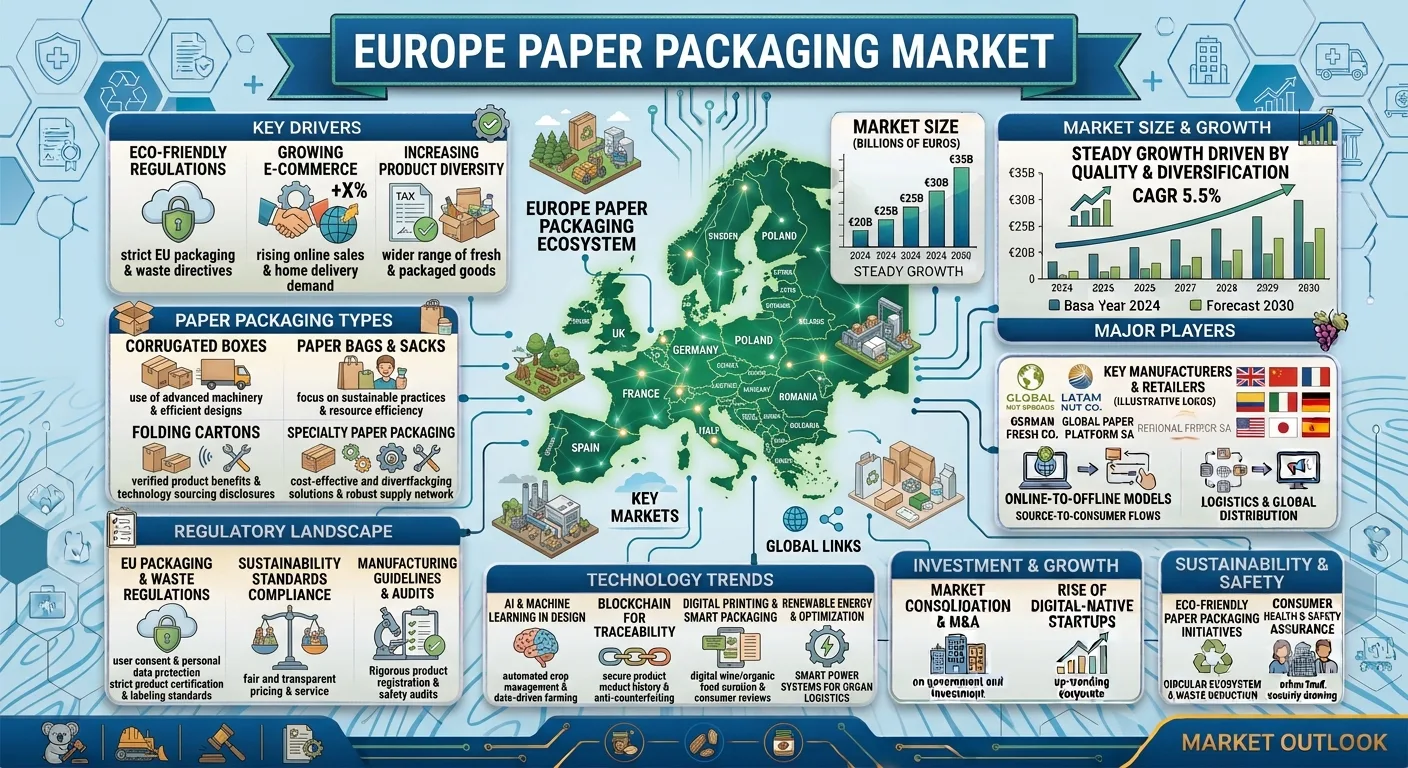
The Europe paper packaging market grew from USD 56.4 Billion in 2025 to USD 58.9 Billion in 2026. Looking forward, IMARC Group expects the market to reach USD 76.8 Billion by 2034, exhibiting a growth rate (CAGR of 3.38%) during 2026-2034. The increasing consumer demand for sustainable packaging, stringent government regulations, advancements in packaging technology, growth in the e-commerce sector, rising environmental awareness, innovation in design and printing, surging demand from the food and beverage industry, and cost-effective alternatives to plastic packaging are some of the key factors contributing to the market expansion.
The Europe paper packaging market encompasses corrugated boxes, folding boxes and cases, liquid paperboard cartons, paper bags and sacks, and other product types across solid bleached, coated recycled, uncoated recycled, and other grades, delivered through primary, secondary, and tertiary packaging levels for food, beverages, personal care and home care, healthcare, and other end-use industries across Germany, France, the United Kingdom, Italy, Spain, and other European markets. The market is strategically important to Europe's circular economy transition, regulatory compliance with EU packaging and waste directives, and the decarbonization of the packaging value chain. The ecosystem is shaped by the progressive substitution of plastic packaging with fibre-based alternatives, tightening regulatory requirements on recyclability and single-use plastics, and expanding e-commerce logistics demand for durable, lightweight packaging.
Europe's paper packaging landscape is being fundamentally reshaped by growing consumer environmental consciousness. Heightened understanding of the environmental impact of plastic waste has brought about a widespread consumer consciousness towards products packaged in an environmentally responsible manner, with paper packaging being biodegradable and recyclable, making it an ideal material for packaging solutions. Younger demographics illustrate this concept most clearly, as they are the most willing of all age brackets to choose brands that use sustainable packaging, prompting key companies to focus on manufacturing innovative paper packaging. Government regulations promoting recyclability are reinforcing this shift, with the European Union's Circular Economy Action Plan focused on more recyclability and less waste over the longer term, alongside the introduction of plastic taxes in Europe that make plastic packaging less attractive economically. Governments are also providing aid in the form of subsidies and grants to businesses that implement sustainable packaging solutions, accelerating the substitution of plastic with paper-based alternatives.
Advancements in packaging technology are playing a crucial role in expanding paper packaging adoption across Europe. Innovations in material science and engineering have significantly enhanced the strength, durability, and versatility of paper packaging, with modern paper-based materials now offering comparable protection to plastic and making them suitable for a broader range of products including food, beverages, and consumer goods. Improved barrier properties, such as resistance to moisture and grease, have expanded the functionality of paper packaging, allowing it to replace plastic in applications that require protection against contamination. These technological developments are particularly important in the food and beverage sector, where packaging must provide safe, hygienic, and contamination-resistant solutions while meeting sustainability objectives.
The competitive landscape features major players including Smurfit Westrock, DS Smith PLC, Mondi Group, Hamburger Containerboard GmbH, Papierfabrik Palm GmbH & Co. KG, Metsa Board Oyj, Progroup AG, Emin Leydier SA, Svenska Cellulosa Aktiebolaget SCA, Stora Enso Oyj, and International Paper Company. Key players are actively focusing on innovation and sustainability, investing heavily in research and development to create advanced paper-based packaging materials with durability, flexibility, and improved barrier properties, while expanding product portfolios to include biodegradable and compostable options. In 2024, Smurfit Kappa announced a EUR 54 million investment to expand its Bag-in-Box plant in Ibi, Spain, aimed at significantly enhancing production capacity and technological capabilities to meet growing demand for sustainable packaging solutions, with new state-of-the-art equipment allowing the plant to increase output of Bag-in-Box products, a key growth area due to sustainable features such as reduced plastic use and extended product shelf life. In 2024, Mondi collaborated with Cemex to introduce water-soluble cement bags to the Balearic Islands, a product that minimizes waste by allowing bags to dissolve in water during cement mixing, aligning with Mondi's strategy to provide fully recyclable or compostable products.
The Europe paper packaging market is poised for sustained expansion, underpinned by regulatory mandates, consumer preference for sustainable materials, technological advancement, and e-commerce growth. With a projected CAGR of 3.38% through 2034, the market presents significant opportunities for providers focusing on fibre-based alternatives to plastic, high-barrier paper solutions for food applications, recycled and recyclable grades, e-commerce packaging formats, and innovation in barrier coatings and compostable materials.
EUROPE PAPER PACKAGING MARKET SUMMARY
The Europe paper packaging market encompasses the design, manufacturing, and supply of fibre-based packaging products—including corrugated boxes, folding cartons, liquid paperboard cartons, and paper bags and sacks—for primary, secondary, and tertiary packaging applications across food, beverage, personal care, healthcare, and other end-use industries in Europe.
The ecosystem spans paper and board producers, packaging converters, corrugated box manufacturers, folding carton specialists, barrier coating technology providers, recycling infrastructure operators, brand owners, retailers, and e-commerce platforms serving customers across the packaged goods and logistics value chain.
By Product Type, the market is segmented into Corrugated Boxes, Folding Boxes and Cases (dominating), Liquid Paperboard Cartons, Paper Bags and Sacks, and Others. By Grade, the market is segmented into Solid Bleached, Coated Recycled, Uncoated Recycled (dominating), and Others. By Packaging Level, the market is segmented into Primary Packaging (dominating), Secondary Packaging, and Tertiary Packaging. By End Use Industry, the market is segmented into Food (dominating), Beverages, Personal Care and Home Care, Healthcare, and Others. By Country, the market serves Germany (dominating), France, United Kingdom, Italy, Spain, and Others.
Key trends shaping the market include increasing consumer preference for sustainable packaging, government regulations promoting recyclability, advancements in packaging technology and barrier properties, growth in flexible paper packaging, custom paper design for brand experience, biodegradable and compostable solutions, and innovation in recycling technologies.
PORTER'S FIVE FORCES ANALYSIS – EUROPE PAPER PACKAGING MARKET
Competitive Rivalry: High. The Europe paper packaging market features intense competition among integrated paper and board producers, packaging converters, and regional specialists. Competition centers on sustainability credentials, recyclability and recycled content, barrier performance, printability, cost efficiency, and supply reliability. The market is moderately consolidated around major integrated players including Smurfit Westrock, DS Smith, Mondi, and Stora Enso, with a long tail of regional converters competing in local and niche segments. Competition is intensifying as brand owners seek packaging partners capable of meeting ambitious recyclability and carbon reduction targets, while the availability of new sustainable packaging materials like bioplastics introduces additional competitive pressure. Business implication: Companies must differentiate through certified recyclability, high recycled content, advanced barrier performance, and integrated design services to defend market positions.
Supplier Power (Pulp and Raw Material Providers): High. Paper packaging producers rely on suppliers of wood pulp, recycled fibre, virgin fibre, and specialty coatings. Raw material costs, particularly wood pulp, represent a significant cost driver, and supply is concentrated among a limited number of integrated forest products companies. Fluctuating pulp prices and competition for recycled fibre from other applications create significant supplier power. The increasing cost of raw materials including wood pulp is a major barrier facing the European market. Business implication: Vertical integration into pulp and fibre supply, investment in recycling infrastructure for recovered fibre, and long-term supply agreements can reduce dependency and mitigate price volatility.
Buyer Power (Brand Owners, Retailers, and E-commerce Platforms): High. Large FMCG brand owners, grocery retailers, and e-commerce platforms exercise substantial purchasing power through high-volume contracts, specification control, and sustainability requirements. Buyers demand recyclable and recycled-content packaging, barrier performance suitable for their products, print quality for brand expression, and competitive pricing. The growth of private label and retailer sustainability commitments further concentrates buyer influence, while brand owners increasingly require packaging partners to demonstrate carbon footprint transparency and compliance with EU regulations. Business implication: Providers must offer certified sustainable packaging, reliable supply, design and innovation support, and competitive pricing to win and retain major accounts.
Threat of Substitutes: Moderate. Paper packaging competes with plastic packaging, bioplastics, glass, metal, and flexible film formats across different applications. While regulatory pressure and consumer preference are driving substitution toward paper, bioplastics offer an alternative sustainable material that creates competition for certain applications. In applications requiring high barrier protection, particularly for perishable foods, plastic and multi-material formats retain performance advantages, though advances in barrier coatings are narrowing this gap. Business implication: Demonstrating performance parity with plastic in barrier, strength, and durability while maintaining sustainability advantages is essential to drive substitution.
Threat of New Entrants: Moderate. Barriers to entry include substantial capital requirements for paper mills and converting equipment, access to fibre supply, regulatory compliance, and established relationships with major brand owners. However, the growth of barrier coating technologies, compostable materials innovation, and e-commerce packaging formats has enabled new entrants focused on niche and specialty applications. Smaller converters can enter regional markets serving local brand owners and food producers. Business implication: Incumbents must leverage scale, fibre access, and integrated design capabilities while monitoring specialty and technology-driven new entrants in barrier and compostable segments.
KEY ASPECTS REQUIRED FOR THE EUROPE PAPER PACKAGING MARKET
Market Performance: USD 56.4 Billion in 2025, growing to USD 58.9 Billion in 2026, and projected to reach USD 76.8 Billion by 2034, driven by sustainability demand, regulatory mandates, technology advancement, and e-commerce growth.
Market Outlook: A 3.38% CAGR through 2034 reflects steady growth led by folding boxes and cases dominance, uncoated recycled grade leadership, primary packaging prevalence, food sector dominance, and Germany's regional leadership.
Growth Drivers: Increasing consumer demand for sustainable packaging; stringent government regulations including the EU Circular Economy Action Plan and plastic taxes; advancements in packaging technology and barrier properties; growth in the e-commerce sector requiring durable, lightweight packaging; rising environmental awareness particularly among younger demographics; innovation in design and printing; surging demand from the food and beverage industry; cost-effective alternatives to plastic packaging; government subsidies and grants for sustainable packaging adoption.
Competitive Landscape: A moderately consolidated market with integrated paper and board producers, packaging converters, and regional specialists. Key players including Smurfit Westrock, DS Smith, Mondi Group, Stora Enso, Metsa Board, and International Paper invest in R&D, barrier technology, recyclable and compostable products, strategic partnerships, and automation.
Value Chain Analysis: From wood pulp and recovered fibre sourcing through paper and board production, converting into cartons, boxes, and bags, barrier coating and printing, distribution to brand owners and retailers, and end-of-life recycling or composting.
Industry Trends: Increasing consumer preference for sustainable packaging; government regulations promoting recyclability; advancements in packaging technology and barrier properties; growth of flexible paper packaging; custom paper design for brand experience; biodegradable and compostable packaging solutions; innovation in recycling technologies; substitution of plastic in food and beverage applications; e-commerce packaging demand.
Strategic Recommendations: Invest in high-barrier paper solutions for food and beverage applications; expand recycled and recyclable product portfolios with certified content; develop compostable and biodegradable options; target e-commerce packaging formats with durable, lightweight designs; pursue government subsidies and grants for sustainable packaging initiatives; invest in recycling technology innovation; expand Bag-in-Box and liquid packaging capabilities; strengthen presence in Germany and other high-growth European markets; pursue strategic partnerships across the supply chain; invest in automation and digital technologies to improve manufacturing efficiency.
Request for Sample Report: https://www.imarcgroup.com/europe-paper-packaging-market/requestsample
MARKET GROWTH DRIVERS
Increasing Consumer Preference for Sustainable Packaging
A growing consumer environmental consciousness is gradually replacing plastic with paper packaging in Europe. The heightened understanding of the environmental impact of plastic waste has brought about a global consumer consciousness towards products packaged in an environmentally responsible manner, which is further fueling the market growth. Paper packaging is biodegradable and recyclable, which makes it an ideal material for packaging solutions. Moreover, younger demographics illustrate this concept more clearly, as they are the most willing of all age brackets to choose brands that use sustainable packaging. As a result, key companies are focusing on manufacturing innovative paper packaging, which is further fueling the market growth. This consumer-driven shift is reinforced by brand owner commitments to sustainability, with major FMCG companies setting ambitious targets for recyclable, reusable, and compostable packaging that accelerate demand for paper-based alternatives across food, beverage, personal care, and household categories.
Government Regulations Promoting Recyclability
The stringent government regulations in Europe are favoring the demand for paper packaging, further boosting the market growth. The European Union's Circular Economy Action Plan is focused on more recyclability and less waste over the longer term, which has further surged the demand for sustainable materials. Moreover, in Europe, plastic taxes are being introduced, which make plastic packaging less attractive economically, further fostering the market growth. Governments are also providing aid in the form of subsidies and grants to businesses that implement sustainable packaging solutions, which is propelling the market growth. These regulatory mechanisms create a structural cost advantage for paper-based packaging relative to plastic alternatives, while also establishing compliance requirements that favour materials with established recycling infrastructure. The combination of extended producer responsibility schemes, recycled content mandates, and single-use plastic restrictions is accelerating the substitution of plastic with fibre-based packaging across multiple end-use sectors.
Advancements in Packaging Technology
Advancements in packaging technology are playing a crucial role in the growing adoption of paper packaging in Europe. Innovations in material science and engineering have significantly enhanced the strength, durability, and versatility of paper packaging. Modern paper-based materials can now offer comparable protection to plastic, making them suitable for a broader range of products, including food, beverages, and consumer goods. Improved barrier properties, such as resistance to moisture and grease, have expanded the functionality of paper packaging, allowing it to replace plastic in applications that require protection against contamination. These technological developments are particularly significant for food and beverage applications where packaging must maintain product safety and shelf life while meeting sustainability objectives. Continued innovation in barrier coatings, moulded fibre, and high-strength board grades is expected to further expand the addressable applications for paper packaging, including areas previously dominated by rigid plastics and multi-material formats.
Growth in the E-commerce Sector
The growth of the e-commerce sector is a significant driver of demand for paper packaging in Europe, particularly corrugated boxes and protective packaging formats. Online retail requires rugged, lightweight packaging that protects goods through multi-stage logistics networks while minimizing shipping costs and material consumption. Corrugated boxes are ideal for shipping goods securely while minimizing waste, and their recyclability aligns with both consumer preferences and retailer sustainability commitments. The rise in e-commerce has led to increased demand for robust and recyclable packaging materials, with retailers and logistics providers seeking packaging that performs reliably through automated sorting and handling systems while supporting circular economy objectives. Right-sized packaging, easy-open and return-ready designs, and packaging optimization to reduce void fill and dimensional weight are emerging as key requirements in the e-commerce channel, driving innovation in corrugated and paper-based protective packaging formats.
EUROPE PAPER PACKAGING MARKET SEGMENTATION
Segmentation analysis provides a detailed view of the Europe paper packaging market by category:
Product Type Insights: The report has provided a detailed breakup and analysis of the market based on product type. This includes corrugated boxes, folding boxes and cases, liquid paperboard cartons, paper bags and sacks, and others. Folding boxes and cases represent the largest segment, driven by growing demand for sustainable and recyclable packaging solutions as consumers and businesses increasingly prioritize environmental responsibility. The segment benefits from advancements in packaging technology enhancing strength and durability for a wide range of products from food to electronics, the rise of e-commerce fueling demand for secure shipping with minimal waste, regulatory pressures to reduce plastic use and promote recyclability, and the versatility of folding boxes in design and printability that allows brands to enhance product appeal and align with eco-friendly consumer preferences. Corrugated boxes represent a significant segment serving shipping, logistics, and e-commerce applications with durable, recyclable formats. Liquid paperboard cartons serve beverage and liquid food applications with aseptic and chilled distribution requirements. Paper bags and sacks serve retail, grocery, and industrial applications, benefiting from plastic bag restrictions across European markets.
Grade Insights: The report has also provided a detailed breakup and analysis of the market based on grade. This includes solid bleached, coated recycled, uncoated recycled, and others. Uncoated recycled accounts for the largest market share, driven by rising demand for environmentally friendly packaging solutions as consumers and businesses become more conscious of their environmental impact. The segment is propelled by stringent government regulations aimed at reducing plastic waste and promoting the use of recycled materials, advancements in recycling technologies that have improved the quality and performance of uncoated recycled paper making it more versatile and suitable for a wider range of applications including food and beverage packaging, and the increasing cost-effectiveness of recycled materials compared to virgin fibers. Solid bleached grades serve premium applications requiring high whiteness and printability, particularly in food service and healthcare. Coated recycled grades offer enhanced printability and barrier performance for branded consumer packaging, while other grades serve specialty and industrial applications.
Packaging Level Insights: The report has also provided a detailed breakup and analysis of the market based on packaging level. This includes primary packaging, secondary packaging, and tertiary packaging. Primary packaging represents the largest segment, driven by increasing consumer demand for sustainable and environmentally friendly packaging solutions as paper packaging is both biodegradable and recyclable, making it an attractive alternative to plastic. The rising popularity of paper packaging in the food and beverage industry fuels growth given its ability to provide safe, hygienic, and contamination-resistant solutions, while technological advancements enhancing strength and durability allow it to be used for a broader range of products. Strict government regulations aimed at reducing plastic waste and promoting recyclable materials are encouraging manufacturers to adopt paper-based packaging. Secondary packaging serves retail-ready and shelf-ready formats supporting brand presentation and logistics efficiency, while tertiary packaging serves transport and bulk distribution requirements.
End Use Industry Insights: The report has also provided a detailed breakup and analysis of the market based on end use industry. This includes food, beverages, personal care and home care, healthcare, and others. Food accounts for the largest market share, driven by escalating demand for eco-friendly and sustainable packaging solutions as increasing consumer awareness about health and environmental issues pushes brands to adopt biodegradable and recyclable materials like paper. Stringent food safety regulations require packaging that protects food from contamination, and advancements in paper packaging technology now offer improved barrier properties making them suitable for perishable items. The rise of convenience foods and ready-to-eat meals, particularly in urban areas, has increased the need for versatile and sustainable packaging options, while the trend toward reducing plastic usage in food packaging aligns with both consumer preferences and regulatory guidelines. Beverages represents a significant segment served by liquid paperboard cartons and secondary packaging. Personal care and home care represents a growing segment driven by brand sustainability commitments and plastic reduction targets. Healthcare represents a specialized segment requiring sterile barrier and compliance with medical packaging standards.
Country Insights: The report has also provided a comprehensive analysis of all the major regional markets, which include Germany, France, United Kingdom, Italy, Spain, and others. Germany represents the largest regional market, driven by increasing consumer demand for eco-friendly packaging solutions as awareness about environmental sustainability grows. Government regulations aimed at reducing plastic waste and encouraging recycling push companies to adopt paper-based packaging, while the strong presence of the food and beverage industry requires safe and sustainable packaging. Advancements in packaging technology have enabled German manufacturers to offer high-quality, durable paper packaging meeting both consumer and industrial needs. Germany's thriving e-commerce sector has led to a rise in demand for robust and recyclable packaging materials, while the country's commitment to recycling and decreasing plastic waste has been increasing demand for paper packaging across several sectors. Germany is also a hub of several big packaging companies and a well-developed supply chain infrastructure, with technology and innovation capabilities allowing for manufacturing of superior paper packaging solutions. France, the United Kingdom, Italy, and Spain represent significant markets with distinct regulatory environments, retail structures, and packaging preferences, while other European markets contribute additional volume through expanding recycling infrastructure and sustainability mandates.
COMPETITIVE LANDSCAPE
The market research report has also provided a comprehensive analysis of the competitive landscape. Competitive analysis such as market structure, key player positioning, top winning strategies, competitive dashboard, and company evaluation quadrant has been covered in the report. Also, detailed profiles of all major companies have been provided.
Key players in the Europe paper packaging market are actively focusing on innovation and sustainability to meet the growing demand for eco-friendly solutions. They are investing heavily in research and development to create advanced paper-based packaging materials that offer durability, flexibility, and improved barrier properties, making them suitable for a wide range of products including food, beverages, and consumer goods. Many companies are also expanding their product portfolios to include biodegradable and compostable options, aligning with increasing regulatory pressures and consumer preferences for sustainable packaging. To further strengthen market position, these players are forming strategic partnerships and collaborations to enhance supply chain capabilities and ensure a steady supply of raw materials. Additionally, they are adopting digital technologies and automation to improve manufacturing efficiency and reduce costs, enabling them to offer competitive pricing. Major companies include Smurfit Westrock, DS Smith PLC, Mondi Group, Hamburger Containerboard GmbH, Papierfabrik Palm GmbH & Co. KG, Metsa Board Oyj, Progroup AG, Emin Leydier SA, Svenska Cellulosa Aktiebolaget SCA, Stora Enso Oyj, and International Paper Company.
Recent Developments:
In 2024, Smurfit Kappa announced a EUR 54 million investment to expand its Bag-in-Box plant in Ibi, Spain. This investment is aimed at significantly enhancing the facility's production capacity and technological capabilities to meet the growing demand for sustainable packaging solutions. The expansion will include the installation of new state-of-the-art equipment, which will allow the plant to increase its output of Bag-in-Box products, a key area of growth due to its sustainable features, such as reduced plastic use and extended product shelf life. In 2024, Mondi collaborated with Cemex to introduce water-soluble cement bags to the Balearic Islands. This product aims to minimize waste by allowing the bags to dissolve in water during cement mixing, thus eliminating packaging waste. The initiative aligns with Mondi's strategy to provide fully recyclable or compostable products and supports its commitment to sustainability by reducing the carbon footprint associated with packaging materials.
Investment opportunities exist in high-barrier paper solutions for food applications, recycled and recyclable grades, compostable and biodegradable packaging, e-commerce packaging formats, barrier coating technology innovation, and Bag-in-Box and liquid packaging expansion.
REGIONAL ANALYSIS
Germany leads the Europe paper packaging market, driven by increasing consumer demand for eco-friendly packaging solutions as awareness about environmental sustainability grows. Government regulations aimed at reducing plastic waste and encouraging recycling play a significant role in pushing companies to adopt paper-based packaging, while the strong presence of the food and beverage industry requires safe and sustainable packaging, further boosting demand. Advancements in packaging technology have enabled German manufacturers to offer high-quality, durable paper packaging that meets both consumer and industrial needs. Germany's thriving e-commerce sector has led to a rise in demand for robust and recyclable packaging materials, while the country's commitment to recycling and decreasing plastic waste has been increasing demand for paper packaging across several sectors. Germany is also a hub of several big packaging companies and a well-developed supply chain infrastructure, with technology and innovation capabilities allowing for manufacturing of superior paper packaging solutions, positioning the country as the region's dominant market.
France represents a significant market, driven by progressive circular economy legislation, including extended producer responsibility schemes and recycled content mandates that favour fibre-based packaging. France's strong food and beverage industry, agricultural sector, and retail structure support demand for corrugated, folding carton, and liquid paperboard packaging formats. French brand owners demonstrate strong sustainability commitments, driving demand for certified recyclable and compostable packaging solutions, while the country's e-commerce growth supports demand for shipping and protective packaging formats.
United Kingdom represents a significant market, driven by plastic packaging tax measures and extended producer responsibility reforms that create economic incentives for paper-based packaging substitution. The UK's advanced retail sector, grocery multiples, and e-commerce penetration support demand for corrugated and folding carton formats, while the country's food and beverage manufacturing base drives liquid paperboard and primary packaging demand. UK brand owners and retailers are investing in recyclable packaging formats and closed-loop systems, supporting demand for recycled grades and innovation in barrier technologies.
Italy represents a significant market, driven by a strong food and beverage manufacturing base including wine, pasta, and processed foods, along with a packaging machinery industry that supports innovation in paper-based formats. Italy's retail structure, including independent grocers and specialist food retailers, supports demand for paper bags, folding cartons, and secondary packaging. Italian converters demonstrate strength in design and printability, supporting premium branded packaging applications across food and personal care segments.
Spain represents a significant market, driven by a strong agricultural and food processing base including fresh produce, olive oil, and processed foods, along with a growing retail sector and tourism-driven demand for packaged goods. Spain's corrugated and folding carton converters serve domestic food and beverage manufacturers as well as export-oriented producers, while growing e-commerce penetration supports demand for shipping and protective packaging formats. Spanish producers are investing in recycled grades and barrier technologies to meet regulatory and brand owner sustainability requirements.
Others represent additional European markets including the Netherlands, Belgium, Poland, Scandinavia, and other countries, each contributing through their respective food and beverage industries, retail structures, and packaging regulatory environments. The Netherlands and Belgium serve as major logistics and distribution hubs supporting packaging demand, while Scandinavian markets demonstrate strong environmental consciousness and recycling infrastructure, and Eastern European markets offer growth potential through expanding retail and e-commerce penetration.
RECENT INDUSTRY DEVELOPMENTS
2026 Activity: The Europe paper packaging market continued its growth trajectory from USD 56.4 Billion in 2025 to USD 58.9 Billion in 2026, on track toward USD 76.8 Billion by 2034 at a CAGR of 3.38%.
2024: Smurfit Kappa announced a EUR 54 million investment to expand its Bag-in-Box plant in Ibi, Spain, aimed at significantly enhancing production capacity and technological capabilities to meet growing demand for sustainable packaging solutions, with new state-of-the-art equipment allowing the plant to increase output of Bag-in-Box products, a key area of growth due to sustainable features such as reduced plastic use and extended product shelf life.
2024: Mondi collaborated with Cemex to introduce water-soluble cement bags to the Balearic Islands, minimizing waste by allowing bags to dissolve in water during cement mixing and eliminating packaging waste. The initiative aligns with Mondi's strategy to provide fully recyclable or compostable products and supports its commitment to sustainability by reducing the carbon footprint associated with packaging materials.
2025-2026: Continued industry investment in research and development to create advanced paper-based packaging materials with improved barrier properties, along with expansion of product portfolios to include biodegradable and compostable options aligning with regulatory pressures and consumer preferences.
2025-2026: Growing adoption of digital technologies and automation to improve manufacturing efficiency and reduce costs, alongside strategic partnerships and collaborations to enhance supply chain capabilities and ensure steady raw material supply.
FREQUENTLY ASKED QUESTIONS
Q1: What is the current size of the Europe paper packaging market?
A: The Europe paper packaging market grew from USD 56.4 Billion in 2025 to USD 58.9 Billion in 2026 and is projected to reach USD 76.8 Billion by 2034, exhibiting a CAGR of 3.38% from 2026-2034.
Q2: What are the key drivers of the Europe paper packaging market?
A: The market is driven by: (i) increasing consumer demand for sustainable packaging; (ii) stringent government regulations including the EU Circular Economy Action Plan and plastic taxes; (iii) advancements in packaging technology and barrier properties; (iv) growth in the e-commerce sector requiring durable, lightweight packaging; (v) rising environmental awareness particularly among younger demographics; (vi) innovation in design and printing; (vii) surging demand from the food and beverage industry; (viii) cost-effective alternatives to plastic packaging; and (ix) government subsidies and grants for sustainable packaging adoption.
Q3: What are the major segments in the Europe paper packaging market?
A: Major segments include Product Type (Folding Boxes and Cases dominating, Corrugated Boxes, Liquid Paperboard Cartons, Paper Bags and Sacks, Others), Grade (Uncoated Recycled dominating, Solid Bleached, Coated Recycled, Others), Packaging Level (Primary Packaging dominating, Secondary Packaging, Tertiary Packaging), End Use Industry (Food dominating, Beverages, Personal Care and Home Care, Healthcare, Others), and Country (Germany dominating, France, United Kingdom, Italy, Spain, Others).
Q4: Which country leads the Europe paper packaging market?
A: Germany leads the market, driven by increasing consumer demand for eco-friendly packaging solutions, government regulations aimed at reducing plastic waste and encouraging recycling, the strong presence of the food and beverage industry, advancements in packaging technology enabling high-quality durable paper packaging, a thriving e-commerce sector driving demand for robust recyclable materials, and a hub of several big packaging companies with a well-developed supply chain infrastructure and technology and innovation capabilities. France, the United Kingdom, Italy, and Spain represent significant markets with distinct regulatory environments and packaging preferences.
Q5: What are the challenges facing the Europe paper packaging market?
A: Key challenges include the expensive cost of raw materials, particularly wood pulp, which represents a significant cost driver for producers; the availability of new sustainable packaging materials like bioplastics, which creates additional competition for certain applications; performance limitations in barrier protection for some food and perishable applications where plastic retains advantages; and the capital intensity of recycling infrastructure and converting equipment. Fluctuating fibre prices and competition for recovered fibre from other applications further pressure margins.
Q6: What is the outlook for the Europe paper packaging market?
A: The market is projected to grow at a 3.38% CAGR through 2034, with growth driven by regulatory mandates, consumer preference for sustainable materials, technological advancement, and e-commerce growth. The gradual movement toward flexible paper packaging across Europe, custom paper design for brand experience, increasing environmental consciousness, and growing use of biodegradable and compostable packaging solutions are expected to shape the market's evolution. Innovation in recycling technologies to manufacture new and improved paper packaging solutions, along with continued advances in barrier properties expanding paper's addressable applications, will support long-term growth. The progressive substitution of plastic with fibre-based alternatives, driven by EU Circular Economy Action Plan requirements and plastic tax mechanisms, provides a structural growth tailwind through the forecast period.
Q7: Who are the key players in the Europe paper packaging market?
A: Key players include Smurfit Westrock, DS Smith PLC, Mondi Group, Hamburger Containerboard GmbH, Papierfabrik Palm GmbH & Co. KG, Metsa Board Oyj, Progroup AG, Emin Leydier SA, Svenska Cellulosa Aktiebolaget SCA, Stora Enso Oyj, and International Paper Company. Recent developments include Smurfit Kappa's EUR 54 million investment to expand its Bag-in-Box plant in Ibi, Spain, and Mondi's collaboration with Cemex to introduce water-soluble cement bags to the Balearic Islands.
Note: If you need any specific information that is not covered currently within the scope of the report, we will provide the same as a part of customization.
Report Format, Delivery, and Customization Details
Report Format Mode: PPT, PDF, and Excel
Report Delivery Mode: Online Delivery, Physical Delivery
Report Delivery Time: Report Delivered Over Email within 24 to 48 hours. If requested by the client, a physical copy will be delivered within three to ten days.
Report Confirmation Mode: Yes via Email
Report Customization Mode: Yes via Email / Call
Report Table of Content: Yes
Report List of Figures: Yes
Report Methodology Mode: Yes
Request For Sample Report: Ye