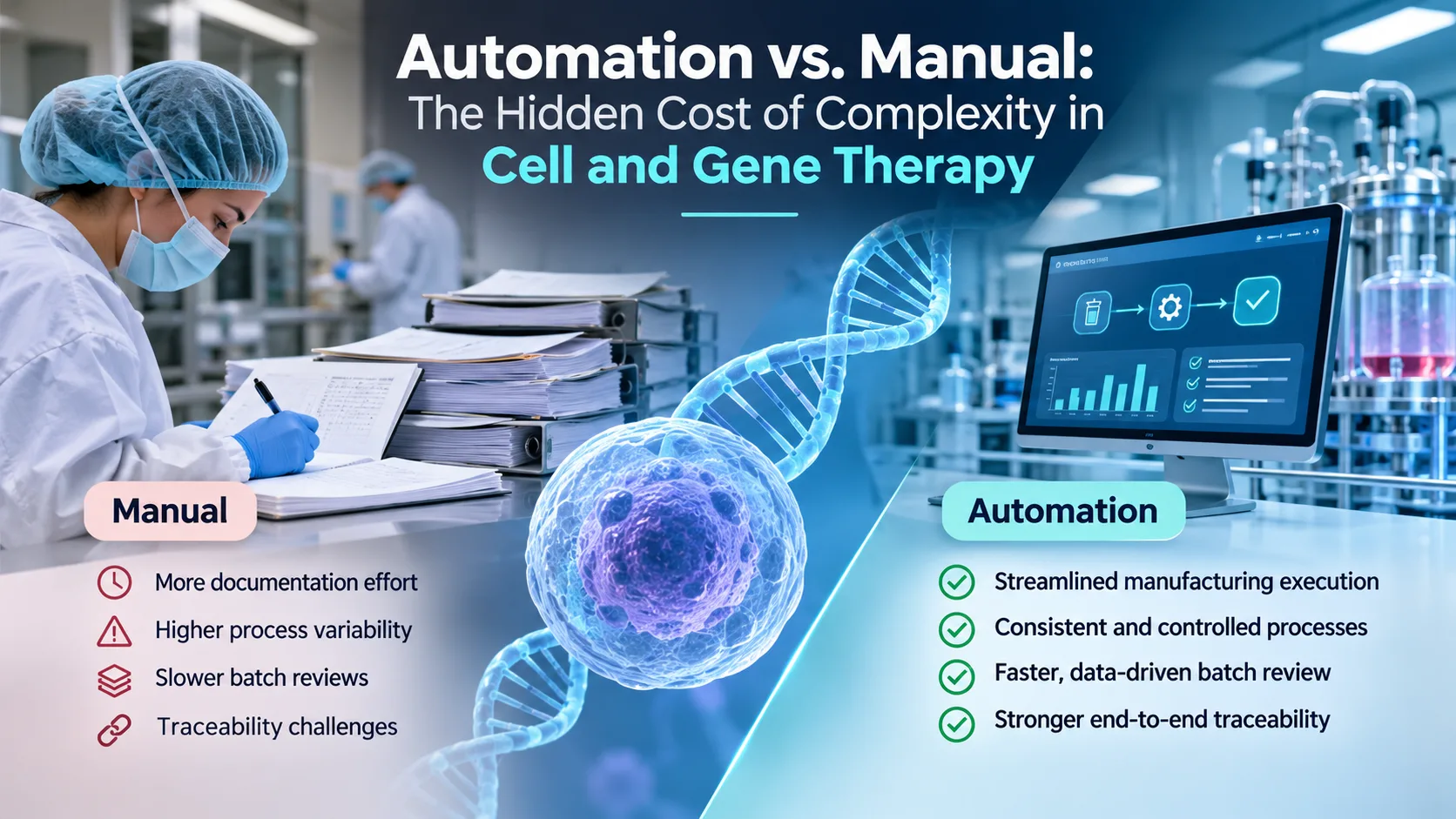
Why manufacturing complexity, fragmented records, and manual workflows are becoming critical challenges for cell and gene therapy developers.
Cell and gene therapies (CGTs) are changing how serious diseases are treated. But manufacturing these therapies brings challenges that are very different from conventional pharmaceutical production.
Many cell therapies involve living material, complex processing steps, strict handling requirements, and limited manufacturing windows. Autologous therapies add another layer of complexity because each batch is manufactured for an individual patient.
As CGT developers move from clinical production toward commercialization, managing these processes consistently becomes increasingly important.
The question is where automation can reduce operational complexity without compromising the flexibility these therapies require.
The Hidden Costs of Manual Manufacturing
A peer-reviewed study on automation in cell and gene therapy manufacturing identifies labor-intensive operations, process variability, contamination risks, and manufacturing costs as important challenges.
These risks extend beyond physical manufacturing activities.
Production records, laboratory results, equipment information, material tracking, and quality documentation may be maintained in separate systems or spreadsheets.
This creates several operational challenges:
- Documentation effort: Operators and reviewers spend additional time recording, checking, and reconciling information.
- Process variability: Manual interventions and differences in execution can introduce inconsistencies.
- Batch review delays: Quality teams must gather information from multiple sources before completing reviews.
- Traceability risks: Patient-specific therapies require reliable chain-of-identity and chain-of-custody controls throughout the treatment journey.
For autologous therapies, a batch failure can have consequences beyond material loss. It may also affect treatment scheduling for the individual patient.
Where Automation Makes a Difference
Automation in CGT manufacturing operates at different levels.
Closed and automated processing equipment can reduce operator interventions during cell isolation, expansion, and other manufacturing steps.
Digital manufacturing systems address a different part of the process: controlling instructions, capturing execution data, maintaining laboratory records, and supporting quality decisions.
Electronic batch records, for example, allow manufacturing activities to be documented as they occur. Configured workflows can guide operators through approved instructions, check required entries, and make exceptions visible for review.
Laboratory Information Management Systems (LIMS) can support sample tracking, testing workflows, instrument integration, and laboratory data traceability.
Electronic Quality Management Systems (eQMS) support the investigation of deviations, corrective and preventive actions (CAPA), change control, and controlled documentation.
These systems can reduce repetitive administrative work while improving access to the evidence needed for quality decisions.
Digital Solutions Supporting Cell and Gene Therapy Manufacturing
Several technology providers address different aspects of CGT manufacturing and quality operations.
Caliber Technologies offers digital solutions for laboratory, manufacturing, and quality workflows.
CaliberBRM supports electronic batch records, configurable manufacturing workflows, traceability, and review by exception.
CaliberLIMS supports sample management, laboratory testing, instrument integration, and controlled QC records.
epiq QMS connects quality management, document control, and training workflows.
These capabilities address activities relevant to regulated CGT operations, although their suitability for a specific therapy, manufacturing process, or patient-identity workflow must be evaluated.
MasterControl provides manufacturing and quality software for CGT companies, including electronic batch records, manufacturing execution, document management, and CAPA workflows.
Körber Werum PAS-X MES offers CGT-focused manufacturing execution capabilities, including operator guidance, electronic batch recording, barcode scanning, and review by exception.
Cytiva Chronicle supports the digital integration of cell therapy manufacturing equipment, process information, and batch documentation.
TrakCel OCELLOS focuses on cellular orchestration, connecting patient scheduling, manufacturing activities, logistics, and chain-of-identity and chain-of-custody information.
These solutions address different operational requirements. Manufacturing execution, laboratory data management, quality management, equipment automation, and patient orchestration are related but distinct capabilities.
What Should CGT Manufacturers Prioritize?
The FDA's May 2026 guidance on CMC flexibilities for cellular and gene therapy products describes a flexible, science- and risk-based approach within applicable regulatory requirements.
Technology selection should follow the same practical thinking.
Manufacturers need to understand which activities introduce the greatest risk or operational burden.
That may include manual data transcription, complex manufacturing instructions, delayed batch reviews, disconnected laboratory systems, or inadequate visibility into patient-specific material movements.
Before selecting software, organizations should evaluate integration capabilities, data integrity controls, electronic records, validation requirements, and the ability to accommodate process changes.
Automating an inefficient workflow without addressing its underlying complexity may simply transfer that complexity into a new system.
Building More Reliable CGT Manufacturing Operations
As cell and gene therapies progress toward broader commercial use, manufacturers must support increasing production demands while maintaining product quality and patient traceability.
Automation can contribute through more consistent execution, reliable documentation, connected data, and efficient quality reviews.
Platforms from Caliber, MasterControl, Körber, Cytiva, and TrakCel demonstrate the different ways technology can support these requirements.
The greatest value comes from applying automation where it improves process control, reduces avoidable work, and helps manufacturing and quality teams make well-supported decisions.