
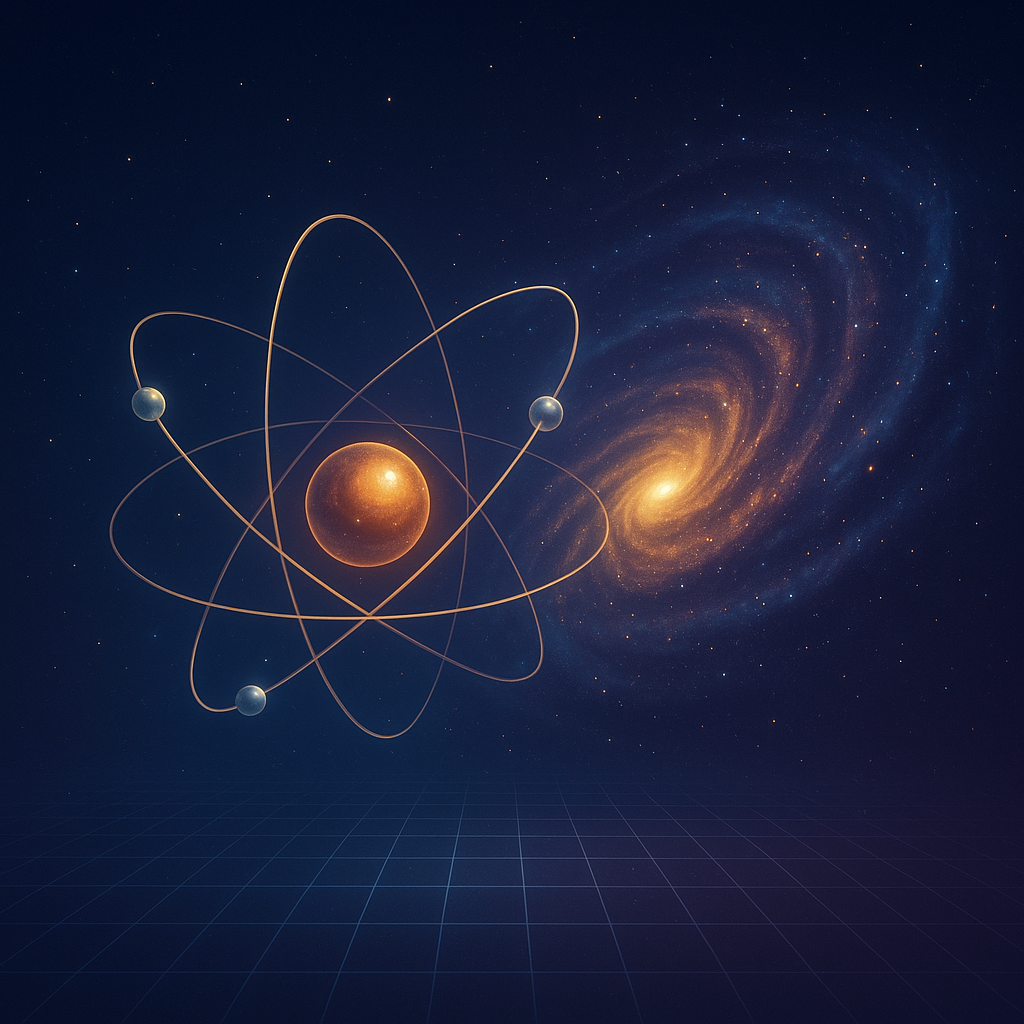
The Invisible Threads: Physics' Role in Shaping Reality
Imagine standing on the edge of a vast canyon, witnessing the interplay of light and shadow, feeling the pull of gravity beneath your feet, and sensing the astonishing complexity behind every atom that makes up the landscape before you. Physics, the fundamental science of nature’s laws, is the invisible thread weaving together the fabric of this experience. It governs everything from the tiniest particles to the grandest galaxies, underlying all phenomena we observe.
In 2026, physics remains the cornerstone of technological innovation and scientific understanding, yet it continues to challenge our grasp of reality. One striking fact is that despite centuries of advancements, physicists still grapple with unified theories that can reconcile quantum mechanics with general relativity—a quest that has driven the field since Einstein’s era.
“Physics is not merely about equations and experiments; it is the art of questioning how the universe constructs itself.” — Dr. Helen Mira, Theoretical Physicist
This quest has inspired breakthroughs that ripple across disciplines, impacting everything from computing and energy to cosmology and materials science. The current landscape of physics is a blend of classical foundations and revolutionary ideas that redefine what we understand about matter, energy, space, and time.
To appreciate the magnitude of physics’ influence today, it helps to trace the journey that brought us here, analyze the latest developments, and explore the horizon that beckons the next generation of discovery.
Tracing the Path: How Physics Evolved to Its Present State
The history of physics is a story of human curiosity pushing against the boundaries of the unknown. Beginning with the classical mechanics of Newton in the 17th century, physics explained motion, forces, and gravity in ways that transformed science and technology. Newton’s laws provided predictive power over planetary motion and laid the groundwork for the Industrial Revolution.
However, by the late 19th century, cracks appeared in classical physics. Phenomena such as blackbody radiation and the photoelectric effect defied explanation. The early 20th century ushered in the quantum revolution, initiated by Max Planck and expanded by Einstein, Bohr, and Schrödinger, revealing the probabilistic and discrete nature of energy and matter.
Alongside quantum mechanics, Einstein’s theory of general relativity revolutionized our understanding of gravity not as a force but as the curvature of spacetime. These two pillars—quantum mechanics and relativity—became the twin engines of modern physics, yet they remain fundamentally incompatible in their current formulations.
Post-World War II, physics diversified into particle physics, condensed matter physics, astrophysics, and cosmology. The discovery of the Higgs boson at CERN in 2012 confirmed the Standard Model’s mechanism for particle mass, but mysteries like dark matter and dark energy persist.
Today, physics stands at a crossroads. The search for a unified theory, such as string theory or loop quantum gravity, continues while experimental physics pushes the limits of precision and scale.
Decoding Complexity: The Core Pillars of Physics Today
Physics in 2026 is dominated by several core domains, each with its own challenges and breakthroughs.
- Quantum Mechanics and Quantum Information: Quantum computing has matured, with companies like IBM and Google achieving stable, scalable qubit systems. Quantum entanglement and error correction continue to improve, paving the way for quantum supremacy in practical applications.
- Particle Physics: The Large Hadron Collider's upgrades have enabled unprecedented collision energies, allowing physicists to probe beyond the Standard Model. Efforts to detect supersymmetric particles or dark matter candidates have intensified.
- Cosmology and Astrophysics: New telescopes and space missions provide detailed maps of cosmic microwave background radiation and galaxy distributions, deepening understanding of dark energy and the universe’s accelerated expansion.
- Condensed Matter Physics: Research into novel materials, including topological insulators and room-temperature superconductors, is revolutionizing electronics and energy transport.
- Gravitational Physics: Following the first detection of gravitational waves in 2015, observatories like LIGO and Virgo have cataloged dozens of events, offering insights into black holes and neutron stars.
These areas rely heavily on interdisciplinary collaboration, combining particle accelerators, quantum labs, space observatories, and sophisticated computational models.
“The beauty of physics lies in its universality and its capacity to unify disparate phenomena under common principles.” — Prof. Luis Moreno, Astrophysicist
Physics Milestones in 2026: Recent Breakthroughs and Innovations
The year 2026 has witnessed notable advancements that underscore physics’ dynamic nature.
- Quantum Networks Expansion: The global quantum internet infrastructure has expanded substantially, connecting new quantum nodes across continents. China’s Quantum Experiments at Space Scale (QUESS) satellite network has inspired similar projects worldwide.
- Discovery of Exotic Particles: CERN's latest run detected signals consistent with tetraquark states, offering clues about strong force interactions beyond traditional quark models.
- Dark Energy Probes: The European Space Agency’s Euclid mission has provided refined measurements of dark energy’s equation of state, challenging existing cosmological models.
- Room-Temperature Superconductivity: Scientists at the National Institute for Materials Science announced a stable material exhibiting superconductivity at ambient conditions, promising transformative applications in energy and transportation.
- AI Integration in Physics Research: Artificial intelligence and machine learning algorithms have accelerated data analysis and simulation, revealing patterns in particle collisions and cosmic phenomena previously obscured.
These developments are propelling physics into practical realms with potential economic and societal impacts while also deepening foundational knowledge.
For a broader understanding of recent advances, readers can explore Quantum Horizons and Cosmic Mysteries: Physics Breakthroughs Shaping 2026 and 2026 Update: Physics at the Frontier of Discovery.
Voices from the Field: Perspectives of Leading Physicists and Industry Impact
The physics community in 2026 is vibrant, with experts emphasizing the synergy between theory, experiment, and technology. Dr. Anaya Kaur, a quantum physicist at MIT, notes that “the fusion of quantum algorithms with experimental platforms is the key to unlocking computational problems that classical computers cannot solve.”
Meanwhile, in particle physics, Dr. Marco Leto from CERN highlights the importance of international cooperation: “Our discoveries rely on global collaboration, massive data sharing, and cross-disciplinary expertise.”
Industry sectors are increasingly investing in physics-based technologies. Quantum computing startups have attracted billions of dollars, aiming to revolutionize pharmaceuticals, finance, and cryptography. Material science breakthroughs have spurred advancements in sustainable energy, particularly through novel superconductors and photovoltaic materials.
Physics also influences education and policy. Governments worldwide prioritize funding for fundamental research to maintain competitive edges in innovation and defense. Physics-inspired approaches to climate modeling and renewable energy technologies are now central to addressing global challenges.
“Physics is the intellectual engine driving the technologies that shape our future economies and societies.” — Dr. Anaya Kaur, Quantum Physicist
Looking Ahead: Emerging Themes and Challenges in Physics
As physics progresses, several themes demand attention:
- Unification of Forces: The challenge remains to reconcile quantum mechanics with gravity, potentially through theories like quantum gravity or string theory.
- Dark Sector Exploration: Understanding dark matter and dark energy continues to be a top priority, with new detectors and space missions planned for the late 2020s.
- Quantum Technology Commercialization: Transitioning quantum devices from labs to widespread use requires overcoming scaling and error correction hurdles.
- Ethical and Societal Implications: As physics-enabled technologies grow, ethical frameworks around AI, surveillance, and energy use must evolve.
- Interdisciplinary Integration: Physics increasingly intersects with biology, chemistry, and computer science, opening novel research frontiers.
Physicists and policymakers alike must balance curiosity-driven research with pragmatic applications. The potential for breakthroughs is immense, but so are the complexities.
For those interested in the foundational principles and emergent frontiers, Unraveling Reality: A Complete Guide to the Foundations and Frontiers of Physics offers a comprehensive resource.
In conclusion, physics in 2026 is a dynamic tapestry of discovery, innovation, and inquiry. It continues to shape our understanding of the universe and the technologies that define modern life, promising profound insights and practical benefits in the years ahead.