
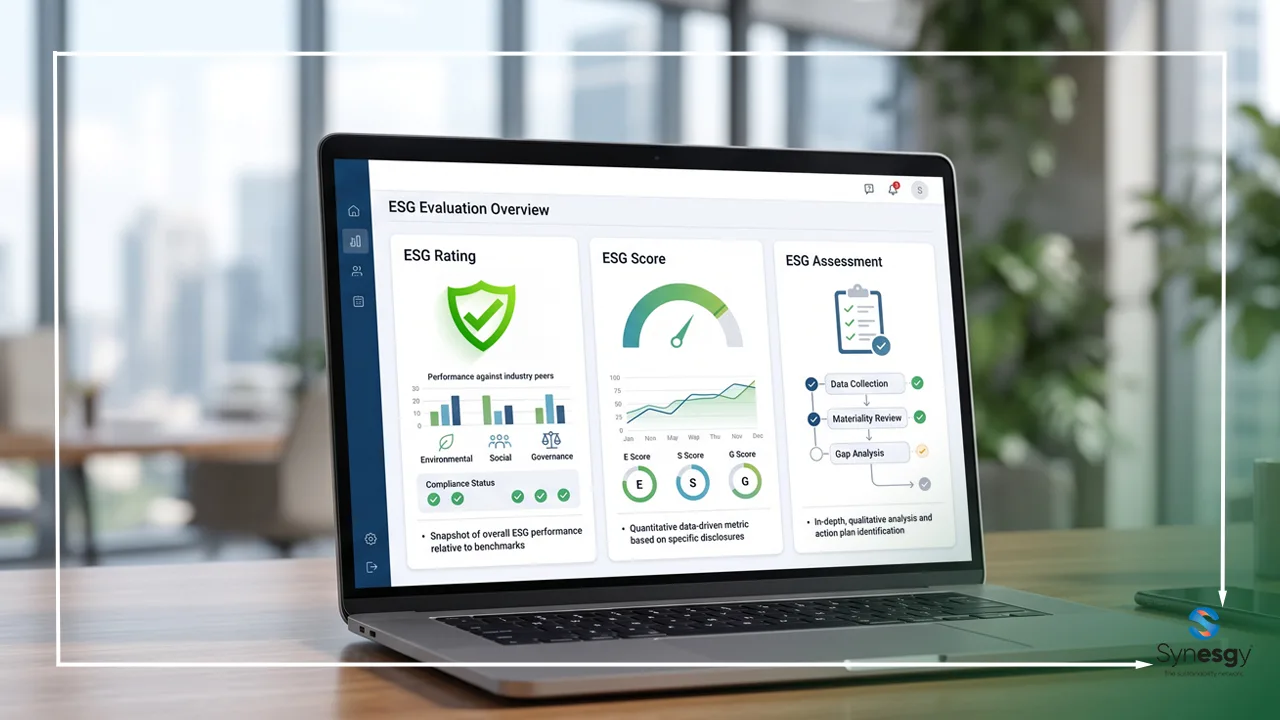
As environmental, social, and governance expectations continue to influence business decisions, companies are under growing pressure to understand, measure, and communicate their ESG performance. Investors, customers, lenders, regulators, and procurement teams increasingly want to know whether a company is managing sustainability risks responsibly. However, many businesses still use terms such as ESG rating, ESG score, and ESG assessment interchangeably.
Although these concepts are closely related, they do not mean the same thing. Each one plays a different role in evaluating ESG performance. Understanding the difference helps companies choose the right tools, prepare better disclosures, improve internal practices, and communicate their sustainability position more clearly.
What Is an ESG Assessment?
An ESG assessment is the process of evaluating a company’s performance across environmental, social, and governance areas. It is usually the starting point for understanding where a business stands in relation to sustainability practices, risk exposure, compliance expectations, and stakeholder requirements.
An ESG assessment reviews a wide range of factors. Environmental areas may include energy use, carbon emissions, waste management, water consumption, resource efficiency, and climate-related policies. Social areas may cover employee welfare, health and safety, diversity, human rights, training, customer responsibility, and community impact. Governance areas may include business ethics, anti-corruption policies, board structure, data protection, compliance systems, and risk management practices.
Unlike a simple number or label, an ESG assessment is more detailed and diagnostic. It helps companies identify gaps, strengths, risks, and improvement opportunities. For example, a company may discover that it has strong health and safety practices but weak emissions tracking. Another company may have good governance policies but limited supplier ESG visibility.
The main purpose of an ESG assessment is to create a clear picture of current ESG performance. It helps businesses understand what needs to be improved before they pursue formal ratings, certifications, customer ESG audits, or sustainability reporting.
What Is an ESG Score?
An ESG score is a numerical or structured value that represents a company’s ESG performance based on specific assessment criteria. It is usually generated after an ESG assessment has been completed. The score converts ESG data into a measurable format so companies and stakeholders can compare performance more easily.
For example, an ESG platform may assign a score out of 100, or use graded levels such as low, medium, or high ESG performance. The scoring model may consider environmental policies, social practices, governance controls, documentation, risk exposure, and evidence submitted by the company.
The value of an ESG score is that it simplifies complex ESG information. Instead of reviewing dozens of individual data points, stakeholders can use the score as a quick indicator of how well a company is performing. Procurement teams may use ESG scores to compare suppliers. Investors may use them to screen companies. Management teams may use them to monitor improvement over time.
However, an ESG score should not be viewed in isolation. A number alone does not explain why a company performed well or poorly. Two companies may receive similar ESG scores but have very different strengths and weaknesses. This is why the score is most useful when supported by a detailed assessment report and improvement recommendations.
What Is an ESG Rating?
An ESG rating is a broader evaluation that categorises a company’s ESG performance, risk level, or sustainability maturity. Ratings are often used by external stakeholders to understand how a company compares against peers, industry standards, or risk benchmarks.
While an ESG score is often numerical, an ESG rating may appear as a letter grade, category, ranking, or risk classification. For example, a company may be rated as strong, moderate, or weak in ESG performance. In some systems, ratings may use letter grades such as A, B, or C. In others, they may classify the company based on ESG risk exposure or sustainability readiness.
ESG ratings are commonly used in investment decisions, supplier evaluations, lender assessments, and corporate reputation management. They help external stakeholders quickly understand whether a business is managing ESG risks effectively.
The key point is that an ESG rating is usually more interpretive than an ESG score. It does not just show a number. It gives meaning to performance by placing the company into a category. This makes ratings useful for benchmarking, stakeholder communication, and business credibility.
Key Differences Between ESG Assessment, ESG Score, and ESG Rating
The simplest way to understand the difference is to view them as three connected stages.
An ESG assessment is the evaluation process. It collects and reviews ESG information. It identifies gaps, risks, evidence, and improvement areas.
An ESG score is the measurable result. It converts assessment findings into a numerical or structured performance value.
An ESG rating is the interpreted classification. It places the company’s ESG performance into a category that stakeholders can understand and compare.
For example, a manufacturing company may complete an ESG assessment that reviews its energy use, employee safety practices, supplier policies, and governance systems. Based on this data, it may receive an ESG score of 72 out of 100. That score may then translate into a rating such as “good,” “medium risk,” or “B grade,” depending on the methodology used.
Each element has a different purpose. The assessment helps the company understand what is happening internally. The score helps measure performance. The rating helps communicate that performance externally.
Why Businesses Should Not Rely Only on Ratings or Scores
Many companies focus only on getting a better ESG score or rating. While this is important, it should not be the only objective. A score or rating is only meaningful if it reflects real ESG performance and reliable data.
If a business does not have proper internal processes, documentation, or evidence, its ESG score may not improve sustainably. Similarly, if the company treats ESG as a one-time exercise, it may struggle when customers, regulators, or investors request updated information.
The stronger approach is to use ESG assessment as a continuous improvement tool. Companies should review their ESG practices regularly, update policies, track performance indicators, and close gaps over time. This makes the score and rating more credible.
For suppliers and SMEs, this is especially important. Many large companies now expect their suppliers to provide ESG information as part of procurement and supply chain risk management. A strong ESG assessment process can help suppliers prepare for customer questionnaires, improve transparency, and demonstrate responsible business practices.
How ESG Assessment Platforms Help
Digital ESG assessment platforms make the process more structured and efficient. They help companies collect ESG data, answer standardised questionnaires, submit supporting evidence, generate scores, and receive improvement guidance.
Instead of managing ESG information manually through spreadsheets and scattered documents, companies can use an ESG assessment platform to centralise their sustainability data. This improves visibility and makes it easier to track progress over time.
For businesses in the UAE and other markets where ESG expectations are increasing, platforms can support reporting readiness, supplier evaluation, sustainability certification, and stakeholder communication. They also help companies move from awareness to action by showing which areas need improvement.
Conclusion
ESG rating, ESG score, and ESG assessment are connected, but they serve different purposes. An ESG assessment is a detailed evaluation process. An ESG score is the measurable output of that process. An ESG rating is the broader classification that helps stakeholders understand performance.
For businesses, the most important step is not simply to chase a higher rating. It is to build a reliable ESG assessment process that identifies real gaps, improves data quality, and supports long-term sustainability performance. When companies understand the difference between assessment, score, and rating, they can make better decisions, communicate with greater confidence, and strengthen their position in a market where ESG performance is becoming a core business requirement.