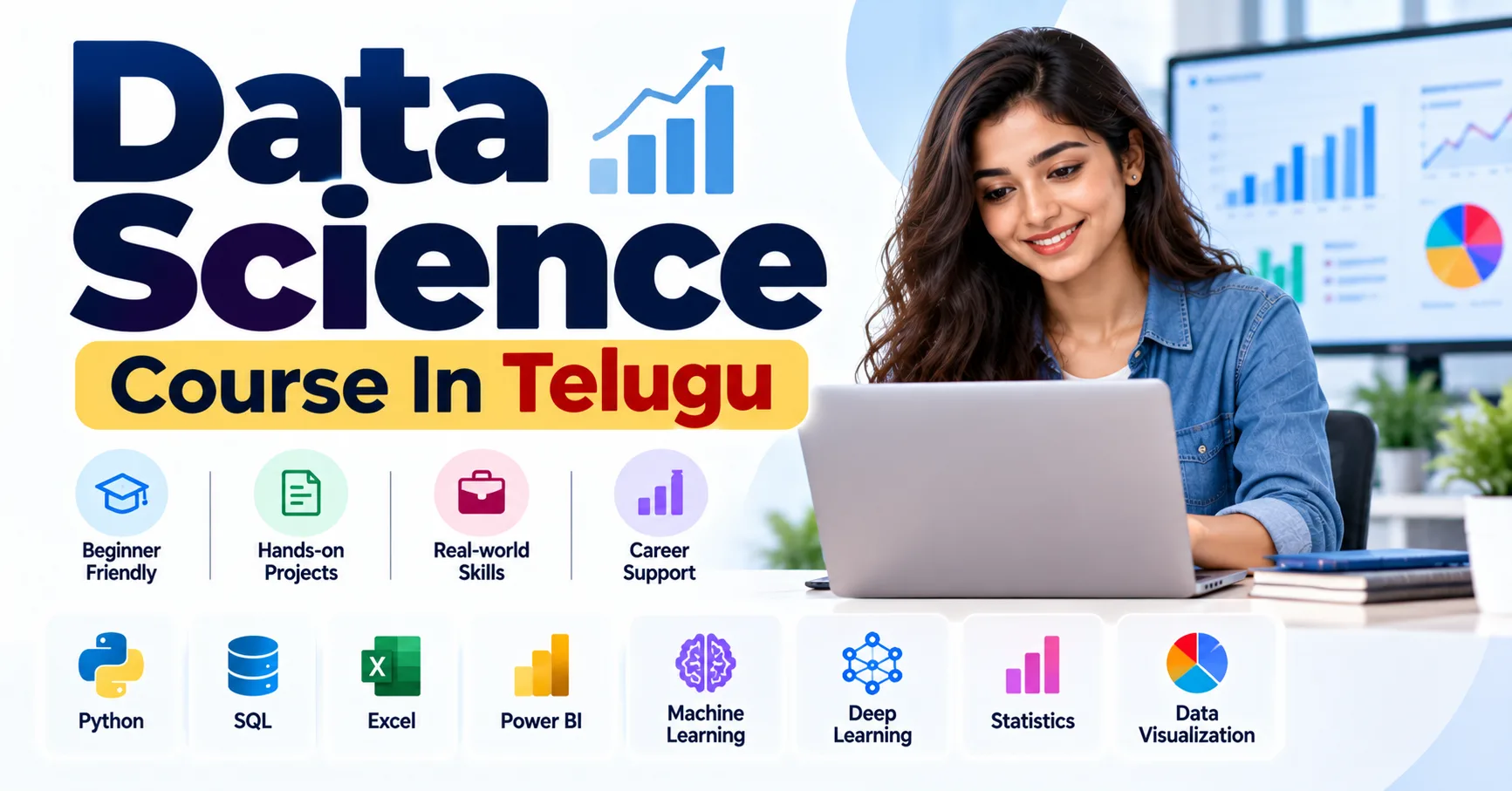
Data science is becoming an important part of modern businesses, helping organizations make better decisions using data, statistics, and technology. From healthcare and banking to e-commerce and IT, companies use data science to understand customer behavior, improve operations, and predict future trends. If you want to build a strong foundation in this field, the Data Science Course in Telugu can help you understand essential concepts in a language that is easier to follow.
What Is Data Science?
Data science is the process of collecting, cleaning, analyzing, and interpreting data to discover useful insights. It combines programming, mathematics, statistics, data visualization, and machine learning to solve real-world problems.
For example, an online shopping company can analyze purchase history to recommend products to customers. A bank can use data to identify unusual transactions, while a hospital can analyze patient information to improve operational planning.
Data science professionals help convert raw information into meaningful insights that support business decisions.
Why Choose a Career in Data Science?
Data science offers opportunities for people interested in technology, analytics, problem-solving, and business intelligence. As organizations generate more data, they need professionals who can organize and interpret it effectively.
Key reasons to explore this career include:
- Multiple career paths: Choose from analytics, machine learning, business intelligence, and data engineering roles.
- Industry-wide applications: Data science skills are useful across finance, healthcare, retail, manufacturing, education, and technology.
- Practical problem-solving: Work with real datasets to identify patterns and support decisions.
- Continuous learning: Develop skills in emerging areas such as artificial intelligence and predictive analytics.
- Career progression: Build experience and move toward specialized or leadership positions over time.
Career opportunities depend on your skills, practical experience, qualifications, and the requirements of individual employers.
Popular Data Science Jobs
Data science includes several roles with different responsibilities. Understanding these options can help you choose a suitable career direction.
1. Data Analyst
A data analyst collects, organizes, and examines information to identify trends and answer business questions. Common responsibilities include preparing reports, creating dashboards, and communicating findings.
Skills to learn: Excel, SQL, Python basics, Power BI or Tableau, and data visualization.
2. Data Scientist
A data scientist uses programming, statistics, and machine learning to investigate complex problems and develop predictive models.
Skills to learn: Python, SQL, statistics, exploratory data analysis, machine learning, and model evaluation.
3. Machine Learning Engineer
A machine learning engineer develops and deploys models that learn patterns from data. The role often involves programming, model optimization, software engineering, and production monitoring.
Skills to learn: Python, machine learning algorithms, software development, model deployment, and relevant ML frameworks.
4. Business Intelligence Analyst
A business intelligence analyst transforms business data into reports and dashboards that help teams monitor performance and make informed decisions.
Skills to learn: SQL, Power BI, Tableau, data modeling, dashboard design, and business analysis.
5. Data Engineer
A data engineer builds and maintains systems that collect, store, and process data for analytics and machine learning.
Skills to learn: SQL, Python, databases, ETL processes, data pipelines, and cloud data platforms.
6. Research or AI Analyst
Professionals in AI-related analytical roles may evaluate datasets, test models, investigate patterns, or support the development of AI applications.
Skills to learn: Python, statistics, machine learning fundamentals, data preparation, and analytical thinking.
The exact responsibilities of these positions vary by company and experience level.
Essential Skills for a Data Science Career
You do not need to learn every advanced tool at the beginning. Start with the fundamentals and gradually build your technical knowledge.
Python Programming
Python is widely used for data cleaning, analysis, visualization, and machine learning. Learn variables, loops, functions, data structures, and libraries such as Pandas and NumPy.
SQL and Database Management
SQL helps you retrieve, filter, join, and summarize information stored in databases. It is an important skill for data analyst, data scientist, and data engineering roles.
Statistics and Mathematics
Learn descriptive statistics, probability, distributions, correlation, hypothesis testing, and basic linear algebra. These concepts help you interpret results and understand machine learning models.
Data Cleaning and Exploratory Data Analysis
Real-world data often contains missing values, duplicates, inconsistent formats, and incorrect entries. Learn how to clean datasets and explore them to identify trends, outliers, and relationships.
Data Visualization
Tools such as Power BI, Tableau, Matplotlib, and Seaborn help communicate findings through charts, dashboards, and reports.
Machine Learning
Once you understand programming, statistics, and data preparation, learn regression, classification, clustering, model evaluation, and the basics of feature engineering.
Communication and Business Understanding
Technical knowledge is only one part of data science. You should also be able to explain your findings clearly and connect them to a business problem.
Data Science Career Growth: From Beginner to Specialist
A data science career does not follow one fixed path. Your progression depends on your chosen role, learning pace, work experience, and the opportunities available to you.
Beginner stage: Build foundations in Python, SQL, statistics, Excel, and data visualization. Practice with small datasets and basic analysis tasks.
Entry-level stage: Apply for suitable roles such as Junior Data Analyst, Reporting Analyst, or other entry-level analytics positions. Develop practical experience with reports, dashboards, and data preparation.
Intermediate stage: Improve your analytical skills, work on more complex datasets, automate repetitive tasks, and develop a stronger understanding of business requirements.
Specialization stage: Choose a direction such as data science, machine learning, business intelligence, data engineering, or AI analytics. Build projects relevant to that specialization.
Senior stage: With substantial experience, some professionals progress into Senior Data Scientist, Lead Analyst, Analytics Manager, or related technical and leadership roles.
These stages are illustrative rather than guaranteed timelines. Progress depends on performance, experience, and role requirements.
How to Build a Strong Data Science Portfolio
A portfolio demonstrates how you apply your knowledge to practical problems. It can be valuable when applying for internships and entry-level positions.
Consider creating these projects:
- Sales Analysis Dashboard: Analyze sales, revenue, and product performance using SQL and Power BI.
- Customer Segmentation: Group customers based on purchasing patterns using exploratory analysis and clustering.
- House Price Prediction: Build a regression model and evaluate its predictions.
- Customer Churn Analysis: Investigate why customers stop using a service and identify important patterns.
- Exploratory Data Analysis Project: Clean a public dataset, visualize key trends, and present your findings in a clear report.
For each project, document the problem, dataset, cleaning steps, methods used, results, and limitations. Make sure you can explain your decisions instead of simply presenting the final output.
How to Prepare for Data Science Job Interviews
Preparing for interviews requires both theoretical understanding and hands-on practice.
- Practice SQL queries, including joins, aggregations, subqueries, and window functions.
- Review Python fundamentals and data manipulation using Pandas.
- Understand statistical concepts and common machine learning algorithms.
- Prepare to explain at least two or three projects in detail.
- Practice interpreting charts and explaining business insights.
- Learn how to discuss data quality, assumptions, and model limitations.
- Prepare examples that demonstrate problem-solving, teamwork, and communication.
Review the job description before each interview and prioritize the tools and skills mentioned by the employer.
Is Data Science Suitable for Beginners?
Yes, beginners can start learning data science with a structured approach. A computer science degree may be useful for some positions, but requirements vary across employers and roles. Candidates from other educational backgrounds can also build relevant skills through programming practice, analytical learning, and project work.
If you are new to the field, begin with Excel and basic statistics, then progress to SQL, Python, data visualization, and machine learning. Avoid trying to learn every tool at once. Consistent practice and a strong understanding of fundamentals are more useful than collecting many certificates without practical experience.
Frequently Asked Questions
1. Which data science job is suitable for beginners?
Data Analyst, Junior Data Analyst, and Reporting Analyst positions can be suitable starting points, depending on your skills and qualifications. Some entry-level data science roles are also available, but they may require stronger programming and statistical knowledge.
2. Do I need Python to become a data scientist?
Python is one of the most widely used programming languages in data science. Learning Python helps you clean data, perform analysis, build models, and automate tasks.
3. Can I learn data science in Telugu?
Yes. Telugu explanations can help learners understand technical concepts more comfortably, especially when they are new to programming or analytics. You should also practice reading technical documentation and using common English technical terms.
4. How can I gain practical experience without a job?
Work on public datasets, create portfolio projects, participate in data challenges, and document your analysis. Internships and supervised practical assignments can also help you gain experience.
5. What affects data science salary and career growth?
Salary and career progression depend on the job role, technical skills, experience, location, industry, employer, and interview performance. Developing practical expertise and demonstrating measurable results can strengthen your career prospects.
Conclusion
Discovering data science jobs and career growth begins with understanding the different roles, learning the right skills, and gaining practical experience. Whether you choose data analytics, machine learning, business intelligence, or data engineering, a strong foundation in Python, SQL, statistics, and data visualization can help you prepare for relevant opportunities.
Start with the fundamentals, build projects that solve real problems, and practice explaining your findings clearly. With consistent learning and hands-on experience, you can work toward a data science career path that matches your interests and long-term goals.