Bulova has been American since 1875, though it's been owned by Citizen since 2007 — a detail that shapes how the brand's movements and pricing actually work today. The Bulova watches range spans automatic, Precisionist quartz, and Marine Star diver references at meaningfully different price points depending on movement type.
Movement type is the thread that ties the pricing together, so understanding the three tiers up front makes the range far easier to read than comparing individual models cold. It's the primary reason two Bulova watches can sit far apart on price.
Quick Answer
Bulova pricing splits mainly by movement type: automatic references (like the Sutton Skeleton Dial, using Miyota calibers) sit at one tier, Precisionist high-frequency quartz references at another, and standard quartz Marine Star divers at a third. Bulova was founded in 1875 in New York and has been owned by Citizen Watch since 2007, which supplies the Miyota movements used in Bulova's automatic line. Added complications and diamond accents move price further within each tier.
Bulova's History and Current Ownership
Founded in 1875 in New York by Joseph Bulova, the company became known for innovations like the Accutron tuning-fork movement. Citizen Watch acquired Bulova at the end of 2007, connecting it to the same corporate family as Miyota, the movement supplier used in Bulova's automatic references.
That ownership link is more than trivia — it's why Bulova automatics commonly run Miyota calibers, since both brands now sit under Citizen. It gives Bulova access to a proven, widely serviced movement supply while keeping its own distinct American brand identity.
Automatic References: The Sutton and Similar Models
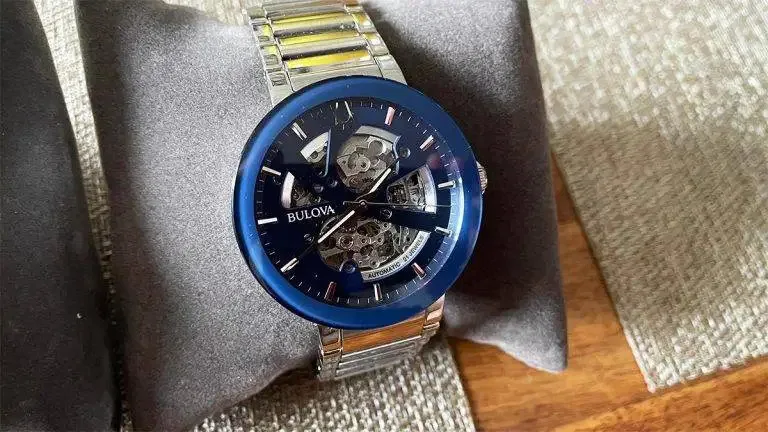
The Sutton Automatic Skeleton Dial pairs a visible mechanical movement with a stainless steel case, generally sitting in a mid-range price tier reflecting automatic movement construction, sourced from Miyota given Citizen's ownership of both brands.
A skeleton dial shows the movement working, which is part of the appeal at this tier — you're paying for a mechanical watch and getting a view of it. Automatics sit above the brand's quartz lines on price because the movement itself is more complex to build.
Precisionist: The High-Frequency Quartz Claim
Precisionist references use a high-frequency quartz movement marketed as more accurate than standard quartz calibers, typically priced above Bulova's standard quartz range but below its automatic tier, reflecting the specialized movement engineering.
The high-frequency movement also gives Precisionist models a distinctive smooth-sweeping seconds hand rather than the once-per-second tick of ordinary quartz. It's a genuine engineering feature within Bulova's own range rather than a claim about outperforming other brands.
Marine Star: The Diver-Styled Quartz Line
References like the 96B431 (Precisionist Quartz Diver's, 200M) and 96B272 (Quartz Diver's, 200M) combine dive-rated water resistance with quartz movement, generally priced according to whether they use standard quartz or the Precisionist variant.
Marine Star is Bulova's main sport-diver family, so it's where dive-rated water resistance meets everyday quartz convenience. Within the line, the Precisionist versions sit above the standard quartz ones on price, consistent with the movement tiering across the wider range.
Diamond-Accented References: A Separate Pricing Factor
Watches like the Marine Star Diamond Accents 96P248 add diamond or crystal detailing to the base design, which typically pushes price above the equivalent plain-dial reference — confirm whether the accent is genuine diamond on the specific listing.
Accent stones move price independently of movement type, so a diamond-accented quartz reference can cost more than a plain automatic. As with any accent-stone watch, checking whether "diamond" means genuine or a substitute stone is worth doing before comparing value.
Case Material and Finish as a Price Factor
Beyond movement and accents, case material and finish also move price within the range. Two-tone or gold-tone plating, more elaborate case shaping, and bracelet construction all add cost over a plain stainless steel reference with the same movement. When comparing two Bulova watches that seem close in specification, checking the case material and finish often explains a price gap that movement type alone doesn't.
FAQ
Who owns Bulova now?
Citizen Watch has owned Bulova since acquiring it at the end of 2007, connecting the brand to Citizen's broader manufacturing group, including movement supplier Miyota.
Are Bulova automatic watches expensive?
They generally sit in a mid-range tier, reflecting automatic movement construction (commonly Miyota-sourced) rather than Bulova's more affordable quartz options.
What is Precisionist and how does it affect price?
It's Bulova's high-frequency quartz movement, marketed as more accurate than standard quartz, typically priced above standard quartz references but below the automatic tier.
Is the Marine Star line dive-rated?
Yes, several references carry 200M water resistance with dive-oriented construction, available in both standard quartz and Precisionist variants.
Do diamond-accented Bulova watches cost more?
Generally yes, compared to the equivalent plain-dial reference — confirm on the specific listing whether the accent is genuine diamond, since this affects the value proposition.
Was Bulova always American?
It was founded in New York in 1875 by Joseph Bulova and remained independently American for over a century before Citizen's 2007 acquisition.
Verdict
Bulova pricing follows movement type as the primary driver — automatic (Miyota-sourced, mid-range), Precisionist (high-frequency quartz, above standard), and standard quartz (most accessible) — with diamond accents, case finish, and dive-rated Marine Star references adding further variation within each tier. Decide on movement type first, then compare specific references. Browse the current Bulova watches collection for available options and current prices.