A hairline crack in your basement wall doesn't look like an emergency. It looks like something you'll deal with "eventually." But foundations rarely stay still. A crack that measures a sixteenth of an inch this spring can widen into a visible bow by next winter, and by then you're no longer talking about a patch job — you're talking about structural repair.
That's the situation thousands of homeowners quietly find themselves in every year, and it's why carbon fiber basement repair has become one of the most requested foundation solutions in the industry. It's fast, it's minimally invasive, and unlike some older repair methods, it doesn't require turning your yard into a construction site. Here's what it actually is, why it works, and how to know if it's the right call for your home.
What's Actually Happening Behind Your Basement Walls
Basement walls aren't just holding up your house — they're holding back the earth around it. That soil expands when it absorbs water and contracts as it dries, a cycle that repeats with every season. Engineers call the resulting sideways pressure "hydrostatic and lateral soil pressure," and it's relentless. Add in freeze-thaw cycles in colder climates, poor grading, or clogged gutters funneling water straight into the soil next to your foundation, and that pressure only builds.
Concrete is strong under compression but weak under lateral bending. Over years, that constant push can cause:
- Horizontal or stair-step cracking in poured or block walls
- Inward bowing, most often at the mid-height of the wall
- Wall displacement at the top or bottom (a sign the wall is shifting off its original position)
Foundation and structural damage from soil and water pressure is consistently ranked among the most common — and most expensive — issues homeowners face over the life of a house, which is exactly why catching it early matters so much.
What Is Carbon Fiber Basement Repair, Exactly?
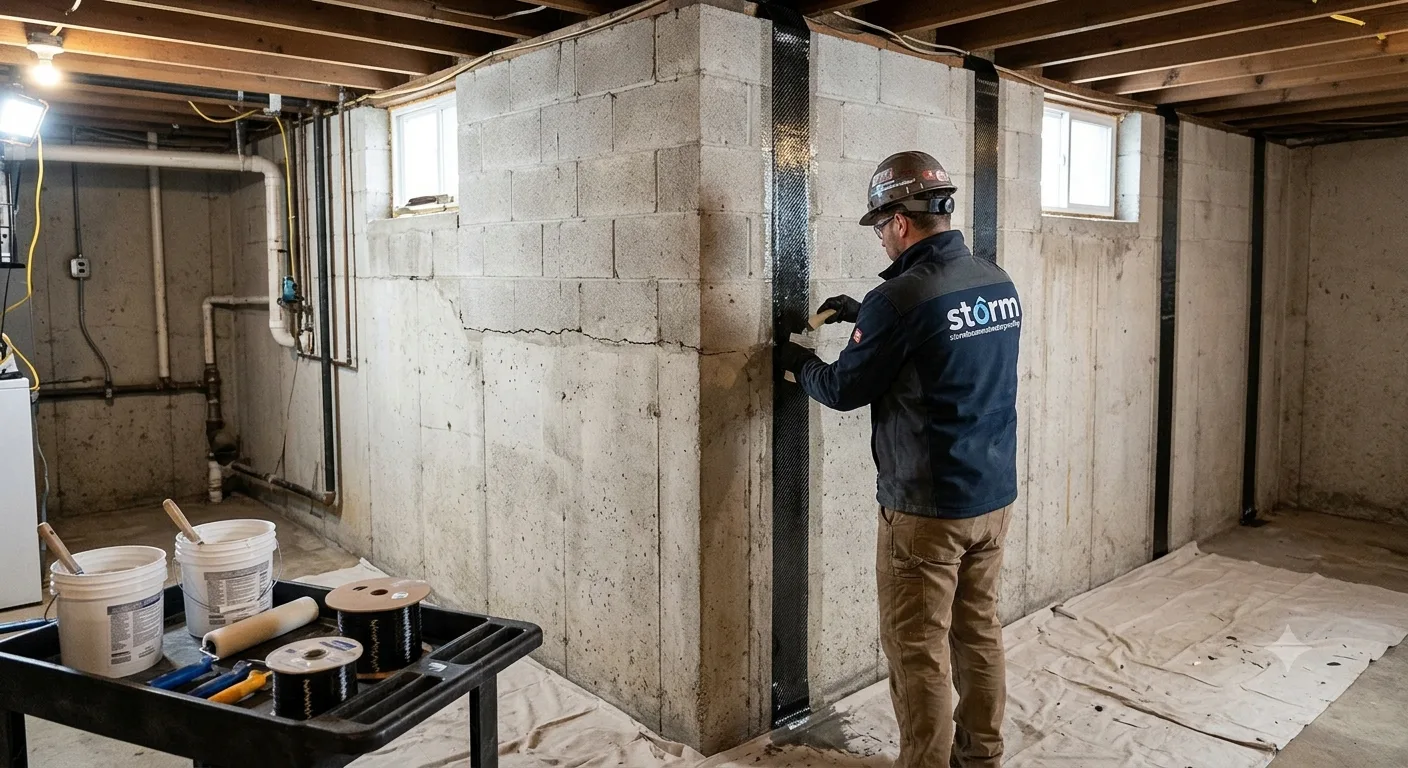
Carbon fiber reinforcement uses strips or straps made from woven carbon fiber, bonded to the interior surface of a foundation wall with a high-strength epoxy resin. Pound for pound, carbon fiber is significantly stronger than steel, yet it adds almost no bulk to the wall.
Once cured, the epoxy and carbon fiber effectively become part of the wall itself, distributing lateral pressure evenly across the reinforced surface instead of letting it concentrate at a crack or weak point. The wall doesn't get pushed back into place — carbon fiber isn't designed to correct existing bowing on its own — but it does stop further inward movement, which is the real goal in most residential cases.
How It Compares to Traditional Methods
MethodInvasivenessTypical TimelineVisibilityCarbon fiber strapsInterior only, no excavation1–2 daysLow profile, paintableSteel I-beamsInterior, some floor anchoring1–3 daysBulky, reduces usable spaceWall replacementExcavation requiredDays to weeksNone post-repair, but highest costFor early-to-moderate bowing (generally under about 2 inches of displacement, depending on the contractor's assessment), carbon fiber is often the most cost-effective and least disruptive option on the table.
The Real-World Benefits Homeowners Notice First
1. Speed
Because there's no excavation, most carbon fiber installations are completed in a single day. Compare that to exterior waterproofing and wall replacement projects, which can take a week or more depending on weather and soil conditions.
2. Preserved Living Space
Steel beams and braces eat into your basement's usable footprint. Carbon fiber strips sit flush against the wall — typically under a quarter-inch thick — so they don't interfere with framing, drywall, or finishing plans down the road.
3. Long-Term Stability
Carbon fiber doesn't rust, rot, or degrade the way steel or wood can when exposed to basement humidity. Properly installed systems are generally backed by long-term warranties precisely because the material itself doesn't break down over time.
4. Lower Overall Cost
Without heavy equipment, extensive labor, or landscaping restoration, carbon fiber repair usually costs less than steel beam installation or full wall replacement — often by a meaningful margin, though exact pricing always depends on wall length, crack severity, and regional labor rates.
When Carbon Fiber Isn't Enough
Honest contractors will tell you carbon fiber has limits, and that's worth knowing before you call anyone.
- Severe bowing (walls displaced several inches inward) often needs wall anchors, helical tiebacks, or replacement instead.
- Active water infiltration through the crack should be addressed alongside — not instead of — structural reinforcement, since carbon fiber straps aren't a waterproofing membrane on their own.
- Footing failure or settlement is a different problem entirely and calls for underpinning or piering, not wall reinforcement.
This is why a proper inspection matters more than the repair method itself. Any waterproofing service worth hiring should assess the whole system — walls, footings, drainage, and grading — before recommending a fix.
A Few Warning Signs Worth Acting On Now
If you notice any of the following, it's worth getting a professional evaluation before the next wet season:
- Cracks wider than 1/8 inch, especially horizontal or stair-step patterns
- Visible bowing when you sight down the wall from the corner
- Doors or windows near the foundation sticking or misaligning
- Efflorescence (white, chalky mineral deposits) or persistent dampness along the wall base
None of these guarantee a major problem, but all of them are worth a second look. Foundation issues rarely improve on their own, and the cost of delay is almost always higher than the cost of early intervention.
The Bottom Line
Foundation problems have a way of feeling bigger than they are — until you understand the fix. Carbon fiber basement repair gives homeowners a way to stop wall movement before it becomes a structural emergency, without tearing up the yard or gutting the basement to do it. It's not the right answer for every situation, but for the early-to-moderate cracking and bowing that makes up the bulk of residential foundation calls, it's often the fastest path back to a stable, dry basement.
If you've spotted a crack, a bulge, or a damp patch that wasn't there last year, don't wait for it to make the decision for you. A qualified waterproofing and foundation repair team can tell you within a single visit whether carbon fiber reinforcement will solve the problem — and give you real peace of mind before the next storm rolls through.