Market Overview
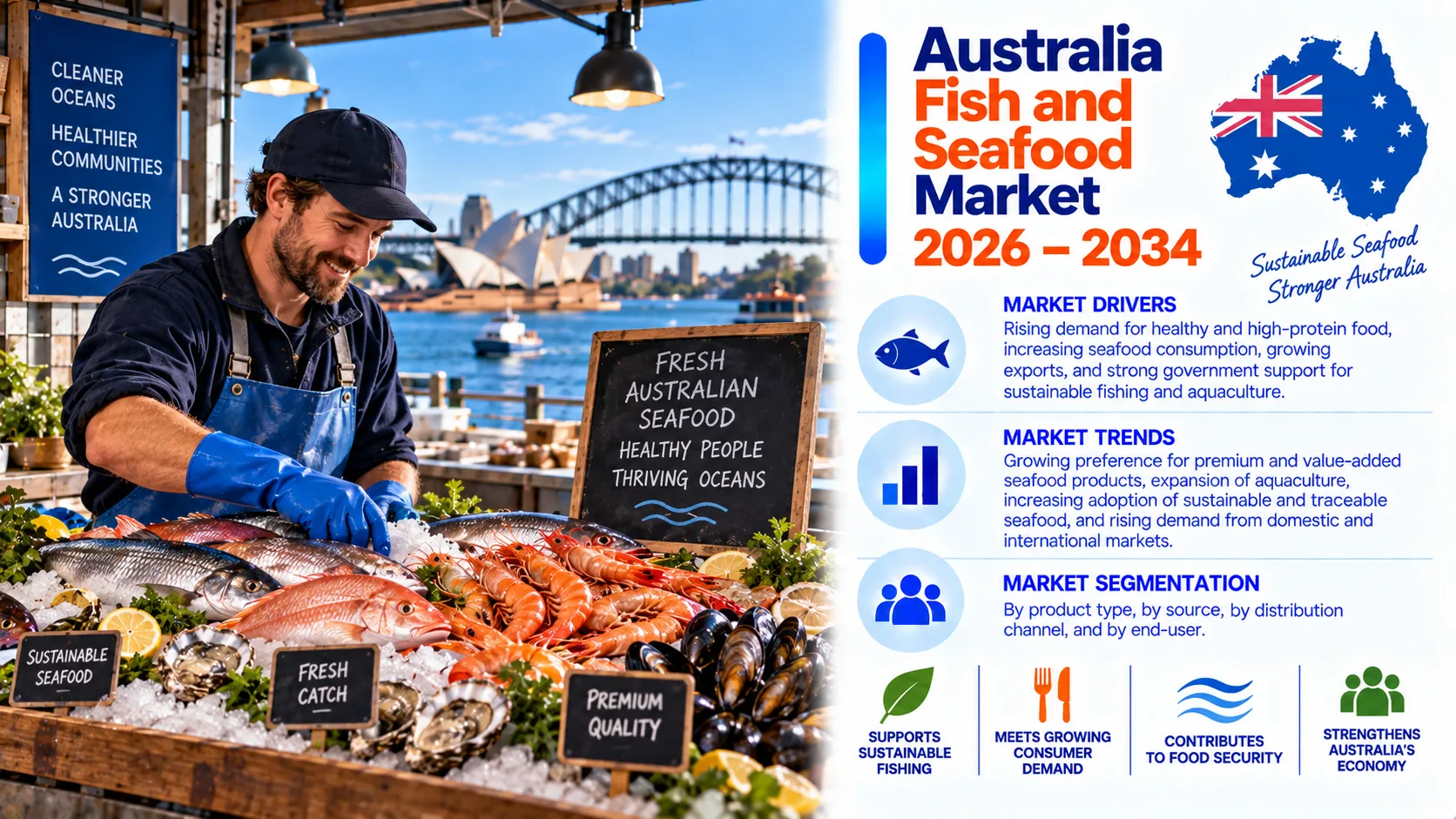
The Australia fish and seafood market is growing, driven by evolving consumer preferences for nutritious and sustainably sourced products, advancements in aquaculture, strong export demand, and government support for sustainable fishing practices. The market size increased from USD 4.1 Billion in 2025 to USD 4.3 Billion in 2026 and is projected to reach USD 6.1 Billion by 2034, registering a compound annual growth rate (CAGR) of 4.65% during 2026-2034. Enhanced focus on traceability and sustainability certifications, innovation in seafood alternatives and convenience-driven products, and the expanding foodservice and tourism sectors are further shaping the Australia fish and seafood market share and outlook through 2034.
Request a Sample Report for In-Depth Market Insights: https://www.imarcgroup.com/australia-fish-seafood-market/requestsample
Market Summary
- Growing consumer demand for sustainably sourced, high-quality products, supported by heightened health awareness of omega-3 fatty acids, vitamins, and minerals, is increasing demand for fish and seafood and intensifying competition among suppliers, with the market focused on diverse products for varying consumer needs.
- A landscape of large-scale seafood companies, regional fishers, and aquaculture enterprises is driving investment in sustainable sourcing, advanced processing technologies, and strong distribution networks, with retail giants and specialty seafood stores competing for domestic dominance.
- Enhanced traceability systems and sustainability certifications, along with the 2025 origin-labelling agreement for restaurants, cafes, and clubs, are bolstering consumer trust and shaping how suppliers position their products.
- Advancements in aquaculture and fishing practices are streamlining supply chains, with Australia's fisheries and aquaculture production value expected to remain stable between 2024-25 and 2028-29 at an average of USD 3.48 billion.
- The expanding foodservice industry and coastal tourism are amplifying demand for locally sourced seafood, while export opportunities to Asia and Europe continue to contribute to robust growth.
- The market is segmented by product, form, distribution channel, and region for 2026-2034, with fresh fish and fresh seafood holding dominant shares and online distribution offering growth potential.
Market Growth Drivers
Growing Demand for Sustainable and Certified Seafood
Australia's fish and seafood market is experiencing increased consumer demand for sustainably sourced and certified products, driven by heightened awareness of environmental issues and overfishing. In November 2023, State and territory consumer affairs ministers announced an agreement for limited seafood labeling in restaurants, cafes, and clubs, taking effect in 2025, under which seafood will be labeled as Australian, imported, or mixed origin (AIM model). The Australian Marine Conservation Society has stressed additional measures, emphasizing the need for labeling to include species name, fishing or farming methods, and country of origin. This focus aligns with global trends, ensuring Australia remains competitive in the premium seafood segment while supporting the long-term health of marine ecosystems.
Rising Exports to Asian Markets
The Australia fish and seafood market growth is benefiting from rising exports to Asian markets, driven by high demand for premium-quality products such as tuna, lobster, and abalone. Countries like Japan, China, and South Korea view Australian seafood as a luxury item due to its freshness, sustainability, and stringent quality standards. This export growth is encouraging investment in processing facilities and cold-chain logistics to maintain quality and expand market share. In September 2024, the Australian Government launched the NEXDOC system to simplify seafood export documentation, supporting the USD 1.8 billion trade through streamlined permits, QR-coded certificates, faster approvals, and improved tracking as part of a USD 322.9 million digital initiative.
Increased Adoption of Technology in Aquaculture
Technology adoption is transforming the Australia aquaculture industry, a significant contributor to the fish and seafood market. Advanced systems like automated feeding, real-time water quality monitoring, and data analytics are improving productivity and sustainability. The use of recirculating aquaculture systems (RAS) is gaining momentum, allowing for fish farming in controlled environments with reduced environmental impact. In July 2024, Huon Aquaculture announced an investment of USD 110 million to expand its freshwater Atlantic salmon nursery at Whale Point, Port Huon, Tasmania, with the new RAS growing larger fish on land and reducing marine time. These innovations are enhancing yields, reducing costs, and ensuring consistent supply to both domestic and international markets.
Porter's Five Forces Analysis
Competitive Rivalry: High
- Large-scale seafood companies, regional fishers, and aquaculture enterprises are competing on sustainable sourcing, processing technology, and distribution reach.
- Retail giants and specialty seafood stores compete for domestic market dominance, while the foodservice industry fuels demand for premium and fresh products.
- Sustainability credentials, traceability, and product freshness are key points of differentiation.
Supplier Power: Moderate to High
- Fishers, aquaculture operators, and cold-chain logistics providers hold influence, particularly for premium species such as tuna, lobster, and abalone.
- Seasonal availability, weather events, and quota restrictions can tighten supply and increase supplier leverage.
- Technology and RAS equipment providers are gaining importance as aquaculture operators invest in controlled-environment farming.
Buyer Power: High
- Consumers and foodservice operators can compare and switch products easily across supermarkets, fishmongers, and online platforms.
- Price sensitivity is high for canned and frozen segments, though willingness to pay premiums grows for certified sustainable and premium fresh products.
- Demand for traceability, origin labeling, and sustainably sourced options is raising expectations for transparency.
Threat of Substitutes: Moderate
- Alternative proteins, including plant-based seafood and other meats, provide substitutes for some consumer occasions.
- Canned and frozen products substitute for fresh in convenience-driven purchasing, while cured products serve niche premium demand.
- Seafood's nutritional profile, including omega-3 content, limits substitution for health-conscious consumers.
Threat of New Entrants: Moderate
- Online marketplaces and direct-to-consumer models have lowered entry barriers for smaller producers and specialized distributors.
- Sustainability certifications, traceability systems, and cold-chain capabilities raise operational barriers.
- Established brands, export relationships, and distribution networks favor incumbents.
Market Segmentation
Product Insights
- Fresh Fish
- Fresh Seafood
Form Insights
- Fresh
- Frozen
- Canned
- Cured
Distribution Channel Insights
- Offline
- Online
Regional Insights
- Australia Capital Territory and New South Wales
- Victoria and Tasmania
- Queensland
- Northern Territory and Southern Australia
- Western Australia
Regional Analysis
Australia Capital Territory and New South Wales: This region represents a significant market, driven by strong demand in Canberra and Sydney, with a diverse fishing industry including wild-caught and farmed seafood supported by key ports such as Sydney and Eden, and growing demand for high-quality products like Australian lobsters and prawns.
Victoria and Tasmania: Victoria and Tasmania play a crucial role, with Tasmania renowned for premium products including Atlantic salmon, oysters, and abalone, supported by clean waters and advanced aquaculture, while Victoria's diverse culinary culture drives demand for sustainable, traceable seafood.
Queensland: Queensland is a significant player driven by its vast coastline and rich marine biodiversity, as a major producer of prawns, tuna, and reef fish, with large-scale commercial fishing along the coast and aquaculture for prawns and barramundi.
Northern Territory and Southern Australia: This region contributes through unique aquatic ecosystems and specialized fisheries, with the Northern Territory known for barramundi and mud crab, and South Australia famous for abalone, tuna, and kingfish alongside growing aquaculture.
Western Australia: Western Australia plays a crucial role with a strong presence in wild-caught and aquaculture sectors, as a major exporter of Western rock lobster, abalone, and prawns, supported by an expansive coastline and investment in innovative fishing technologies.
Competitive Landscape
The competitive landscape of the Australia fish and seafood market is characterized by a mix of large-scale seafood companies, regional fishers, and aquaculture enterprises. Key players focus on sustainable sourcing, advanced processing technologies, and strong distribution networks to maintain market share. Retail giants and specialty seafood stores compete for domestic market dominance, while the foodservice industry fuels demand for premium and fresh seafood products. Collaboration between stakeholders ensures adherence to sustainability standards, further enhancing market competitiveness. The report provides a comprehensive analysis of the competitive landscape with detailed profiles of all major companies.
Key players include:
- Large-scale seafood companies
- Regional fishers and wild-catch operators
- Aquaculture enterprises
- Retail giants and specialty seafood stores
Recent Industry Developments
October 2026: Australia’s fish and seafood market advanced through trade, traceability, aquaculture, and sustainability developments. On October 19, 2026, the Australian government highlighted the new EU free trade agreement as a major opportunity to expand seafood exports to Europe, noting that Australia exported USD 1.5 billion worth of seafood globally but only USD 7 million to Europe.
October 2026: Scientists developed artificial intelligence capable of recognizing individual lobsters, enabling pot-to-plate traceability. The technology is expected to strengthen consumer trust, support premium branding, and help Australian lobster exporters access new markets, including the European Union.
October 2026: On October 27, 2026, Australia announced a new AUD 10 million aquaculture research hub. Researchers from the University of Queensland are also planning pilot-scale trials of a process that uses gases from organic waste to produce a protein ingredient for aquaculture feed, with studies indicating microbial single-cell proteins could replace up to 75% of fishmeal in barramundi diets.
October 2026: On October 30, 2026, the Australian Pesticides and Veterinary Medicines Authority began assessing an application to permit a higher dose of the antibiotic florfenicol for farmed Tasmanian salmon. The issue remains sensitive because earlier residue detections led to precautionary closures of rock lobster and abalone fisheries and raised export-market concerns.
Key Aspects Required for the Australia Fish and Seafood Market
- Market Performance: The market grew from USD 4.1 Billion in 2025 to USD 4.3 Billion in 2026 and is projected to reach USD 6.1 Billion by 2034, driven by sustainable sourcing demand, aquaculture advancement, export growth, and government support.
- Market Outlook: A 4.65% CAGR during 2026-2034 reflects steady expansion supported by traceability, convenience-driven products, foodservice growth, and Asian export demand.
- Growth Drivers: Growing demand for sustainable and certified seafood; rising exports to Asian markets; and increased adoption of technology in aquaculture, together shaping long-term demand.
- Competitive Landscape: Large-scale seafood companies, regional fishers, aquaculture enterprises, and retail giants are competing on sustainable sourcing, processing technology, and distribution networks.
- Value Chain Analysis: The value chain runs from fishers and aquaculture operators through processors, cold-chain logistics, and offline/online distribution to households, restaurants, and export markets across Australian regions, supported by sustainability certification bodies and government export systems.
- Industry Trends: Growth of sustainable and certified seafood; rising Asian exports; adoption of RAS and automated aquaculture technology; and increasing focus on origin labeling and traceability.
- Strategic Recommendations: Invest in RAS and automated aquaculture systems; expand cold-chain and processing capacity for Asian exports; strengthen sustainability certifications and traceability; and develop online and direct-to-consumer distribution channels.
Note: If you need any specific information that is not currently covered within the scope of the report, we will provide the same as a part of customization.
Speak to an analyst: https://www.imarcgroup.com/request?type=report&id=21975&flag=C
Frequently Asked Questions
1. What is the size of the Australia fish and seafood market?
The market increased from USD 4.1 Billion in 2025 to USD 4.3 Billion in 2026 and is projected to reach USD 6.1 Billion by 2034.
2. What is the expected growth rate of the Australia fish and seafood market?
The market is projected to grow at a CAGR of 4.65% during 2026-2034.
3. What is driving the growth of the Australia fish and seafood market?
Growth is driven by strong demand for high-quality, sustainable products, increasing export opportunities in Asian markets, technological advancements in aquaculture, government initiatives supporting sustainability and streamlined export processes, and growing awareness of health benefits.