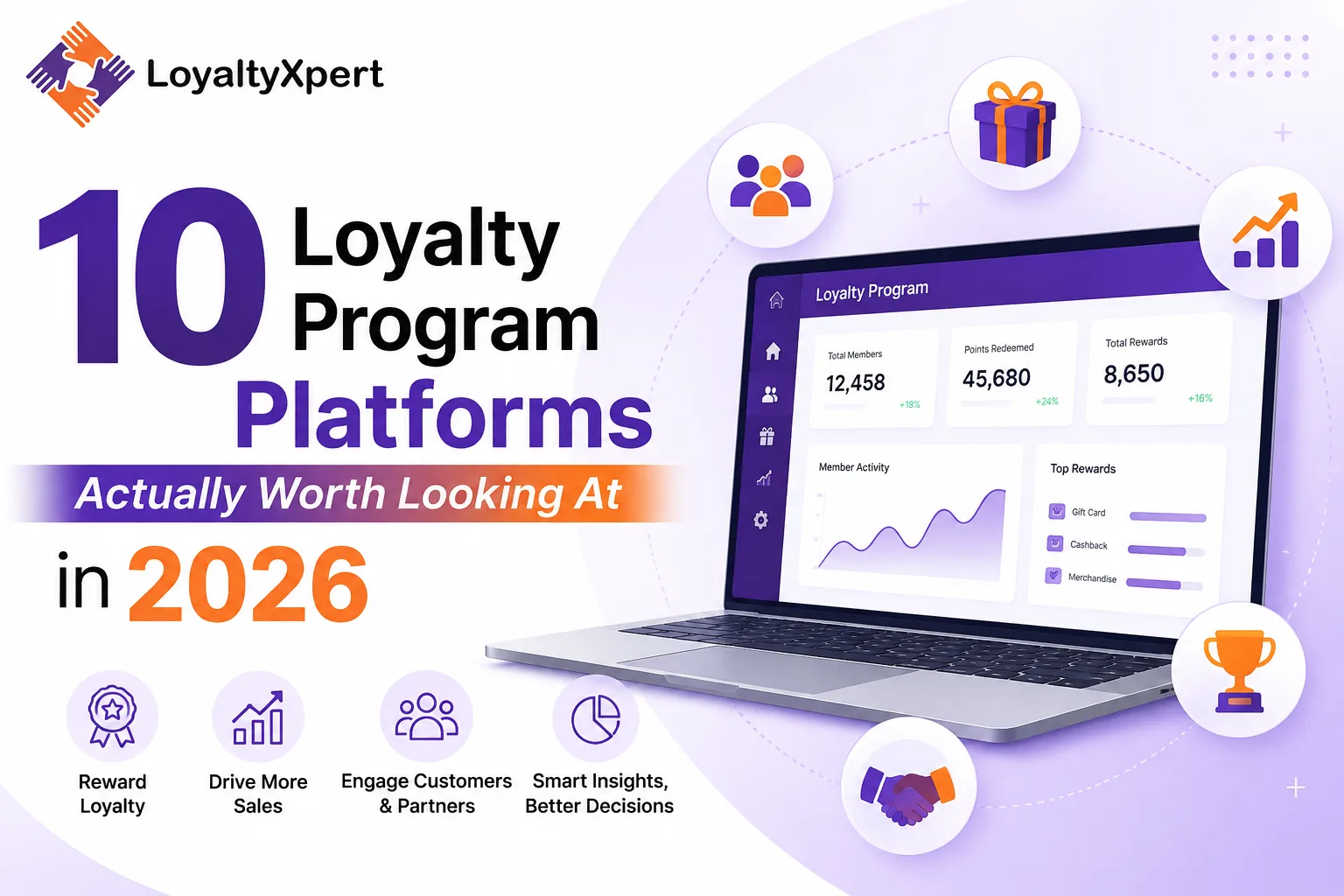
Remember when "loyalty program" just meant a stamp card or a flat 10% off your next visit? Those days are mostly gone. Customers expect a lot more now, and honestly, so do the partners and dealers businesses work with on the B2B side. A punch card doesn't cut it anymore.
That shift is exactly why loyalty program software exists. Rather than someone on your team manually tracking points in a spreadsheet, chasing down redemptions, and guessing which campaigns actually worked, the right platform pulls all of that into one system: rewards, engagement, partner activity, the works.
Here's the catch, though: picking a platform isn't as simple as it sounds. The market is crowded, and a tool built for a DTC skincare brand isn't going to serve a manufacturer trying to motivate a network of dealers. So if you're in research mode for 2026, here's a rundown worth working through.
So What Does Loyalty Software Actually Do?
At its core, this kind of software takes the manual grind out of running a loyalty program. Depending on which platform you pick, that could mean:
- Setting up rules for earning and redeeming points
- Keeping track of customer or partner accounts
- Running and managing campaigns
- Handling reward redemption logistics
- Building referral programs
- Setting up tiered membership levels
- Watching engagement over time
- Splitting users into segments
- Reporting on how the whole program is performing
A retail brand might use this to reward people for buying, referring friends, or just sticking around. A manufacturer, though, could use the exact same category of tool to motivate dealers, distributors, contractors, or even influencers to push more products. Same underlying tech, very different use case which is worth remembering, because a platform built with one of these in mind won't necessarily serve the other well.
Why Bother With Loyalty Software In the First Place?
The whole point of a loyalty program is to give people a reason to keep coming back. That's easy to say and much harder to pull off once your program has more than a handful of members.
- It nudges people toward repeat business. A reward worth chasing gives someone a reason to buy again instead of going with whoever's cheapest that week.
- It keeps people involved between purchases. Contests, referral bonuses, and small challenges give customers or partners something to do even when they're not actively buying.
- It cuts down on busywork. Somebody has to calculate balances, track redemptions, and update records. Automating that frees your team up for things that actually need a human.
- It hands you real data. Every action inside a loyalty program, what gets redeemed, who's engaging, which campaigns land, tells you something about your audience you probably didn't have before.
- It lets you stop treating everyone the same. Not every customer wants the same reward. Segmentation means you can offer something relevant to a specific group instead of blasting one generic reward at your entire list.
10 Platforms Worth Adding to Your Shortlist
No single tool is the "best" one here, it really comes down to who you're trying to reach, what industry you're in, and how much customization your program actually needs. With that in mind, here's where to start looking.
1. LoyaltyXpert
Good fit for: manufacturers, B2B companies, and anyone managing a channel partner network
LoyaltyXpert leans heavily into channel loyalty, think dealers, distributors, retailers, contractors, and influencers, while still supporting standard consumer-facing programs. What stands out is the range: partner loyalty tools, point and reward management, gamification, referrals, a reward catalog, campaign tools, analytics, multi-language support, automatic point expiry, and product catalog management. If you're running programs across several regions or managing a large, spread-out partner base, the amount of customization on offer here is genuinely useful.
2. Zinrelo
Good fit for: mid-market and enterprise companies
Zinrelo's angle is data. It pairs loyalty management with analytics and segmentation, which makes sense if your priority is understanding customer behavior well enough to build genuinely personalized experiences rather than generic ones.
3. Antavo
Good fit for: retail and consumer brands
Antavo goes beyond the standard points-for-purchases setup, layering in gamification and personalization. It's a solid pick if you want your program to feel more like an experience than a transaction ledger.
4. Loyltworks
Good fit for: businesses across a range of industries
Loyltworks covers the usual bases, rewards, referrals, gamification, analytics, engagement tools with an emphasis on flexibility across different business types. Worth including in a side-by-side comparison if customization is a priority.
5. Capillary Technologies
Good fit for: large retailers and enterprise consumer brands
Capillary is built for scale. It centers on pulling customer data together across touchpoints and using it to personalize engagement, which matters most for companies operating across multiple markets or regions.
6. Open Loyalty
Good fit for: companies with strong in-house dev teams
This one's API-first, meaning it's less "plug and play" and more "build exactly what you want." That's a plus if you have the technical resources to shape a custom experience, and a drawback if you were hoping for something ready to go out of the box.
7. Annex Cloud
Good fit for: enterprise-level engagement programs
Annex Cloud goes past basic points tracking into referrals and user-generated content, making it a reasonable option if you want several engagement initiatives tied together under one loyalty strategy.
8. Talon.One
Good fit for: businesses running complicated promotions
Another API-first platform, Talon.One is built for flexibility around business rules, useful if your promotions or incentive structures get complex. Like Open Loyalty, it's more valuable if you've got developers on hand to make use of that flexibility.
9. Yotpo
Good fit for: eCommerce brands
Yotpo bundles loyalty in with reviews, referrals, and other marketing tools it's known for. For online sellers, having all of that under one roof can simplify managing the customer experience overall.
10. LoyaltyLion
Good fit for: eCommerce businesses
LoyaltyLion sticks close to eCommerce, offering the standard mix of points, rewards, referrals, and VIP tiers. A reasonable option to have on your comparison list if you're specifically shopping for an online-store-focused tool.
B2B and B2C Loyalty Aren't the Same Thing
Before you go platform-shopping, it's worth stepping back and asking who you're actually trying to keep engaged with because B2B and B2C loyalty programs, despite looking similar from a distance, are usually solving different problems.
Consumer programs are generally trying to get people to buy more often, spend more per purchase, refer friends, stay engaged with the brand, and redeem their rewards. Points, cashback, discounts, and VIP perks are the usual tools here.
B2B programs are more about the relationship. A manufacturer might be trying to get dealers to push a specific product line, finish training, submit paperwork on time, or take part in a campaign. That usually involves a different cast of characters entirely dealers, distributors, retailers, contractors, sales reps, influencers and it demands stronger partner management, transaction validation, and reporting than a typical consumer program needs.
The takeaway: don't pick a platform because it has the longest feature list. Pick one whose features actually match the people and behaviors you're trying to influence.
Features That Actually Matter
Once your requirements are clear, here's what's worth scrutinizing as you compare platforms.
- Points and reward management. How easy is it to define earning rules, point values, and redemption options?
- Segmentation. If you're dealing with multiple customer types or partner tiers, this lets you tailor offers instead of treating everyone identically.
- Analytics and reporting. You want visibility into participation, redemptions, engagement, and how individual campaigns are performing not a black box.
- Gamification. Leaderboards, badges, challenges, and contests keep a program from feeling stale.
- Referral tools. Built-in referral management turns your existing base into a source of new business without extra manual effort.
- Integrations. Check that it connects cleanly with your CRM, ERP, POS, eCommerce platform, or marketing stack whatever your business already runs on.
- Mobile experience. If people are checking points or redeeming rewards on their phones, a clunky mobile experience will quietly kill adoption.
- Scalability. What works for your program today may not hold up in two years. Make sure the platform can grow with you.
Questions to Ask Before You Commit
Feature comparisons alone can get overwhelming. It helps to start with these questions instead:
- Who's actually going to participate in this program?
- What behavior are we trying to drive?
- Is this B2B, B2C, or a mix of both?
- What existing systems does this need to talk to?
- How much customization do we realistically need?
- What kind of reporting will our team rely on?
- How simple is this for participants to actually use?
- Will this still work as we scale up?
- Does this vendor understand our industry?
- Does the cost make sense against the return we expect?
Working through these first tends to narrow the list fast.
What's Shaping Loyalty Programs in 2026
The industry's moving well past simple points-and-discounts.
- AI-driven personalization is helping brands to spot behavioral patterns which are nearly impossible to catch manually, which in turn shapes more relevant rewards and recommendations by AI personalisation programs.
- Mobile-first design keeps mattering most in loyalty platforms as people are nowadays increasingly managing their loyalty activity entirely from their phones.
- Gamified mechanics missions, challenges, achievement badges are replacing the flat "collect points, get discount" model in a lot of programs.
- Omnichannel consistency matters here because customers bounce between your website, app, and physical store before they ever buy a loyalty program, and the loyalty experience needs to follow them there. Customer experience should be the first priority.
- More personalized rewards are edging out generic ones. The standard point-for-discount model is losing its pull, and brands are experimenting with exclusive perks, curated experiences, and tailored offers instead.
Bottom Line
Best loyalty program software helps in a lot more than count points. Agreed right? it becomes the backbone of how you engage customers or partners by automating the busywork pattern, surfacing real behavioral insight, and running campaigns that actually work.
More number of features doesn't automatically mean it is better fit. The right platform is the one which is built around how your business actually operates. Here are examples. An e-Commerce brand will probably care most about integrations and customer-facing engagement tools. A manufacturer is more likely to prioritize dealer management, partner incentives, and multilingual support.
Figure out what actually works for your business and what you need from your loyalty program to accomplish before you start comparing vendors. The shortlist gets a lot shorter once you do this.
Original source: https://www.loyaltyxpert.com/blog/top-loyalty-program-software/