
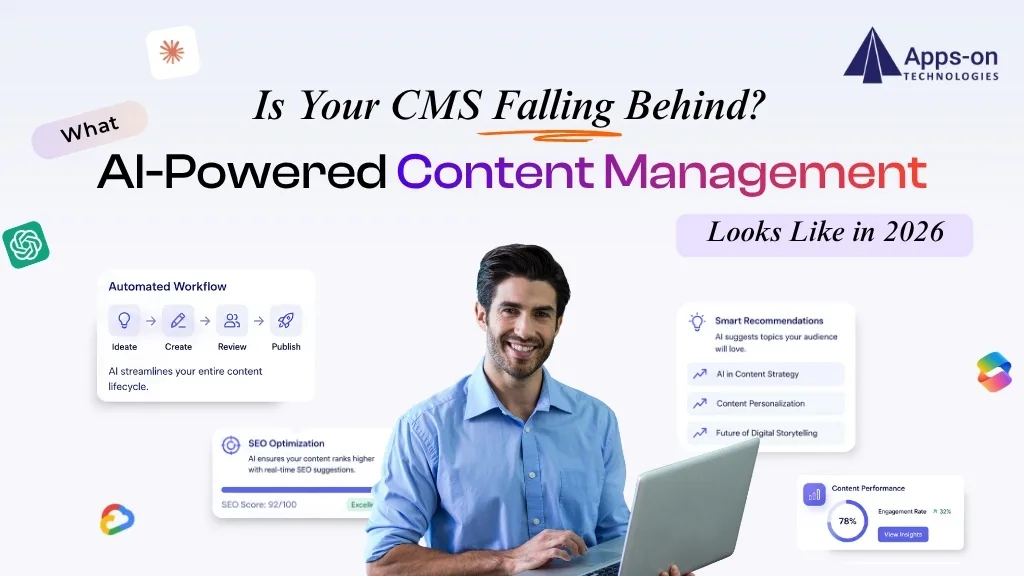
If your content team is still manually tagging articles, guessing at personalization, and waiting days for a developer to update a template, you're not just behind on features — you're behind on infrastructure. An AI-Powered Content Management System isn't a nice-to-have add-on anymore; it's quickly becoming the baseline expectation for how modern businesses create, manage, and deliver content. And if your current CMS still treats AI as an afterthought bolted onto an old dashboard, 2026 is the year that gap starts to show.

The Shift Nobody Can Ignore Anymore
For years, "CMS" simply meant a place to write and publish. That definition no longer holds. The headless CMS market alone is projected to grow from under $4 billion in 2025 to over $22 billion by 2034 — a signal that businesses are rapidly moving away from rigid, template-locked platforms toward flexible, API-first systems built for scale.
But the bigger shift isn't just headless architecture — it's what's now built inside that architecture. AI in Content Management has moved from a chatbot sidebar that drafts text on command to something embedded directly into the content lifecycle itself: creation, tagging, optimization, personalization, and governance, all working together instead of as disconnected tools.
What Does "AI-Powered" Actually Mean in 2026?
Here's where most businesses get confused — and where most vendors get away with vague marketing. Nearly every CMS today claims to be "AI-powered." The real question is whether AI is woven into your entire content workflow, or whether it's just a generative text box stapled onto an otherwise outdated system.
A genuine AI CMS Solution in 2026 typically includes:
- Automated content tagging and structuring — no more manually categorizing hundreds of articles or product pages
- AI-native visual editors — allowing non-technical marketers to preview, plan, and personalize content without needing a developer for every small change
- Real-time personalization — content that adapts to a visitor's location, language, and behavior automatically
- Content intelligence — systems that analyze what's actually performing and recommend what to fix or improve
- Governance built in — permissions, workflows, and audit trails that keep AI-assisted content compliant and on-brand at scale
This is a fundamentally different experience than "add AI plugin, hope for the best." It's AI as infrastructure, not AI as decoration.
Signs Your CMS Is Already Falling Behind
You don't need a technical audit to know if your platform is outdated. Ask yourself:
- Does every content update require a developer, or can your marketing team move independently?
- Can your CMS personalize content per visitor automatically, or is every page identical for everyone?
- Are you manually re-uploading the same content across your website, app, and social channels?
- Is your platform still organized around a single website, instead of delivering content anywhere it's needed?
If you answered "yes" to manual work on any of these, your content operations are quietly costing you time, consistency, and competitive ground — even if nothing looks broken on the surface.
Where This Is All Heading: The Future of Content Management
The Future of Content Management Systems is composable, AI-native, and channel-agnostic. Instead of one monolithic platform trying to do everything, businesses are assembling best-of-breed components — a headless CMS for content, a personalization engine, a search layer — into a unified system where content is created once and delivered everywhere: web, mobile, apps, kiosks, even voice assistants.
Industry recognition is already validating this direction. Storyblok, for example, was named a Leader in the IDC MarketScape 2025 for AI-Enabled Headless CMS specifically because of how deeply AI is integrated into its content workflows — not because it added a chatbot. That's the bar the rest of the market is now being measured against.
The businesses adapting early aren't just future-proofing their tech stack. They're cutting the manual workload their content teams carry every single day, while delivering more consistent, more personalized experiences than a traditional CMS could ever manage on its own.
Frequently Asked Questions
What is an AI-Powered Content Management System?
It's a CMS that has artificial intelligence built directly into its core workflows — content creation, tagging, personalization, and governance — rather than AI features added on as separate plugins or a simple chatbot.
How is this different from a regular CMS with a chatbot plugin?
A chatbot plugin only assists with writing text on request. A true AI-powered CMS uses AI across the entire content lifecycle, including automated structuring, real-time personalization, and performance-based recommendations.
Do I need to switch to a headless CMS to get AI benefits?
Not necessarily, but headless and composable architectures make it significantly easier to integrate AI capabilities and deliver content across multiple channels without duplicating work.
Is upgrading to an AI CMS expensive or disruptive?
Usually not. You can modernize one workflow at a time instead of overhauling everything at once — making the transition far smoother than it sounds
How do I know if my business actually needs this upgrade?
If your team spends more time on manual content tasks than strategy, or your content can't scale across channels without duplicate work, it's a strong sign your current CMS is limiting your growth.
Conclusion
The gap between businesses running an outdated CMS and those running a true AI-Powered Content Management System is only going to widen in 2026. This isn't about chasing trends — it's about whether your content operations can keep pace with how fast customer expectations, channels, and competition are moving. The businesses that modernize now won't just save time; they'll be positioned to deliver experiences their competitors simply can't match with a legacy platform.
Ready to See What Your CMS Could Actually Do?
Stop guessing whether your content platform is holding you back. Let's map out exactly where AI can save your team time, improve personalization, and future-proof your content operations — with a clear, no-obligation plan built around your business.
Book Your Free AI CMS Assessment Today at https://appsontechnologies.com/ — Let's Find Out What You're Missing.