
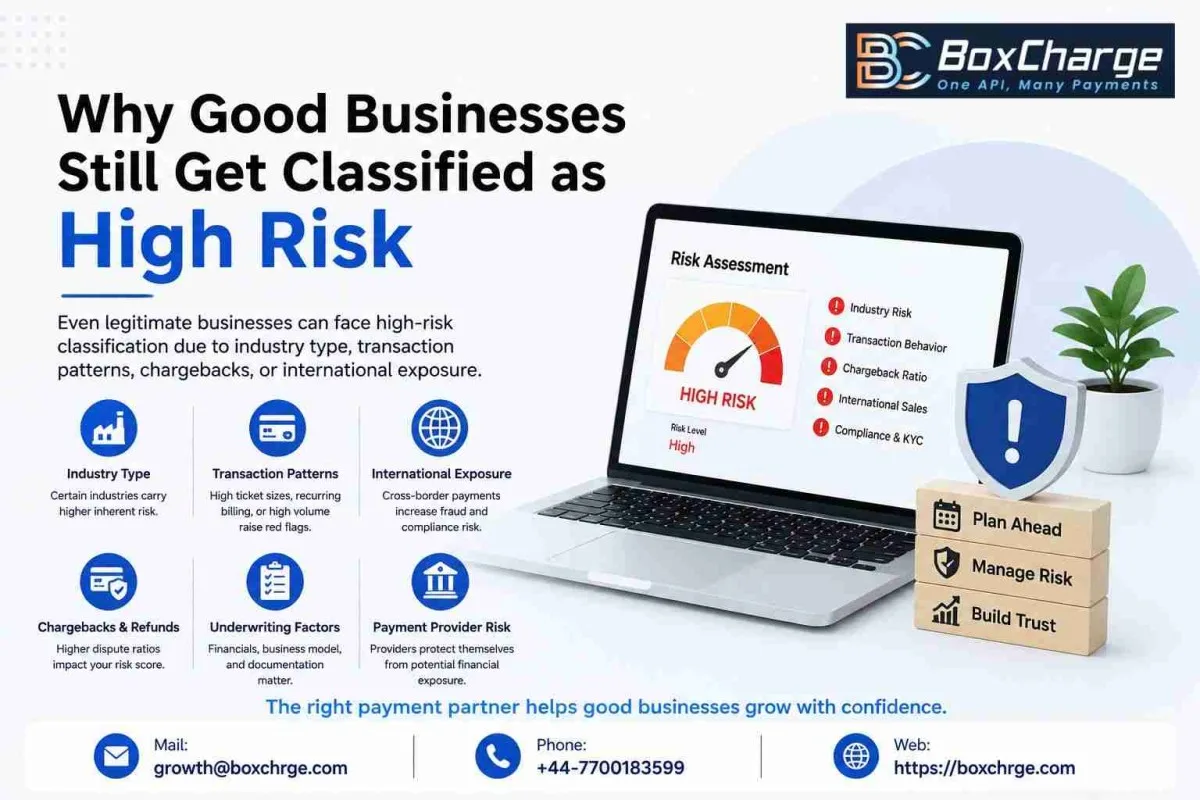
A business can have loyal customers, clean financial records, strong revenue, and no history of fraud—and still be classified as high-risk by a payment provider.
That can be a frustrating reality for merchants operating across the UK, United States, Canada, Australia, and European markets. From the business owner's perspective, everything may look healthy. From an acquiring bank's perspective, however, the question is different: How much financial, fraud, chargeback, compliance, and operational exposure could this merchant create?
A high-risk classification does not necessarily mean a business is doing something wrong. Payment providers assess a combination of factors, including industry, transaction patterns, customer geography, refund and dispute history, financial stability, and how far in advance customers pay for goods or services.
For merchants, understanding those factors can make the difference between constantly searching for payment processing and building a high-risk merchant account strategy that can support long-term growth.
Why a Good Business Can Still Be Considered High-Risk
One of the biggest misconceptions about high-risk merchant accounts is that the classification is simply a judgment about whether a company is trustworthy.
It isn't that straightforward.
Payment providers are assessing potential exposure. A business can be legitimate and well managed while still having characteristics that create greater financial risk for an acquirer.
For example, a merchant may:
- Process high-value transactions
- Accept payments before delivering a service
- Operate on a subscription or recurring billing model
- Sell internationally
- Experience seasonal transaction spikes
- Operate in a regulated industry
- Have a high percentage of card-not-present transactions
- Process products or services that generate more disputes
These factors can increase potential exposure even when the merchant has honest customers and a sound operating model.
That is why merchant account underwriting looks beyond revenue.
Industry Risk Can Influence Merchant Account Approval
Sometimes the business model itself is enough to trigger additional scrutiny.
Industries such as travel, gambling, adult services, nutraceuticals, subscriptions, cryptocurrency, and certain forms of e-commerce can carry additional chargeback, fraud, regulatory, or fulfillment risks.
Consider a legitimate travel company in London.
It may have excellent customer reviews and years of successful trading. But customers might pay months before their hotel, flight, or holiday takes place. If a major disruption occurs before fulfillment, the merchant could face a wave of refunds and disputes.
The business hasn't necessarily become less legitimate.
Its payment risk profile has changed.
This distinction is important because merchants sometimes assume that a rejection means they need to change their business. In many cases, they need a payment provider that understands the risk characteristics of their particular industry.
Chargebacks Can Change How Acquirers See a Business
A business may have thousands of successful transactions and only a relatively small number of disputes.
But payment providers don't look only at the total number of successful payments.
They monitor patterns.
A sudden increase in chargebacks, refunds, or fraud can signal potential financial exposure. Stripe, for example, identifies elevated dispute activity, refund increases, long delivery windows, and extended billing periods as factors that can contribute to higher credit risk.
This creates a common problem for growing merchants.
A business scales its advertising, sales increase rapidly, and transaction volume jumps. From the owner's perspective, that is excellent news.
From an acquirer's perspective, a sudden volume change can require another look at the account.
That can result in additional documentation, revised terms, processing limits, or reserve requirements.
Rapid Growth Can Become a Payment Risk
Growth itself isn't a problem.
Unmanaged growth can be.
Imagine an online subscription business in California that normally processes $100,000 per month. A successful marketing campaign doubles its sales within a few months.
The owner sees a breakthrough.
The processor sees transaction volume that has changed dramatically.
If the merchant's existing underwriting assumptions were based on the original volume, the acquiring relationship may need to be reassessed.
This is one reason merchants should discuss expected transaction growth during onboarding rather than presenting an artificially conservative processing forecast.
A payment account should reflect the business that actually exists—and the growth it reasonably expects.
International Customers Add Another Layer of Risk
A business serving customers in the UK, Germany, France, Canada, Australia, and the United States may be completely legitimate, but its payment environment is more complex than that of a purely domestic merchant.
International transactions can involve:
- Multiple currencies
- Different issuer behavior
- Cross-border acquiring
- Additional payment methods
- Different regulatory requirements
- Higher fraud exposure in some transaction patterns
- Currency conversion
- International refunds and disputes
Payment providers therefore consider international exposure as part of the overall risk assessment.
For a growing e-commerce company, international expansion should therefore include a cross-border payment strategy, not simply a decision to accept foreign cards.
High-Risk Merchants Feel the Pain in Cash Flow
The classification becomes particularly painful when it affects access to working capital.
A merchant may be processing legitimate transactions every day but still have funds held in a rolling reserve or face longer settlement periods.
For a business paying employees, advertising platforms, suppliers, logistics companies, or technology vendors, that delay can create a cash-flow problem.
High-risk merchant accounts commonly involve higher fees, stricter terms, rolling reserves, and potentially longer settlement periods because the provider is managing greater potential exposure.
This is why merchants should compare the entire commercial structure of a payment account—not simply the headline transaction rate.
A processor charging slightly less per transaction may not be the better option if settlement terms are restrictive or reserves place excessive pressure on working capital.
A Strong Processing History Can Work in Your Favor
Being classified as high-risk doesn't have to be permanent.
A merchant that consistently demonstrates healthy transaction activity, controlled chargebacks, transparent operations, and strong financial management can build a stronger processing profile over time.
This is where payment risk management becomes a business function rather than an emergency response.
Merchants should regularly monitor:
- Chargeback ratios
- Refund rates
- Authorization rates
- Failed payments
- Transaction volume
- Average ticket size
- Fraud attempts
- Customer complaints
- Settlement exposure
Keeping accurate records also helps during underwriting reviews. Providers may request bank statements, financial statements, processing history, licenses, business information, and details about the company's operations.
Transparency Matters More Than Trying to Look Low Risk
One of the worst strategies for a high-risk merchant is attempting to disguise the nature of the business.
If a forex broker describes itself as a generic software company, or a regulated gaming business fails to disclose its actual activities, the problem can become significantly more serious when the processor discovers the discrepancy.
Payment providers conduct underwriting because they need an accurate picture of the merchant's exposure.
Visa's merchant-risk guidance emphasizes ongoing underwriting and monitoring for factors including fraud, compliance, financial, and reputational risk.
For merchants, transparency can make the onboarding process more straightforward.
The objective isn't to convince a provider that the business is not high-risk.
It is to demonstrate that the risk is understood, disclosed, and managed.
Choosing the Right High-Risk Payment Provider
The right high-risk payment processing setup should match the merchant's actual business model.
Before choosing a provider, merchants should ask:
- Does the provider understand my industry?
- Can it support my expected transaction volume?
- Does it support my target countries?
- What currencies can I process?
- What are the settlement terms?
- Is a rolling reserve required?
- What fraud and chargeback tools are available?
- How are account reviews handled?
- Can the payment gateway integrate with my website or platform?
- Can the provider support future growth?
A specialist high-risk merchant account provider may be better positioned to understand businesses that conventional processors consider difficult to underwrite.
That doesn't mean every high-risk provider offers the same terms. Merchants should still review pricing, reserves, settlement schedules, contract conditions, compliance requirements, and support before committing.
Being high-risk Doesn't Mean Being a Bad Business
This is ultimately the point many merchants miss.
High-risk is a payment classification, not a verdict on business quality.
A successful forex broker, an established travel company, a growing subscription platform, or an international e-commerce merchant can operate responsibly while still presenting a risk profile that requires specialized payment infrastructure.
The real challenge is finding a payment setup that recognizes the difference between legitimate commercial risk and unmanaged risk.
Good businesses should not ignore their risk profile. They should understand it.
When merchants maintain transparent operations, control disputes, monitor transaction behavior, prepare accurate financial documentation, and work with providers that understand their industry, the payment relationship becomes much easier to manage.
Need a Payment Setup Built Around Your Business?
If your business has been rejected by conventional processors, placed under restrictive terms, or classified as high-risk despite having a legitimate operation, the next step shouldn't be simply applying to another provider.
Review your business model, transaction profile, customer geography, chargeback exposure, and settlement requirements first. Then look for a payment partner capable of underwriting the business as it actually operates.
A suitable high-risk merchant account can give legitimate businesses the payment infrastructure they need to accept transactions, manage risk, and keep growing without treating their risk classification as a barrier to doing business. Contact Us Now