A content-driven website is one where content is the product: a publication, a marketing site with a growing library of pages, a documentation hub, or an online store with rich editorial content around it. For these projects, the content system matters as much as the design. Here is why we reach for Sanity, a headless CMS, when we build them.
Content is data, not pages
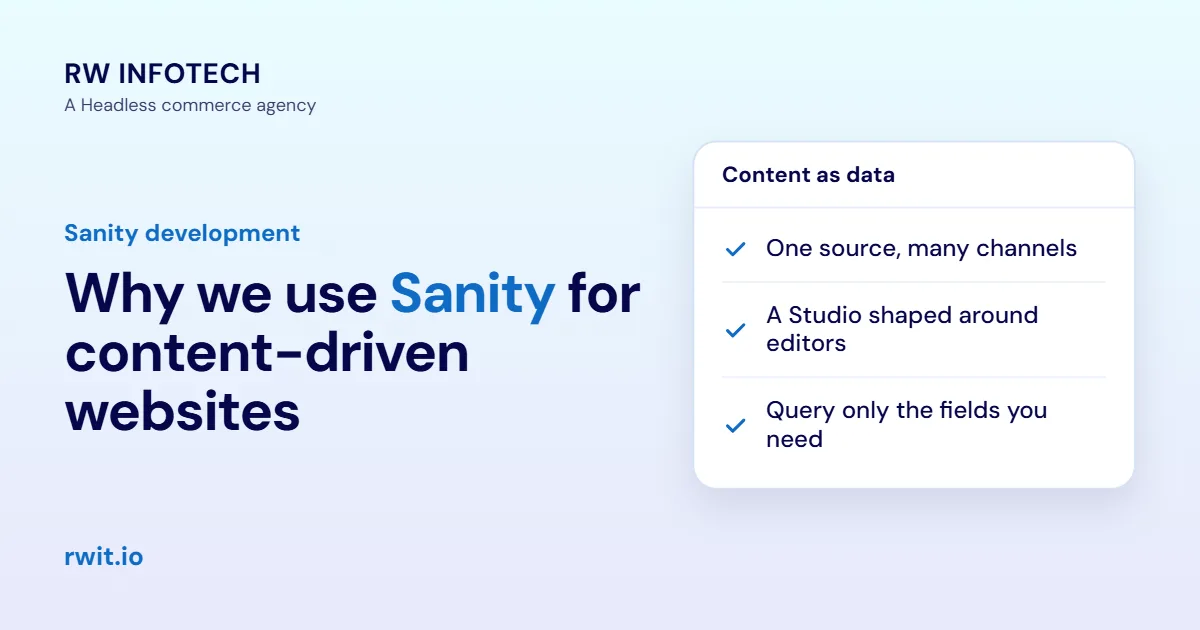
Traditional CMS platforms tend to tie content to page layouts. Sanity treats content as structured data. A product, an author or an article is defined once, with clear fields, and then reused wherever it is needed: the website, a mobile app, a newsletter or a storefront. That means teams stop copying and pasting the same information into many places.
Editors get a workspace built for them
Sanity's editing interface, the Studio, is customizable. We shape it around how a team actually works, with the fields, validation rules and layouts they need. Editors see a clean, focused interface instead of a general-purpose dashboard, and clear validation helps catch mistakes before anything is published. Several people can also work in the same document at the same time without overwriting each other.
Developers query exactly what they need
Sanity includes its own query language, GROQ, which lets a developer ask for specific documents and only the fields required. Smaller responses keep pages light, and the frontend code stays simple because the data already arrives in the shape the page expects.
Freedom to choose the frontend
Because Sanity is API-first, it is not tied to one frontend. We commonly pair it with Next.js for fast, scalable websites, but the same content can power other apps and channels later. This also makes it a good fit for eCommerce, where content and commerce data often live in different systems and need to work together.
Content models that grow with the business
Schemas in Sanity are written in code, so they live in version control and change in a controlled way as a project grows. Adding a new content type or field is a development task, not a risky workaround, which keeps a site maintainable over the long term.
When Sanity is not the answer
Headless is not automatically better. A small brochure site with a handful of pages and a single editor can be served perfectly well by a traditional CMS such as WordPress, and a simpler setup may cost less to build and run. We recommend Sanity when content needs to be reused across channels, when editorial workflows are complex, or when a team wants more control over performance and architecture.
Is Sanity right for your project?
The best way to find out is to look at your content, your team and your goals together. At RW Infotech, we build custom Sanity solutions for web apps and eCommerce, using AI-powered development to move faster. If you are weighing a headless CMS, you can learn more at https://www.rwit.io/technologies/sanity or book a consultation at https://www.rwit.io.