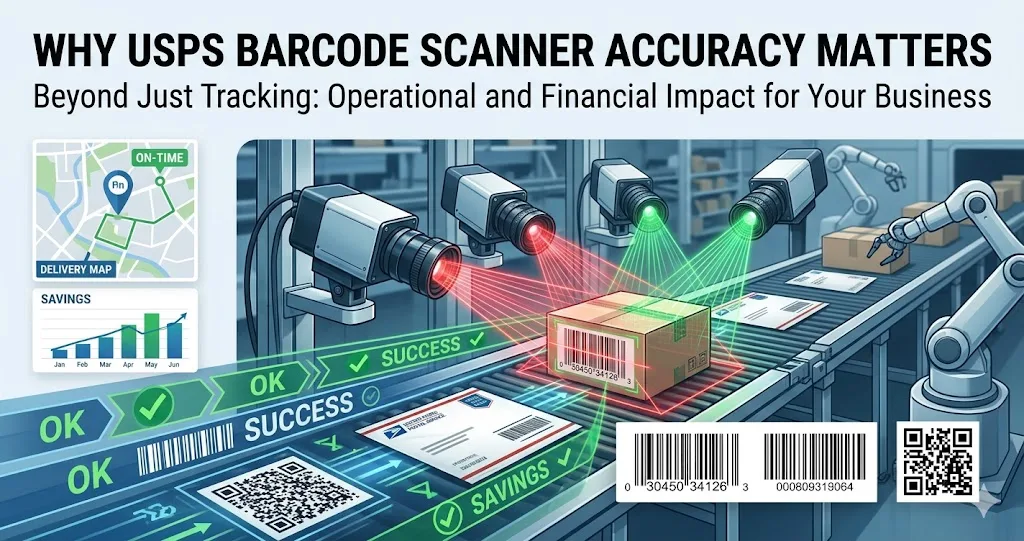
Each day, hundreds of millions of mail pieces move through the United States postal network. This process relies on a complex technology layer that many businesses overlook until issues arise. USPS barcode scanners play a critical role by converting printed barcodes into tracking data, routing decisions, and delivery confirmations. When scanner performance declines, the resulting impact extends well beyond delayed deliveries.
For businesses that rely on physical mail for fulfillment, compliance documentation, direct mail campaigns, or returns processing, understanding postal barcode scanning accuracy is essential. It is fundamental to maintaining reliable operations.
How Postal Barcode Scanning Works at Scale
Understanding the environment is important before addressing the problem. USPS sorting facilities process mail at high speeds, using automated equipment to read barcodes on items moving faster than manual inspection allows.
The Intelligent Mail Barcode (IMb) is the standard used across USPS mail today. It encodes routing codes, service type identifiers, and mailer information in a single linear barcode. Optical readers mounted on sorting machines scan these barcodes as mail passes through at high velocity, feeding data into USPS tracking and workflow automation systems in near real-time.
Accuracy in this environment depends on more than just scanner hardware. Print quality, substrate characteristics, environmental conditions, and database consistency must all align for successful scanning.
Common Accuracy Challenges in Postal Barcode Scanning
Scanning failures and misreads occur more often than many organizations realize and usually stem from predictable sources. Identifying these issues is the first step toward effective quality control.
Print Quality Degradation
Inadequate print quality is a leading cause of scan failure. Postal barcodes require consistent ink density, sharp edges, and precise quiet zones. Poorly calibrated printers can produce voids, bleeding, or low contrast, increasing the risk of misreads.
This is especially relevant for high-volume mail operations using continuous inkjet or thermal transfer printing. Minor fluctuations in print head performance can reduce barcode quality below USPS Mailpiece Design standards.
Organizations using document collaboration tools and print-on-demand workflows should integrate barcode verification checkpoints into their output pipelines, rather than treating verification as a post-production step.
Substrate and Surface Variability
The surface on which a barcode is printed significantly affects scan performance. Glossy or coated stock can scatter light and interfere with optical readers. Recycled materials with uneven textures introduce noise, while patterned envelope interiors, common in security mailers, can create false bar artifacts during high-speed scanning.
Mailers using business process optimization tools for high-volume printing should document approved substrate specifications as part of their quality protocols. This is a straightforward but often overlooked control measure.
Environmental and Handling Conditions
Before reaching a postal facility scanner, a mail piece may be folded, stacked, mechanically extracted, or exposed to moisture. Each interaction can compromise barcode legibility.
Inkjet-printed barcodes are especially vulnerable to humidity and smearing before the ink cures. In fulfillment environments, reduced drying time increases the risk of scan errors.
Warehouse and mailing operations teams using resource planning systems should include drying time and handling protocols in production schedules to reduce preventable scan failures.
Database and Encoding Errors
A barcode may be physically correct but still fail if the encoded information is incorrect. Transposition errors, malformed service type identifiers, or duplicated IMb serial numbers are encoding issues that scanners cannot resolve.
USPS rules prohibit reusing IMb serial numbers within a 45-day period for the same mail class. Organizations producing large volumes of barcodes need robust management systems to track serial numbers and ensure compliance.
The Business Impact of Scan Failures
Scan accuracy affects more than technical operations. It impacts customer experience, operational efficiency, and regulatory compliance.
Failure Type Business Impact Unreadable barcode at entry facility Piece rerouted manually; delayed delivery and tracking gap Misread routing code Mail delivered to incorrect destination or returned Encoding error in bulk mailing Entire presort sequence may fail USPS acceptance Duplicate serial number Tracking data conflicts; audit trail unreliable Low-contrast barcode on return label Customer returns unprocessed; disputes increaseFor organizations managing direct mail campaigns or compliance-sensitive workflows, even a small percentage of scan failures can result in significant financial and reputational costs. Investing in barcode quality management is justified when these downstream costs are considered.
Best Practices for Improving Postal Barcode Accuracy
Improving scan accuracy requires a combination of hardware standards, process design, and quality verification. The following recommendations reflect widely accepted industry practices.
Implement In-Line Barcode Verification
Instead of relying on spot-check audits, organizations should use in-line verification equipment to assess every printed barcode before mailing. Barcode verifiers grade symbols against ISO/IEC standards and provide quality scores to identify barcodes likely to fail scanning.
Integrating verification data into workflow management enables production teams to address quality issues in real time, rather than after acceptance.
Standardize Print Specifications and Substrate Selection
Mailing operations should maintain documented print specifications that define acceptable contrast ratios, bar-width tolerances, quiet-zone dimensions, and approved substrate types. These specifications should be linked to procurement processes to prevent unapproved materials from entering production.
Teams using enterprise productivity tools for vendor management can formalize these requirements as procurement rules or supplier qualifications, reducing the risk of substrate-related scan failures before production.
Audit Encoding Workflows Regularly
Encoding errors are systemic and will persist until the underlying data process is corrected. Regular audits of address hygiene, service type assignment, and serial number management are essential for high-volume mailers.
Organizations using modern collaboration tools and shared databases for mailing data management are better positioned to detect encoding anomalies before barcodes are generated.
Leverage USPS Feedback Data
USPS provides scan rate and address quality data through tools like the Mailer Scorecard in the Business Customer Gateway. This data reveals scan-failure patterns at the facility level, providing operations teams with actionable insights into quality issues.
Incorporating this feedback into regular business process reviews, along with other operational metrics, transforms postal performance data into a tool for continuous improvement rather than reactive troubleshooting.
A Note on Automated Sorting and the Tolerance Threshold
USPS automated sorting equipment is designed to tolerate minor print degradation within set limits. However, cumulative factors such as low contrast, marginal substrates, aging equipment, and humidity can collectively cause a barcode to fail, even if no single issue is apparent.
Effective quality management treats the postal barcode scanning workflow as a complete system rather than isolated variables.
ConclusionPostal barcode scanning accuracy often goes unnoticed until problems arise, by which time the costs have already been incurred. For businesses that rely on the mail stream for revenue, compliance, or customer communication, a structured approach to barcode quality is a sound investment in operational resilience.
Barcode accuracy should be managed as part of a comprehensive quality workflow that includes encoding, production, verification, and continuous improvement. As mail operations become more data-driven and integrated with enterprise systems, organizations that manage barcode quality systematically will consistently outperform those that do not.
While postal infrastructure is one of the oldest logistical systems in modern commerce, its accuracy requirements for businesses remain current and demanding.