Introduction
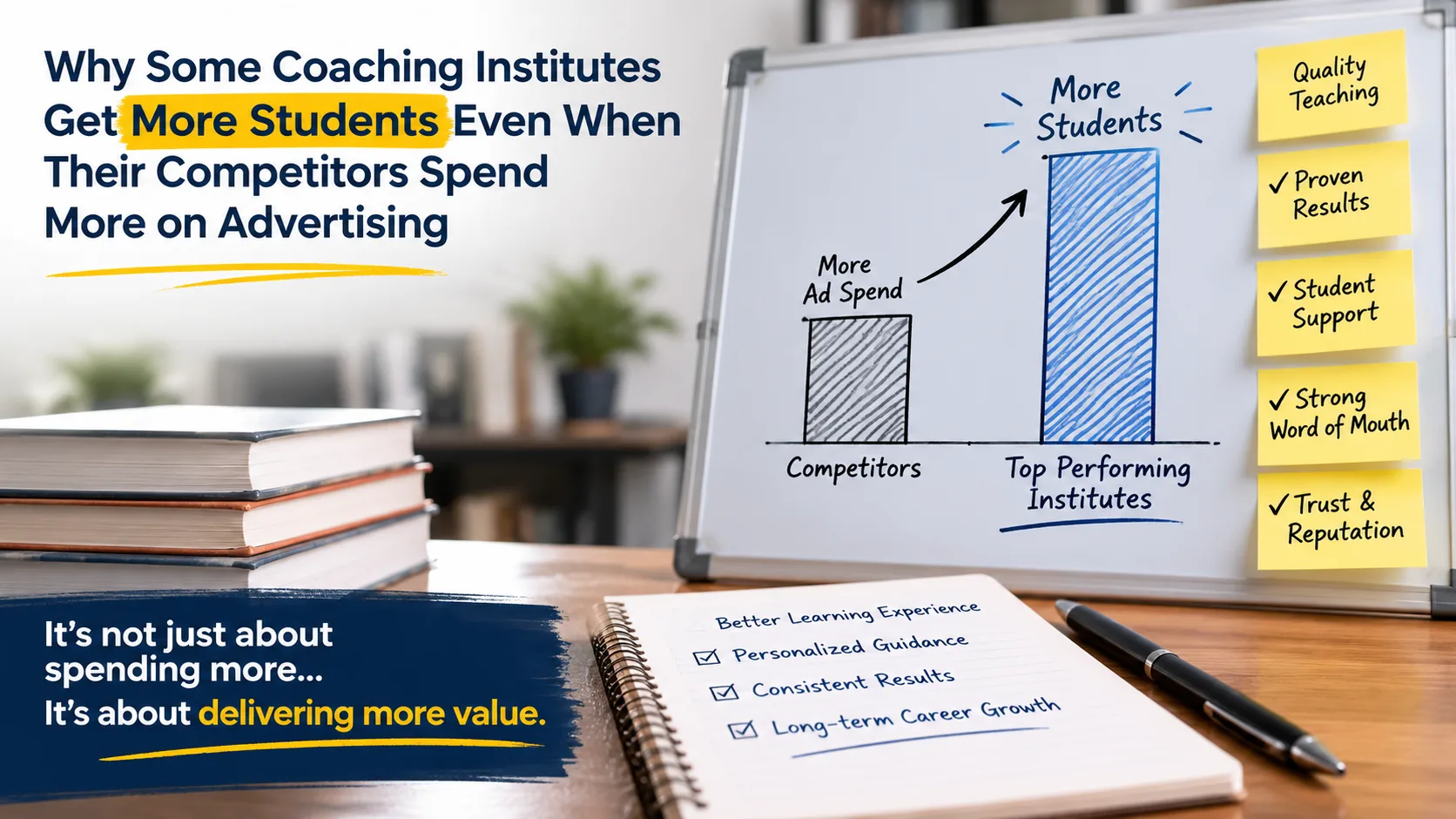
Two coaching institutes can operate in the same city, offer similar courses, and target the same students, yet one may receive far more inquiries and admissions than the other.
The difference is not always the size of the advertising budget.
Today, students and parents research coaching institutes online before making a decision. They search for courses, faculty, fees, results, reviews, study material, locations, and success stories.
This is why a strong digital presence has become an important part of coaching institute marketing company strategies.
The institutes that understand how students search, compare, and choose a coaching program can often build stronger visibility without depending entirely on expensive advertising.
What Do Students Look for Before Joining a Coaching Institute?
Before joining a coaching center, students usually want answers to practical questions.
They may search for:
- Best coaching institute for a particular exam
- Coaching fees
- Faculty experience
- Previous student results
- Course duration
- Online and offline classes
- Study material
- Batch timings
- Test series
- Student reviews
- Location
- Admission process
A coaching institute that provides clear answers to these questions can make the decision easier for prospective students.
Why Digital Marketing Matters for Coaching Institutes
Traditional marketing still has value, but students now spend a large amount of time online.
They discover coaching institutes through:
- Google Search
- YouTube
- Educational websites
- Online reviews
- Search advertisements
- Recommendations and social media
This has made digital marketing for coaching institutes an important way to reach students at different stages of their decision-making journey.
A good digital strategy does not simply promote a course. It provides useful information and builds trust before asking students to enroll.
1. Build a Website That Students Can Understand
A coaching institute's website should answer important questions quickly.
Students should be able to find:
- Courses
- Exam preparation programs
- Faculty details
- Fees
- Batch timings
- Results
- Study material
- Testimonials
- Contact information
- Admission details
The website should also work well on mobile devices because many students browse coaching websites using smartphones.
A slow or confusing website can cause potential students to leave before making an inquiry.
2. Use SEO to Reach Students Searching on Google
Imagine a student searches:
“best JEE coaching institute in Delhi”
or
“NEET coaching classes near me.”
If your institute does not appear among the relevant results, another coaching center may get that student's attention.
SEO for coaching institutes can help improve visibility for searches related to courses, examinations, locations, and educational questions.
Useful SEO content can include:
- Course pages
- Exam preparation guides
- Subject resources
- Faculty pages
- Admission information
- Frequently asked questions
- Success stories
- Educational blogs
The goal should be to attract students who are genuinely interested in the courses offered.
3. Create Content Students Actually Want to Read
Not every blog needs to promote your coaching institute.
Students are often searching for useful information.
For example:
Exam Preparation
- How to Prepare for JEE Effectively
- Common NEET Preparation Mistakes
- How to Create a Study Timetable
- How to Improve Mathematics Preparation
- How to Prepare for Competitive Exams
Course Selection
- How to Choose the Right Coaching Institute
- Online vs Offline Coaching: Which Is Better?
- What Should Students Check Before Joining a Coaching Class?
Career Guidance
- Career Options After Class 12
- How to Choose the Right Competitive Exam
- Popular Career Paths for Science Students
Helpful content can bring students to your website before they are ready to enroll.
4. Don't Underestimate Social Media
Students spend considerable time on social platforms.
For coaching institutes, social media marketing for coaching institutes can be used to showcase useful and engaging content.
Examples include:
- Short study tips
- Exam updates
- Faculty videos
- Student achievements
- Motivational content
- Quiz questions
- Classroom moments
- Exam preparation tips
- Student testimonials
- Important announcements
The content should feel useful rather than like a constant advertisement.
5. Use Video to Build Familiarity
A student may hesitate to contact an unfamiliar coaching institute.
Videos can reduce that hesitation.
Coaching institutes can create:
- Faculty introduction videos
- Short concept explanations
- Student interviews
- Campus tours
- Exam strategy videos
- Doubt-solving sessions
- Success stories
- Classroom videos
YouTube can be particularly useful because students actively use the platform for educational searches.
6. Make Student Results More Meaningful
Many coaching institutes display lists of successful students.
But simply showing numbers may not tell the complete story.
A better approach is to share genuine student journeys.
For example:
Where the student started → Challenges faced → Preparation approach → Support received → Final result
Authentic stories can help prospective students understand the learning experience.
Institutes should avoid exaggerated or misleading claims because trust is extremely important in education marketing.
7. Use Google Ads When Immediate Visibility Is Needed
SEO takes time.
Paid advertising can provide faster visibility for important courses and admission campaigns.
Google Ads for coaching institutes can be used for searches related to:
- JEE coaching
- NEET coaching
- UPSC coaching
- Banking exams
- SSC preparation
- CAT preparation
- IELTS coaching
- Other competitive examinations
However, paid traffic should lead to relevant landing pages.
If an advertisement promotes a specific course, the landing page should clearly explain that course rather than sending visitors to a generic homepage.
8. Focus on Student Lead Generation
Website visitors are valuable, but inquiries are more meaningful.
Student lead generation can be improved through simple conversion opportunities such as:
- Free counseling
- Demo classes
- Free study material
- Course brochures
- Scholarship tests
- Free webinars
- Doubt sessions
- Trial classes
The form should ask for only the information genuinely required.
A complicated form can discourage students from submitting an inquiry.
9. Don't Ignore Local Marketing
Many coaching institutes attract students from a specific city or region.
Local visibility can therefore make a major difference.
For example, a coaching center may target searches such as:
- JEE coaching in Jaipur
- NEET coaching in Kota
- UPSC coaching in Delhi
- SSC coaching in Lucknow
Local SEO, Google Business Profile optimization, reviews, location pages, and relevant local content can support this strategy.
10. Build Trust Before Asking for Admission
Students and parents want to know whether a coaching institute can actually deliver what it promises.
Useful trust signals include:
- Genuine student reviews
- Faculty profiles
- Course details
- Transparent fee information
- Real classroom photographs
- Student achievements
- Study resources
- Academic events
- Testimonials
Trust should be built consistently across the website and social media channels.
11. Connect Marketing With the Admission Team
Generating inquiries is only part of the process.
What happens after someone fills out a form is equally important.
A potential student may submit an inquiry and then wait for a response.
If the coaching institute responds quickly, provides useful information, and understands the student's needs, the chance of continuing the conversation can improve.
This is where admission lead generation and lead nurturing become important.
Marketing and the counseling team should work together rather than operating separately.
12. What Makes a Good Coaching Institute Marketing Strategy?
A successful strategy usually combines several channels rather than relying on one platform.
A simple approach can look like this:
SEO → Organic Traffic
Social Media → Engagement
Google Ads → Immediate Visibility
Content → Trust
Landing Pages → Inquiries
Counseling → Admissions
Each channel has a different role.
The strongest results often come when these channels support one another.
How to Choose a Coaching Institute Marketing Partner
If an institute decides to work with a coaching institute marketing company, it should look for more than attractive promises.
A suitable marketing partner should understand:
- Student search behavior
- Education marketing
- SEO
- Social media marketing
- Paid advertising
- Lead generation
- Landing pages
- Content marketing
- Lead nurturing
- Admission campaigns
It is also important to ask how performance will be measured.
Traffic and social media followers can be useful indicators, but qualified inquiries, counseling appointments, and admissions are usually more meaningful business outcomes.
Final Thoughts
Getting more students is not always about spending more money on advertisements.
A coaching institute needs to be visible where students search, provide useful information, demonstrate genuine results, and make it easy for interested students to take the next step.
A combination of digital marketing for coaching institutes, SEO, social media, content, Google Ads, video marketing, and lead generation can create a stronger and more consistent student acquisition journey.
The most successful coaching brands understand a simple principle:
Students do not want to be marketed to all the time. They want useful information, guidance, proof, and a reason to trust an institute.
When marketing provides those things, visibility can turn into inquiries—and inquiries can turn into admissions.