
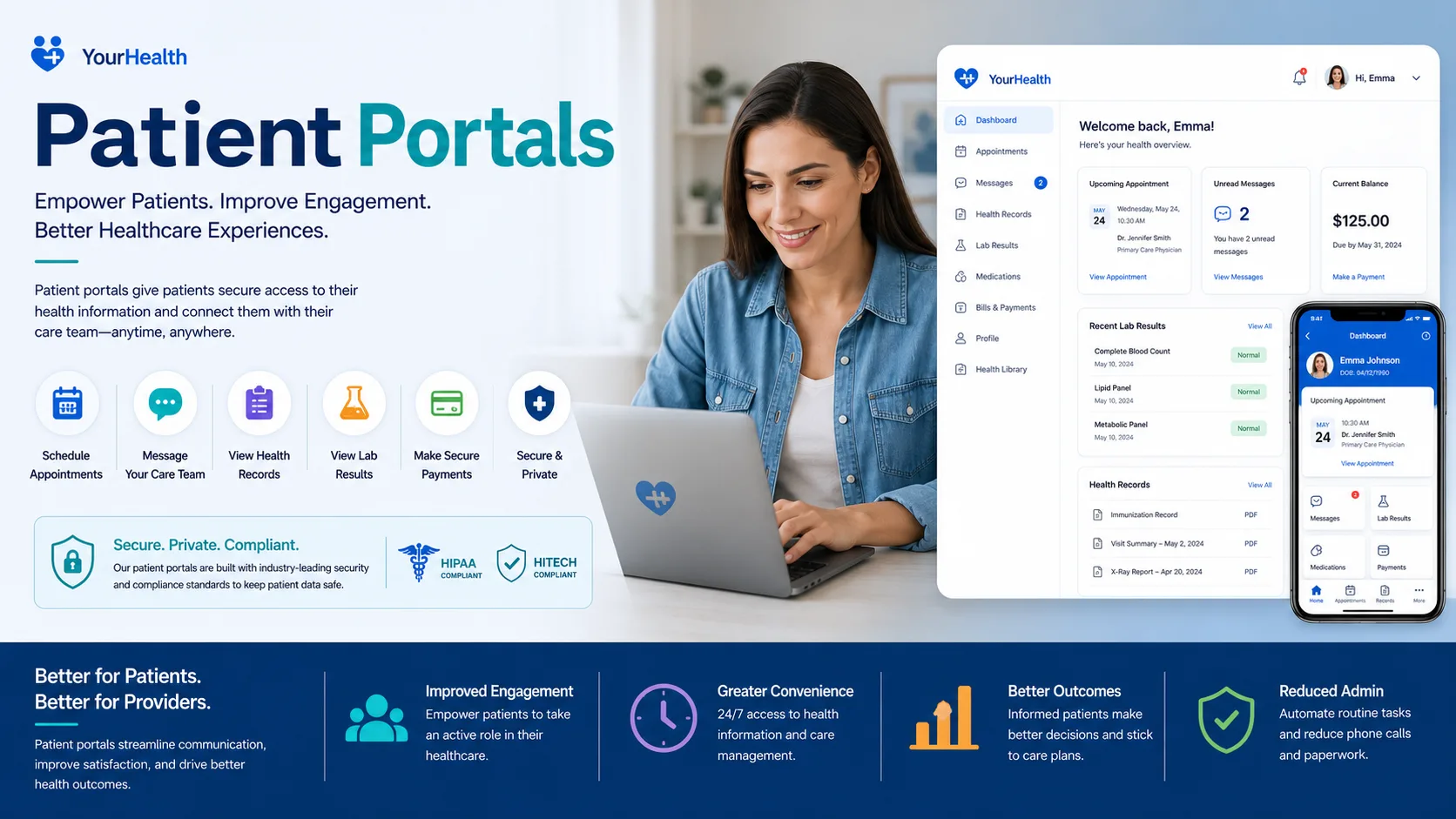
The healthcare industry is evolving rapidly as digital technologies reshape how patients interact with healthcare providers. Today, patients expect convenient access to medical services, health records, appointments, prescriptions, and communication channels without relying solely on in-person visits or phone calls. Healthcare organizations are responding to these expectations by investing in digital platforms that improve accessibility while simplifying clinical and administrative workflows.
One of the most valuable digital healthcare solutions is the patient portal. These secure platforms allow patients to take an active role in managing their healthcare while helping providers deliver more efficient and personalized services. As hospitals and clinics continue their digital transformation, Patient Portals have become an essential part of modern healthcare delivery by improving communication, increasing patient engagement, and streamlining healthcare operations.
The Growing Need for Digital Healthcare
Healthcare providers are managing larger patient populations while facing increasing expectations for faster and more personalized care. Traditional methods of scheduling appointments, sharing reports, and answering routine patient inquiries often create unnecessary delays and administrative burdens.
To address these challenges, many healthcare organizations are implementing Patient Portals that provide secure digital access to healthcare information and services. These platforms reduce manual processes while making healthcare more convenient for patients and providers alike.
Changing Patient Expectations
Patients today expect healthcare to be as convenient as online banking or shopping. They want to schedule appointments, review medical records, communicate with physicians, and access prescriptions anytime through secure digital platforms.
Supporting Healthcare Providers
Digital portals reduce repetitive administrative work by automating routine tasks such as appointment scheduling, prescription refill requests, and patient notifications. This allows healthcare professionals to spend more time delivering quality care.
Improving Patient Engagement
Patient engagement is one of the most important factors influencing treatment success. Patients who actively participate in managing their health are more likely to follow treatment plans, attend follow-up appointments, and maintain healthier lifestyles.
Healthcare organizations using Patient Portals encourage patients to stay informed by providing direct access to healthcare information and personalized communication tools.
Easy Access to Medical Information
Patients can securely view laboratory reports, treatment plans, prescriptions, vaccination history, and physician recommendations whenever needed. Easy access to this information improves understanding and encourages proactive healthcare management.
Better Communication
Secure messaging allows patients to communicate with healthcare providers without unnecessary clinic visits. They can ask questions, request prescription renewals, and receive treatment instructions through a protected communication channel.
Enhancing Healthcare Delivery
Patient portals improve not only patient experiences but also the efficiency of healthcare organizations. Digital access to healthcare services simplifies workflows while reducing paperwork and administrative delays.
Healthcare providers benefit from faster information sharing, improved care coordination, and better patient communication.
Streamlined Appointment Scheduling
Patients can book appointments online, choose available time slots, receive automated reminders, and reschedule visits if necessary. This reduces missed appointments and improves scheduling efficiency.
Faster Access to Healthcare Services
Digital platforms reduce waiting times by allowing patients to complete registration forms, upload medical documents, and access consultation information before their appointments.
Essential Features of Modern Patient Portals
A successful patient portal should provide secure, user-friendly features that improve both patient experiences and healthcare operations.
Modern Patient Portals combine healthcare management, communication, and administrative services into one integrated platform.
Medical Record Access
Patients can securely access health records, laboratory reports, diagnostic results, consultation summaries, and vaccination history from one centralized location.
Prescription Management
Patients can review medications, request prescription refills, and receive notifications when physicians approve renewal requests.
Online Payments
Integrated payment gateways allow patients to securely pay consultation fees, diagnostic charges, and hospital bills using multiple payment methods.
Health Notifications
Automatic reminders for appointments, medications, preventive screenings, and vaccinations help patients stay on track with their healthcare plans.
Integration with Healthcare Systems
Patient portals provide greater value when integrated with existing healthcare software. Connected systems improve efficiency while ensuring accurate information is available across departments.
Healthcare organizations benefit from centralized information and reduced duplicate data entry.
Electronic Health Record Integration
Professional Patient Portals integrate with Electronic Health Records (EHR) and Electronic Medical Records (EMR), allowing physicians and patients to access updated healthcare information from one secure platform.
Hospital Management System Integration
Integration with Hospital Management Systems synchronizes patient registration, appointments, billing, laboratory reports, and administrative operations, creating a seamless healthcare experience.
Security and Data Protection
Healthcare organizations manage highly confidential patient information, making security a top priority for every patient portal.
Strong cybersecurity practices help protect sensitive healthcare data while maintaining patient trust.
Secure Authentication
Multi-factor authentication and role-based access control ensure only authorized users can access medical information.
Data Encryption
Professional Patient Portals use advanced encryption technologies to secure patient records, messages, prescriptions, and healthcare documents during both storage and transmission.
Future of Patient Portals
Patient portals will continue evolving with Artificial Intelligence (AI), cloud computing, wearable healthcare devices, predictive analytics, and telemedicine integration. These technologies will make healthcare more personalized, proactive, and connected.
Future Patient Portals will include AI-powered health assistants, personalized wellness recommendations, wearable device integration, remote patient monitoring, voice-enabled navigation, automated appointment scheduling, and seamless telemedicine connectivity. These innovations will improve patient engagement while enabling healthcare providers to deliver smarter and more efficient care.
Conclusion
As healthcare continues its digital transformation, patient portals have become an essential tool for improving communication, accessibility, and patient engagement. By providing secure access to appointments, medical records, prescriptions, billing, and healthcare communication, Patient Portals support better healthcare delivery while reducing administrative burdens.
Healthcare organizations investing in modern patient portal solutions can strengthen patient relationships, improve operational efficiency, and prepare for the future of connected healthcare. Partnering with an experienced healthcare technology company like SynergyTop enables hospitals and clinics to build secure, scalable, and feature-rich patient portals that deliver exceptional patient experiences and support long-term digital growth.