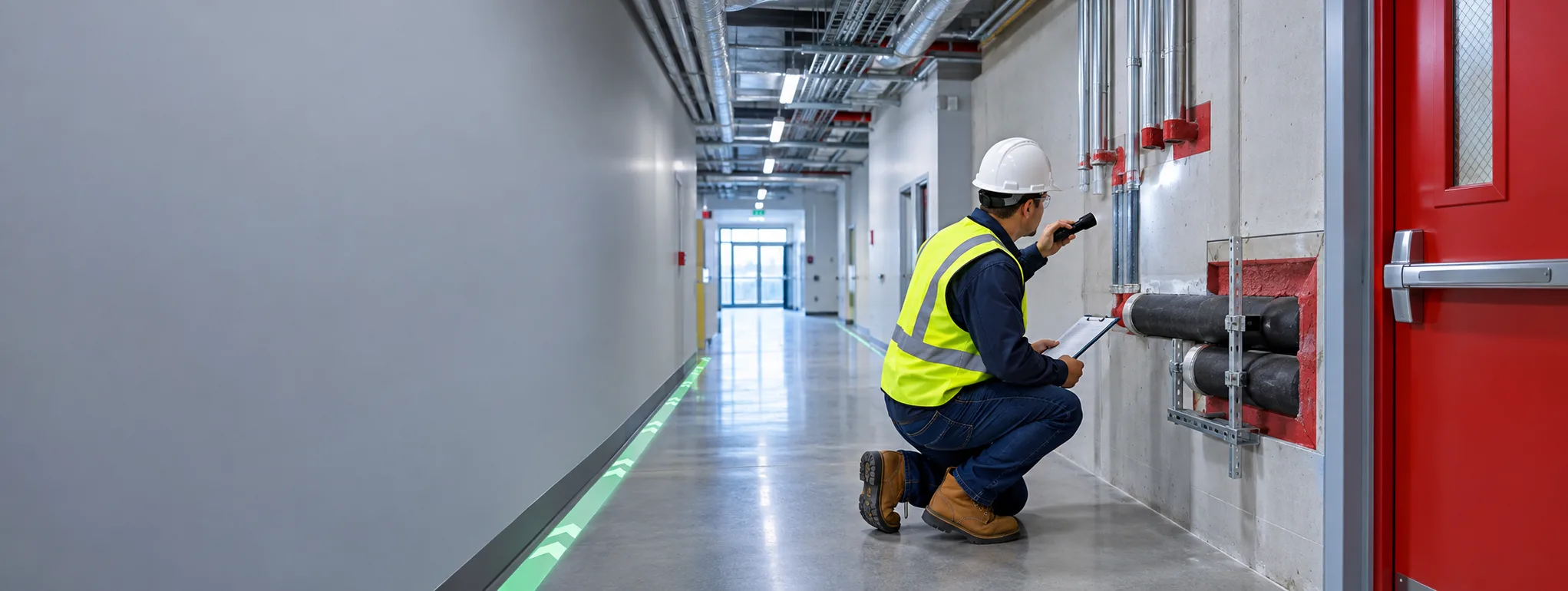
Most building owners think of fire and life safety compliance as a series of boxes to check: pass the inspection, file the paperwork, move on. In practice, compliance is closer to an ongoing system that has to be actively maintained — because every time a new tenant moves in, a cable gets run through a wall, or a space gets retrofitted, that "compliant" status can quietly slip without anyone noticing until the next inspection, or worse, until there's an actual fire.
This is where working with a dedicated fire and safety services company, rather than treating compliance as a one-off task handed to whichever general contractor happens to be on-site, makes a measurable and often underestimated difference.
Compliance Is a System, Not a One-Time Event
A fire-rated wall is only as effective as every penetration sealed within it. A barrier system only works if every violation gets identified and remediated — not just the ones flagged during the most recent walkthrough. And an evacuation plan only holds up in a real emergency if occupants can actually see the path out, even if the power has failed and smoke is filling the corridor.
Each of these — firestopping, barrier management, and egress marking — is its own discipline, governed by its own codes, its own certified system designs, and its own documentation requirements. When facilities treat "compliance" as a single line item and hand it off inconsistently across different vendors over the years, that's exactly how gaps form. A penetration gets sealed correctly during construction, then reopened for a data cable two years later and never resealed. A barrier gets surveyed once, and the paperwork never gets updated as the building changes. These aren't dramatic failures — they're slow, quiet ones, and they're the kind that inspectors (or fires) eventually find.
What a Fire and Safety Services Company Actually Covers
A company built specifically around fire and life safety typically covers several interconnected services, each addressing a different point of failure in a building's overall safety strategy.
Firestopping is the sealing of penetrations and construction joints — the gaps created every time a pipe, conduit, cable, or duct passes through a fire-rated wall or floor — using materials and methods matched to a specific UL and OPL Tested System Design. Done correctly, this restores the wall or floor's original fire-resistance rating. Done poorly, or skipped, it turns a two-hour fire barrier into little more than drywall with a hole in it.
Barrier management takes a broader view of the same problem. Rather than sealing penetrations one at a time as they're discovered, a barrier management program starts with a full-building survey, produces a documented Statement of Conditions, and then systematically remediates every noted fire and smoke barrier violation across the facility. The result is a complete, current picture of a building's barrier integrity — not just a snapshot of whatever happened to be checked last time someone walked the halls.
Perimeter and slab edge containment addresses a specific and often overlooked category of fire-spread risk: the gap between curtainwall systems and floor slabs. Fire and smoke can travel vertically through this gap from floor to floor if it isn't properly sealed, which is why this work requires its own tested system designs and installation expertise, particularly on buildings with advanced curtainwall assemblies.
Egress and evacuation systems round out the picture — because sealing a building against fire spread only helps if occupants can still find their way out. Photoluminescent exit path markings provide a power-free way to keep stairwells, handrails, and door frames visible during outages or smoke conditions, meeting code requirements that have been incorporated into the IBC.
General contracting and construction management ties these disciplines together on active projects, ensuring that facility upgrades and safety improvements are executed without compromising the life-safety systems already in place — a common risk when unrelated trades work in a building without full context on what's behind the walls.
Why Documentation Matters as Much as the Work Itself
The physical work of sealing a penetration, surveying a barrier, or installing exit markings is only half of what actually protects a facility. The other half is proof: a record of exactly what was done, where it was done, when it was completed, and which tested system design was used.
This documentation isn't paperwork for its own sake. Facilities that can produce clear records on demand move through code inspections faster, resolve disputes over who's responsible for a given violation more easily, and — most importantly — can catch degrading conditions before they become active violations. A logged penetration seal with a location, install date, and system design gives facility managers something to check against the next time a trade opens that same wall. Without that record, every new inspection effectively starts from zero.
This is also where full-building surveys pay for themselves. A Statement of Conditions isn't just a compliance artifact; it's a baseline. Every subsequent change to the building can be measured against it, which makes ongoing maintenance far more manageable than repeatedly starting from an unknown state.
The Cost of Treating Safety as an Afterthought
It's worth being direct about what's at stake when fire and life safety work is treated as a low-priority add-on rather than a core discipline. In healthcare facilities, where patients may not be able to self-evacuate, every minute of contained fire spread directly affects how much time staff have to move people to safety. In multi-tenant commercial buildings, an unsealed penetration on one floor can become the reason a fire that started in a mechanical room reaches occupied space on another. In government and institutional buildings, failed inspections can mean lost funding, delayed occupancy, or regulatory penalties.
None of these outcomes require negligence to occur. They typically result from exactly the kind of slow, incremental gap-forming described earlier — work done correctly once, then quietly compromised over years of unrelated changes to the building.
Choosing a Partner, Not Just a Contractor
Facilities — particularly healthcare, education, and government buildings, where occupant safety margins are tightest and regulatory scrutiny is highest — benefit from working with a company that treats fire and life safety as its core specialty rather than a side offering bundled into a broader contract.
Bartkowski Strategic Contracting is one such fire and safety services company, providing firestopping, barrier management, slab edge and perimeter containment, photoluminescent exit path marking installation, and general contracting for healthcare, education, commercial, and government facilities. The company's project experience spans Loyola University Health Center, Edward Hines VA Hospital, and multiple GSA federal facilities, reflecting the kind of high-stakes, compliance-heavy environments where this specialized approach matters most.
The Bottom Line
Compliance isn't a certificate a building earns once and keeps forever — it's a condition that has to be actively maintained against the ordinary wear and change every occupied building goes through. Firestopping, barrier management, perimeter containment, and egress marking each address a different piece of that ongoing responsibility, and each requires its own expertise to get right.
Choosing a dedicated fire and safety partner, rather than distributing this work piecemeal across unrelated trades, is what keeps a building's safety strategy intact — not just on the day of the inspection, but every day in between.